






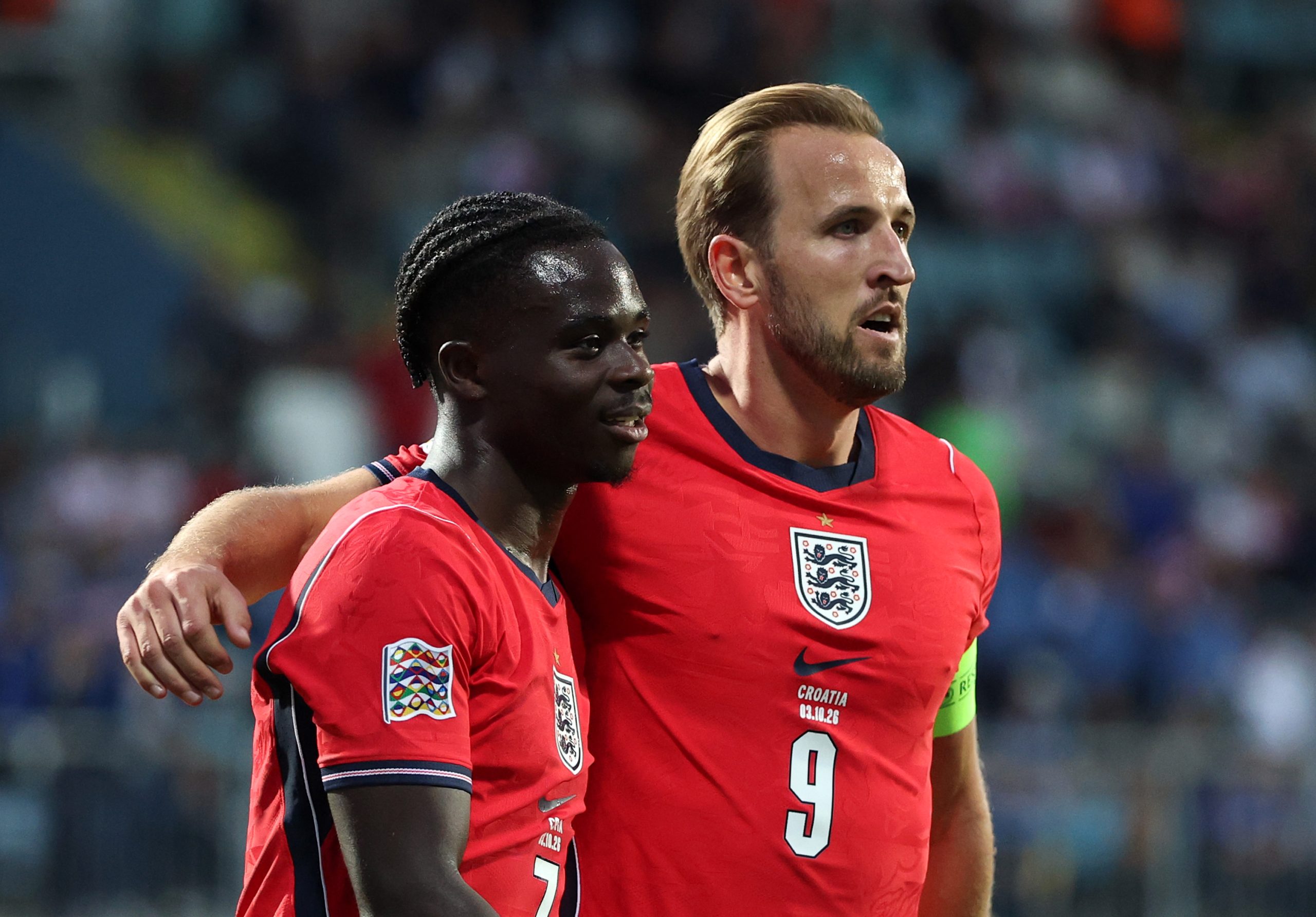
There are nights in football that feel less like a match and more like a confession—a moment when a team bares its soul and the opponent is left helpless, exposed, and utterly overwhelmed. Saturday night in Rijeka was exactly that kind of night for England, as Thomas Tuchel’s side produced a performance of breathtaking ruthlessness to crush Croatia 7-0 in the Nations League. It was a result that will be remembered not just for the scoreline, but for the sheer, unrelenting quality of the football. Harry Kane and Bukayo Saka each scored twice, adding their names to a scoreboard that already gleamed with contributions from Jude Bellingham, Anthony Gordon, and substitute Morgan Rogers. For Croatia, it was a humbling experience in front of their own supporters, a night when their famous midfield guile and defensive resilience simply evaporated under the weight of England’s pace, movement, and clinical finishing. For England, it was a statement of intent—a reminder that under Tuchel, this team is not just talented, but terrifyingly efficient. Kane, a Ballon d’Or contender, extended his national record to 89 international goals, and yet even that remarkable milestone felt like just one part of a collective masterpiece. The visitors were fluid from the first whistle, cutting through Croatia’s lines with the kind of ease that makes football look like art, and by the end, the home side were simply chasing shadows.
The opening exchanges set the tone for everything that followed. England did not wait to feel their way into the game; they attacked with purpose and conviction from the very first minute. In the eighth minute, Kane produced a moment of pure striker’s genius. Bellingham, as he so often does, found space in a crowded midfield and slipped a pass into Kane’s path. The England captain controlled the ball with the outside of his right foot, a touch so delicate and deliberate that it seemed to slow time, before curling a shot into the top left corner. It was the kind of goal that leaves goalkeepers motionless and defenders wondering what they could possibly have done differently. Croatia barely had time to regroup before England struck again. Midway through the first half, Gordon surged down the left and delivered a cross that Bellingham, arriving with perfect timing, poked in from close range. The celebrations were emphatic, but England were far from finished. Gordon himself got on the scoresheet soon after, stooping to head in a right-wing cross from Jarell Quansah, and when Saka side-footed home England’s fourth just before halftime, the game was effectively over as a contest. Tuchel later described the performance with the calm satisfaction of a coach who had seen his vision realised on the pitch. “It was very impressive, and we created so many chances,” he said. “In the first 40 minutes we were so fluid right from the start. It just never stopped. We just kept the pace up and played through the gaps. We were very, very clinical.” Those words captured the essence of the performance: relentless, intelligent, and utterly decisive.
If the first half was a warning, the second half was a demolition. Croatia emerged after the break hoping to salvage some pride, but England’s appetite for goals had not diminished. A quick break caught the home defense horribly out of position, and Elliot Anderson curled in a cross from the right that Kane met at the back post, sliding in with the instinct of a poacher who knows exactly where the ball will land. It was a goal that owed everything to movement and anticipation, and it pushed Kane’s international tally even further into the record books. But England were not done. More poor defending saw Croatia fail to clear the ball inside their own box, and Kane, ever the opportunist, gifted Saka his second goal in the 68th minute. The Arsenal winger made no mistake, finishing with composure to add another layer of gloss to the scoreline. Then came the moment that completed the rout. Rogers, introduced as a substitute, controlled a pass from Bellingham with his heel—a touch of audacity that drew gasps from the crowd—before slotting the ball in from an angle. It was a goal that summed up England’s entire evening: inventive, fearless, and utterly clinical. The 7-0 scoreline eclipsed England’s previous highest victory over Croatia, a 5-1 win in World Cup qualifying at Wembley in 2009, and it moved Tuchel’s side onto six points from their first three Nations League games. For the traveling fans, it was a night to cherish; for the neutrals, it was a reminder of just how exhilarating international football can be when one team finds its rhythm and refuses to let go.
For Croatia, this was a painful evening that will invite difficult questions. Coach Slaven Bilić had already watched his side suffer a 4-1 defeat in Spain just days earlier, and this result compounded a growing sense of crisis. Twelve goals conceded in three matches is a staggering statistic for a nation that has prided itself on defensive organisation and midfield control for over a decade. The sight of Luka Modric, still gliding across the pitch at 41 years old, looking frustrated and helpless was a poignant one. Modric has been the heartbeat of Croatian football for so long, the player who could slow the game down or accelerate it at will, but against England he was often bypassed, overrun, and left to watch as wave after wave of white shirts surged forward. There is no shame in losing to a team as talented as England, but the manner of the defeat—the lack of resistance, the repeated defensive lapses, the inability to hold onto the ball for any meaningful period—will sting for a long time. Bilić now faces the unenviable task of rebuilding confidence in a squad that suddenly looks fragile. The Nations League may not carry the weight of a World Cup or European Championship, but for Croatia, these results matter. They reveal deeper problems, and the clock is ticking before competitive fixtures resume. For Modric, who has given so much to his national team, the frustration was written all over his face. He has seen Croatia beat England in major tournaments, has lifted trophies and silenced critics, but on Saturday he looked like a man watching an era slip away.
For England, the victory was more than just three points; it was a declaration of intent. Tuchel has been in charge for only a short time, but his influence is already visible in the way this team presses, moves, and attacks with a shared understanding. The players spoke afterwards about the freedom they felt on the pitch, and Kane articulated it perfectly: “We’re at our best when we’re free, when we’re physically just overpowering. They couldn’t live with our pace, our movement, our runs.” That sense of liberation was evident in every pass, every run, every goal. Bellingham was at the heart of it all, dictating play and creating chances with a maturity that belies his age. Gordon was a constant threat on the left, his energy and directness causing chaos. Saka, as he so often does for club and country, delivered moments of brilliance while making the difficult look routine. And Kane, the record-breaker, led the line with the intelligence and ruthlessness that have made him one of the greatest strikers of his generation. His 89 international goals are a testament to longevity, consistency, and an insatiable hunger for scoring. But perhaps the most encouraging aspect of the night was the balance of the team. England did not rely on one moment of individual magic; they overwhelmed Croatia as a collective, with goals coming from all areas of the pitch. Tuchel’s side now sit comfortably at the top of their Nations League group with six points from three games, and while there is still work to be done, the signs are hugely promising. This was a performance that will make the rest of Europe sit up and take notice.
Elsewhere in the Nations League, the night had its own subplots. World Cup champions Spain hosted Czechia in Oviedo, looking to extend an extraordinary unbeaten run to 40 straight games. Spain have become the benchmark for international football in recent years, and their pursuit of another record was a reminder of the standards they have set. In League B, Switzerland faced Slovenia and Scotland traveled to North Macedonia, with both matches offering their own dramas and storylines. But it was England’s demolition of Croatia that dominated the conversation, a result so emphatic that it felt less like a football match and more like a statement of power. For the players, the coaches, and the fans, it was a night to remember. For Croatia, it was a night to forget. Football can be cruel, but it can also be beautiful, and on Saturday in Rijeka, England showed just how beautiful it can be when everything clicks. The goals, the assists, the movement, the passion—it all came together in a performance that will be talked about for years. And as the players walked off the pitch, exhausted but exhilarated, they knew they had done something special. The Nations League group stage is far from over, but England have sent a message: they are ready, they are confident, and they are capable of beating anyone. For the rest of the world, that is a warning. For England fans, it is hope. And for the game itself, it was a reminder of why we love it so much.