




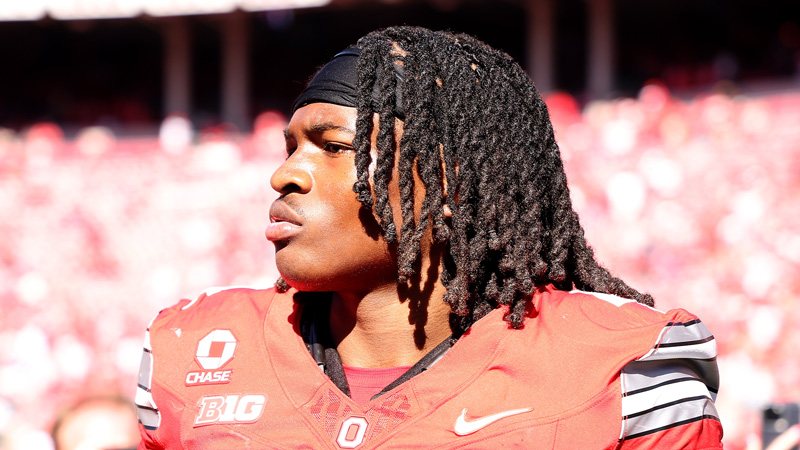
When a coach with nearly three decades of experience is searching for the right words to describe an opposing player, the comparisons he reaches for carry significant weight. Iowa Hawkeyes head coach Kirk Ferentz, the longest-tenured coach in the Football Bowl Subdivision, found himself in precisely that position this week while preparing his undefeated team to face the No. 5-ranked Ohio State Buckeyes. The player in question is Jeremiah Smith, Ohio State’s extraordinary junior wide receiver, who has been so dominant that he is forcing even the most seasoned defensive minds to reach deep into their memory banks for suitable historical parallels. Ferentz, who has been leading the Hawkeyes since 1997 and has seen countless generational talents pass through the Big Ten, ultimately settled on two very different but equally telling comparisons: Saquon Barkley, the Philadelphia Eagles’ record-breaking running back, and Randy Moss, the Hall of Fame wide receiver whose name is synonymous with unmatched athletic supremacy. These are not casual references; they are the gold standards of physical dominance and game-altering ability, and Ferentz’s willingness to invoke them speaks volumes about the unique challenge Smith presents on the gridiron.
When asked specifically about Smith’s physical impact and style of play, Ferentz’s mind immediately drifted to Penn State’s Saquon Barkley, particularly the unforgettable performances Barkley delivered against Iowa in 2016 and 2017. Ferentz described the 2017 game, a 21-19 Nittany Lions’ victory, as one of the most impressive individual performances he has ever witnessed. Barkley rushed for a career-high 211 yards on 7.5 yards per carry while also adding 12 receptions for 94 yards, nearly willing his team to victory on their own. What stood out to Ferentz was not just the raw statistics, but the sheer resilience and toughness Barkley displayed after taking a ferocious hit that seemed to knock him out of the contest. Yet, Barkley returned to the field just a few plays later, refusing to be sidelined. Ferentz sees that same blend of otherworldly athletic ability and relentless toughness in Smith, a player who, like Barkley, operates at a different level than the rest of the athletes on the field. Barkley, who was a two-time Big Ten Offensive Player of the Year and a top-two NFL Draft pick, ultimately achieved national stardom by rushing for 2,000 yards in 2024 and winning a Super Bowl with the Eagles, and Ferentz is seeing the same trajectory of greatness in the young receiver from Ohio State, recognizing the rare quality of a player who can dominate a game through pure will and physicality. This comparison is about more than just production; it is about the intangible aura of a player who makes game-changing plays look routine while absorbing punishment that would sink lesser competitors. Barkley’s 2017 game against Iowa was a clinic in resilience, and Ferentz’s implication is clear: Smith possesses that same indomitable spirit, a quality that makes him dangerous even when defensive plans are executed perfectly.
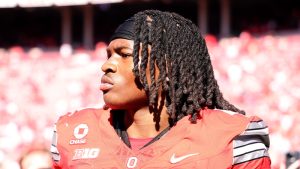
For Smith, whose frame stands at an imposing 6-foot-4, the accolades are starting to pile up at a dizzying rate. He enters the contest coming off the finest statistical performance of his already storied college career: a 12-reception, 217-yard, four-touchdown outburst against Illinois that showcased every facet of his game. Those numbers, all career highs, are merely the latest chapter in a season where he has totaled 33 receptions for a nation-leading 617 yards and seven touchdowns, leading the Big Ten in receiving yards for the second consecutive year. His efficiency is stunning; he averages over 16 yards per reception for his entire collegiate career, a testament to his ability to generate explosive plays. Currently, Smith holds the record for the most receiving yards in Ohio State history and has 201 career receptions, needing just a handful more to surpass Emeka Egbuka as the program’s all-time leader in that category. More importantly, his 34 career touchdown receptions place him just two behind Chris Olave on the Buckeyes’ all-time scoring list, a record he is expected to shatter in the near future. These are not just numbers; they are the legacy of a player who has arrived at college football’s highest level and immediately established himself as the most dominant wide receiver in the nation. He is averaging more than 150 yards per game, a staggering figure that underscores how integral he is to the Buckeyes’ offensive attack. In a program that has produced a veritable factory of NFL-ready wide receivers, Smith is quickly proving to be the best of them all, a player who has consistently raised the bar since stepping foot on campus in Columbus.
Ferentz, however, was not finished with his historical references. He conceded that despite his defense’s impressive numbers—leading the Big Ten in scoring defense while allowing just eight points per game—there is only so much a team can do to slow down a talent like Smith. The Iowa coach recalled a memory from the late 2000s when he was observing training camp with the New England Patriots and saw future Hall of Famer Randy Moss make a play in the red zone that defied logic. Even though the defensive back had perfect coverage, Moss simply went up and made the catch anyway, prompting the secondary coach sitting next to Ferentz to shrug with a look of helpless resignation. Ferentz sees that exact same phenomenon in Smith, particularly when reviewing film from two years ago when Iowa faced Ohio State. On several plays, Smith was perfectly defended, yet he still found a way to make the reception, a skill that separates Hall of Fame-caliber players from the merely elite. Moss, a 6-foot-4, first-ballot Hall of Famer whose name is etched in the NFL record books with 156 touchdown receptions and the second-highest total in league history, was the ultimate game-breaker of his era. By drawing this comparison, Ferentz is placing Smith in the most rarified air imaginable, acknowledging that the Buckeyes’ receiver has that same uncanny ability to win 50-50 balls and turn contested catches into explosive plays. It is a strategic admission of the challenge his defense faces, but also a genuine tribute to a player whose talent is so obvious that it transcends team allegiances. The coach’s message was clear: you can scheme against him, you can double-team him, you can position your defenders perfectly, but sometimes the great ones simply refuse to be stopped.
The memory of that 2024 matchup between Iowa and Ohio State offers a glimmer of hope for Hawkeyes fans, although it comes with significant caveats. In that game, Smith was held to just four receptions, but those four catches went for 89 yards and a touchdown in what was ultimately a 35-7 Buckeyes blowout in Columbus. It was not that Iowa successfully contained him; rather, Ohio State simply did not need to force the ball to him to secure victory. Now, with the game set for Saturday afternoon in Iowa City, the dynamics are completely different. Iowa, riding high after a dramatic 4-0 start that included a last-second, walk-off touchdown pass from quarterback Hank Brown to receiver Reece Vander Zee to beat Michigan on the road, will need to find a way to disrupt Smith’s rhythm. The Hawkeyes’ defense, allowing just 87.8 rushing yards and 152 passing yards per game, has been stout, but it has not faced a receiving threat of Smith’s caliber. Ohio State, meanwhile, has been nearly flawless, averaging over 50 points per game in its wins over Ball State, Kent State, and Illinois. Their lone blemish was a second-half collapse against Texas, where they blew a 20-point lead, a lapse they are eager to correct. The historical context should give Iowa some confidence, as they annihilated the Buckeyes 55-24 in that same Iowa City stadium in 2017, the last time they hosted Ohio State. However, the 2017 edition of the Buckeyes did not have a player like Jeremiah Smith in their arsenal. This time around, the Hawkeyes will have to find a way to neutralize not just a great player, but a game-changer who has already cemented his status as one of the most dangerous weapons in all of college football. The ultimate challenge, as Ferentz aptly put it, is to try to make Smith play a little off his rhythm, but as the coach conceded with a knowing sigh, that is far easier said than done.