




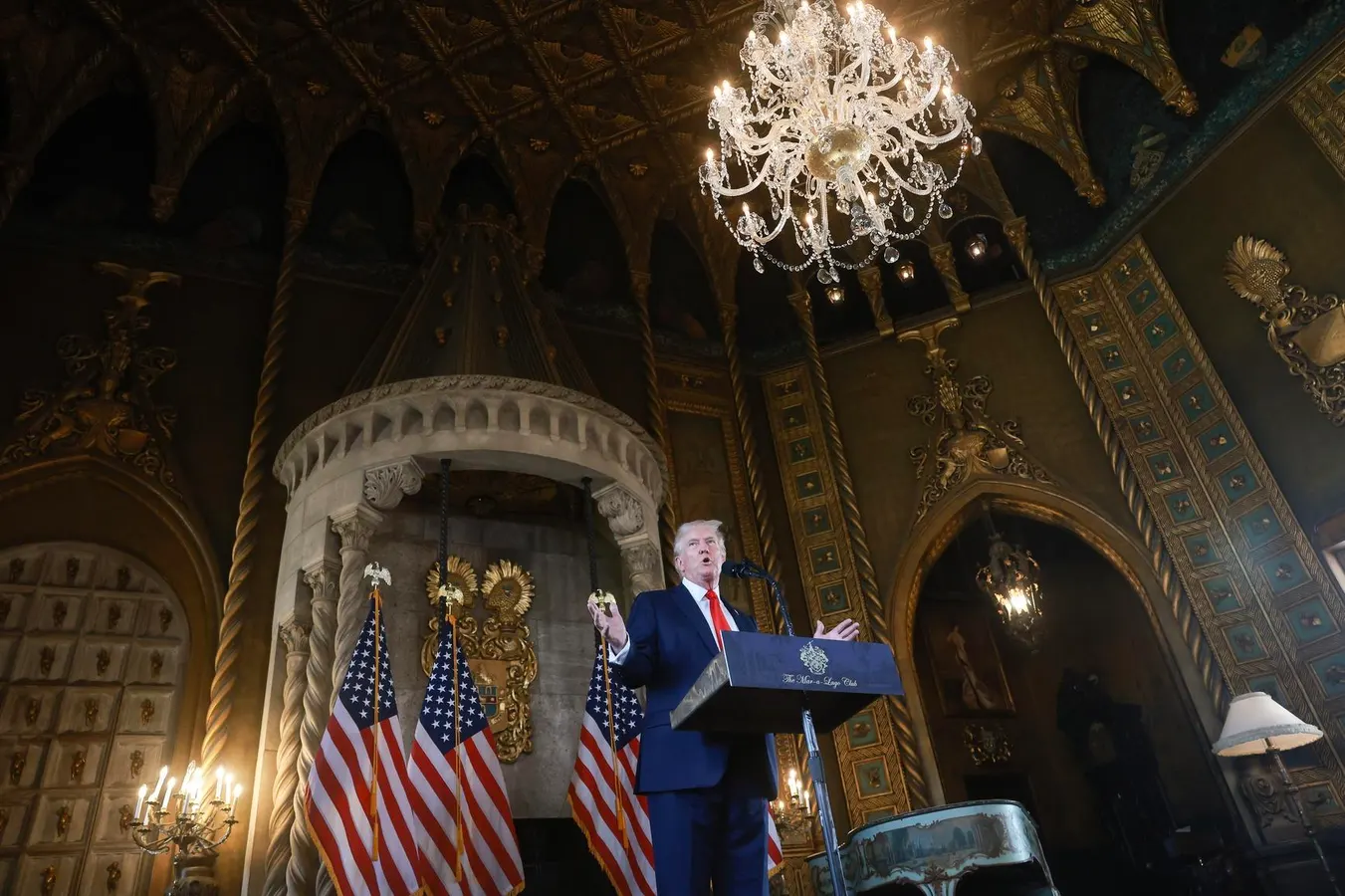
In late April, as geopolitical tensions flared in the Middle East and everyday Americans grappled with the stinging realities of rising grocery bills and soaring gas prices, Donald Trump boarded Air Force One for his twenty-sixth trip to Palm Beach of his second term. Yet, the primary purpose of this journey was not a high-level security briefing or a summit on inflation; instead, the president was traveling to Mar-a-Lago to host an exclusive private gathering for nearly three hundred high-rolling investors of his personal memecoin. This digital asset, which lacked any traditional intrinsic value, had already padded Trump’s personal coffers by an astonishing $635 million during his first year back in office, and the evening was designed to reward its top buyers with access to a glittering roster of celebrity guests, including tech billionaire Tim Draper, investment guru Cathie Wood, and legendary boxer Mike Tyson. The true center of gravity, however, was the president himself, who held court in a grand ballroom dripping with gold ornamentation, crystal chandeliers, and customized merchandise emblazoned with the Trump name. Guests were treated to goodie bags filled with superhero-themed digital trading cards, golden statuettes of the president, and signature MAGA-red wristwatches. On stage, Bill Zanker, the promoter behind this lucrative merchandise bazaar, delighted the crowd with an illuminating anecdote about receiving a midnight phone call from a sleepless president who wanted to personally redesign the typography of the watch’s logo. This seemingly trivial interaction exposed a profound and enduring truth about Donald Trump: despite years of public assurances to the contrary, the commander-in-chief remains deeply, intimately, and transactionally involved in the day-to-day operations of his sprawling commercial empire.
This hands-on management style directly contradicts the carefully curated public narrative that Trump and his family have promoted since he first entered politics. In January 2017, just days before his first inauguration, Trump stood in Trump Tower and promised to step back entirely from his businesses, placing them into a trust managed by his adult sons, Eric and Donald Jr., alongside a longtime financial officer who would later be incarcerated for tax fraud. At the time, Eric Trump solemnly proclaimed a “clear separation of church and state,” swearing that he would never discuss business operations with his father. However, the reality on the ground told a vastly different story of constant, obsessive executive oversight. During his first term, Trump spent hundreds of days at his own golf clubs and resorts, where the line between his role as a paying customer and his status as the active proprietor completely evaporated. Former employees recall Trump constantly scanning his properties with a hawk-like gaze, once pointing out a faint soda stain on a carpet to his general manager with an expectation of immediate resolution. On his Virginia golf course, he would repeatedly solicit opinions about landscaping until he found someone who agreed with his desire to cut down specific trees, expecting the work to be completed before his next visit. Most telling of all, during a speakerphone call from his Virginia driving range, Trump reportedly unleashed a torrent of creative expletives at his son Eric and his managers for spending millions on sand bunkers in Bedminster, New Jersey, while simultaneously vetoing a proposed short-game practice area in Virginia because he personally deemed it “not worth the money.”
When his first term ended and he returned to private life, free from even the nominal constraints of the presidency, Trump lost no time in aggressively expanding his commercial footprint and embracing highly lucrative digital frontiers. Just one week after leaving the White House, he hosted former contestants from The Apprentice at Mar-a-Lago over plates of cheeseburgers and ice cream to sketch out the blueprints for what would eventually become Trump Media and Technology Group, the parent company of Truth Social, which now boasts a multi-billion-dollar market capitalization. Soon after, Bill Zanker approached him with a proposal to license Trump’s likeness for digital trading cards, or non-fungible tokens (NFTs). Though Trump had previously dismissed cryptocurrency as an asset based on “thin air,” his instinct for an easy, high-margin transaction prevailed over his intellectual skepticism. On the eve of the launch, ignoring the warnings of his political advisers who feared the project would look like a cheap gimmick and constitute “political suicide,” Trump personally reviewed the cartoonish designs of himself depicted as a superhero and a hunter, enthusiastically declaring, “Let’s do it.” The digital cards sold out in less than twenty-four hours, bringing in $4 million and paving the way for a barrage of subsequent product lines, including branded sneakers, fragrances, and a family-run crypto platform called World Liberty Financial, ultimately funneling an estimated $1.4 billion in cryptocurrency and licensing fees directly to Trump during the opening year of his second term.
As Trump settled back into the Oval Office, any lingering pretense of maintaining ethical boundaries between public service and private enrichment was completely abandoned. The internal compliance mechanisms that had offered a thin veneer of propriety during his first term were dismantled, highlighted by Trump publicly demanding the firing of his organization’s long-term ethics counsel via a social media post after the attorney took on an unrelated legal case. Secure in his power, the president embarked on his first major overseas trip of his second term, choosing not to visit traditional democratic allies but rather to tour the wealthy monarchies of the Middle East, where his company had quietly secured a portfolio of highly lucrative, state-aligned real estate deals. In Riyadh, Saudi officials and local business developers explicitly appealed to Trump’s identity as a luxury builder, leading to a massive development deal in which the president retained an eighty percent personal stake. In Qatar, Trump met directly with executives of the state’s sovereign wealth fund and its real estate arm, capitalizing on a luxury development deal that yielded him millions in licensing fees. In Abu Dhabi, shell companies acting on Trump’s behalf quietly secured additional luxury branding rights, prompting seasoned international diplomats to characterize the official state visits as an unprecedented, transparent exercise in using the American presidency for personal financial gain.
This blatant fusion of public diplomacy and private commercial promotion was equally visible during Trump’s high-profile excursions to his golf resorts in Scotland. While traveling in an official capacity, the president took the opportunity to host foreign dignitaries, including the British prime minister and the president of the European Commission, at his Turnberry and Aberdeenshire estates, where he proudly pointed out architectural details, window craftsmanship, and the opulence of his ballrooms as if he were actively selling them real estate. Flanked by his sons, who still officially carry the titles of executive vice presidents of the Trump Organization, the president cut ceremonial ribbons to inaugurate new golf courses with all the fanfare of an active corporate chairman. The legal reality behind this corporate theater was finally laid bare in a mandatory British regulatory filing submitted by the Trump Organization. The document, a “notice of individual person with significant control,” officially stated that President Trump retains “the right to exercise, or actually exercises, significant influence or control over the activities of the trust” that owns his Scottish properties. Because this specific trust is the very entity that holds and controls almost the entirety of Trump’s global business portfolio, the foreign filing served as a legally binding admission that the wall between the president and his business empire was, and always had been, an absolute fiction.
Ultimately, the story of Donald Trump’s dual existence as a global political leader and an active real estate mogul is a narrative of a man who views power and brand as entirely synonymous. By refusing to divest from his assets or step away from the operational decisions of his company, Trump has fundamentally redefined the modern presidency as the ultimate marketing platform for a family-owned conglomerate. Whether he is debating the design of a luxury watch logo in the middle of the night, negotiating real estate ventures with foreign sovereign wealth funds during official diplomatic tours, or micromanaging the landscaping of his golf courses from a presidential motorcade, Trump operates with the core belief that his public office is a natural extension of his private brand. For his business partners like Bill Zanker, who is already planning to hold these lucrative, high-dollar investor gatherings at Mar-a-Lago every six months, the arrangement is a commercial dream come true. For the American public, it is a stark, unprecedented demonstration of an administration where the art of statecraft and the art of the deal have become one and the same, permanently blurring the lines between public service and private profit.