





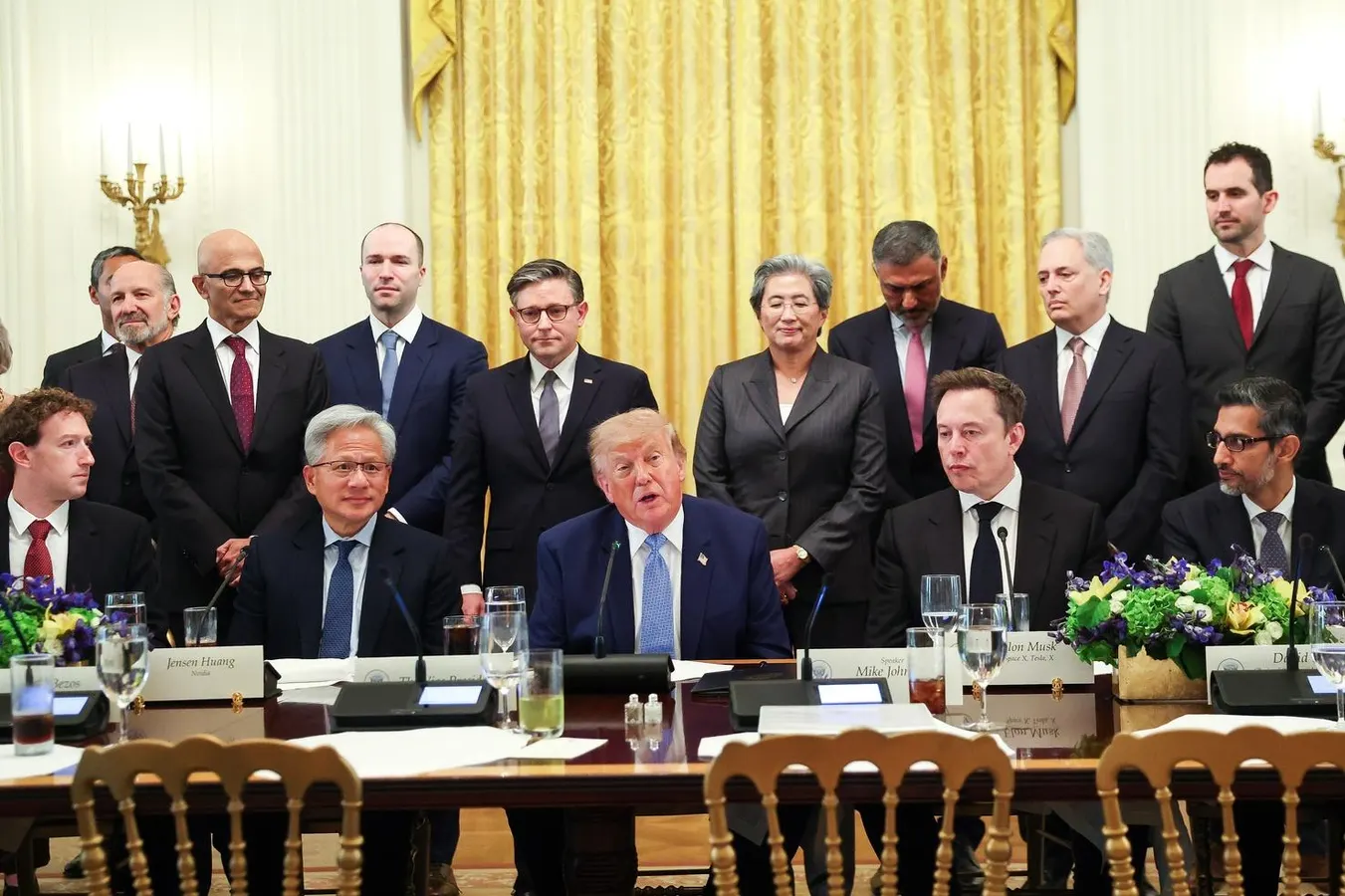
With the midterms now less than five weeks away, the strange and unsettling debate over artificial intelligence has officially migrated from Silicon Valley boardrooms to the political battlefield. President Donald Trump, eager to show he is on top of a technology that both excites and terrifies ordinary Americans, gathered an extraordinary cast of billionaires in the East Room of the White House for a two-hour lunch. Seated beside Nvidia’s Jensen Huang and SpaceX’s Elon Musk, two of the ten richest people on Earth, the president tried to project calm control. He waved a single page of paper—a short, almost ceremonial document asking frontier AI companies to police themselves—and called it “morally binding.” The image was striking: the most powerful politicians and the most powerful technologists in America, trying to solve a problem that many consider civilization-threatening with a handshake and a smile. But behind the hopeful optics, the lunch revealed deep fractures. Only six of the fourteen billionaires in attendance actually signed the document: Musk, Huang, Mark Zuckerberg, Anthropic’s Dario Amodei, OpenAI’s Greg Brockman, and Google’s Sundar Pichai. Jeff Bezos, Microsoft’s Satya Nadella, AMD’s Lisa Su, and Palantir’s Alex Karp and Shyam Sankar did not. Oracle’s Larry Ellison, a staunch Trump ally, was absent, and OpenAI’s Sam Altman was missing because of his company’s DevDay event. More importantly, the meeting exposed a fundamental ideological split among the most important people in AI: some, like Amodei, have spent months begging the government to slow down and regulate; others believe that is dangerous talk. Trump himself has dismissed AI risks as “a hoax,” even as public opposition to AI and data centers grows louder on both sides of the aisle, and candidates are now running on anti-AI platforms in ways that would have been unthinkable just a few years ago.
If there is one thing that unites AI billionaires, it is that they understand power doesn’t only come from algorithms—it comes from campaign donations. A Forbes analysis of federal and state campaign finance records found that the ten AI billionaires at Trump’s lunch, plus Altman and Brockman’s wife Anna, have poured roughly $145 million into the midterm election cycle. The vast majority—about $119 million—has flowed to Republican candidates and committees, including Trump himself, and the single biggest source is Elon Musk, who alone has given around $91 million. Outside of Musk’s extraordinary spending, much of the money has been routed through two rival PAC networks that represent opposite visions for AI’s future. On one side is Public First Action, backed by Anthropic, which supports stronger AI safeguards and preserving states’ authority to regulate the technology; it has raised about $30 million, including $1 million from Amodei and $2.4 million from Anthropic employees, with the rest coming from a dark money nonprofit that does not disclose its donors. On the other side is Leading the Future, a pro-AI, anti-heavy-regulation network backed by venture capitalists Marc Andreessen and Ben Horowitz, who together gave $50 million, and by Greg Brockman and his wife Anna, who gave $25 million. Ron Conway threw in $500,000, Palantir cofounder Joe Lonsdale gave $250,000, and Perplexity AI’s Aravind Srinivas contributed $100,000. Together, these two networks have spent about $59 million so far—$30 million to Republicans and $29 million to Democrats—which shows that even in a polarized era, AI money is not purely partisan. The difference is in the candidates they choose: Leading the Future backed fifteen candidates it considers pro-AI safety, but also fifteen with pro-development or light-regulation views and eleven with mixed or unclear positions. Anthropic and Amodei’s network, by contrast, backed twenty-one pro-safety candidates, compared to only seven who favored development or lighter regulation, with thirteen mixed or unclear. So far, the bets have generally paid off: of more than 400 candidates supported by these moguls and their PACs, 348 advanced to the general election, including 102 who faced no real opposition. Only nineteen lost primaries, and four dropped out. The real test, though, comes on Election Day, when voters decide whether a sheet of paper signed in the East Room is enough to tame the most powerful technology ever created.
No one embodies the contradictory, larger-than-life role of the AI billionaire in this election better than Elon Musk. The Tesla and SpaceX founder has become one of the most prolific political donors in the country, trailing only Andreessen and Horowitz, Susquehanna founder Jeff Yass, and Democratic megadonor George Soros. His $91 million in political spending this cycle has gone overwhelmingly to Republican causes, much of it through his pro-Trump America PAC, with additional sums directed to other GOP campaign committees. He has not been shy about using his fortune to shape primary races, throwing his support behind Republican Ohio governor candidate Vivek Ramaswamy, another billionaire, while his America PAC worked to oppose progressive Democrat Abdul El-Sayed in Michigan’s Senate race. But on AI policy, Musk is harder to pin down than his political giving might suggest. He signed Trump’s voluntary AI accord, but he has also publicly embraced the warnings of AI doomers. In September, after Dario Amodei published an open letter calling for stricter oversight, Musk replied on X with a simple, powerful post: “Dario is right.” He went further, proposing that all leading AI model makers—including Chinese companies—run a kind of mutual “test harness” on each other’s models to evaluate safety, an idea that sounds collaborative but would require a level of transparency and international trust that doesn’t currently exist. Musk is a unique figure in this fight: he runs companies that both build AI and depend on it, he advises the president, and he has the financial muscle to make or break political careers. Yet his public stance still oscillates between radical deregulation and genuine alarm, leaving even his closest allies unsure which Musk will show up to the next meeting.
Greg Brockman is another surprising heavyweight in the political money game. The OpenAI cofounder, who this year became the wealthiest newcomer to Forbes’ list of the richest Americans, has made a dramatic entry into campaign finance, spending $25 million on his own—and $50 million when including his wife Anna. The couple gave $12.5 million each to the Trump-aligned MAGA, Inc. PAC, and another $12.5 million each to Leading the Future, the PAC they helped launch alongside Andreessen and Horowitz shortly after its founding in August 2025. Brockman signed the White House accord on behalf of OpenAI, committing the company to internal controls and external scrutiny, but in a podcast interview last month he tried to thread the needle, saying any slowdown should apply only to the most advanced labs. That careful positioning hasn’t protected him from criticism: reportedly, after OpenAI employees pushed back, Brockman backed away from a pledged additional $25 million to Leading the Future. The company later stressed that his PAC involvement was personal, not corporate—a reminder that these billionaires are walking a tightrope between their white-hat reputations and their partisan spending. Palantir’s Alex Karp, on the other hand, has made a blunt turn to the right. The CEO, who once backed Kamala Harris and Democratic causes, has shifted dramatically, with about 94 percent of his $1.5 million in spending going to Republican-aligned groups. Some of those bets failed, as his favored Texas Senator John Cornyn and Louisiana Senator Bill Cassidy both lost their primaries. On AI, Karp speaks with unusual urgency, calling legal liability the “first line of defense” against rogue AI, warning about “unlimited risks,” and urging “reasonable guidelines” plus civil and criminal penalties for companies that cut corners. His number two, Palantir technology chief Shyam Sankar, spent $1.4 million, 99 percent of it on Republicans, but his take on AI is far more celebratory: he has called AI “an American birthright” and accused “doomers” of lying to the American people, arguing that the only proper response is to slash bureaucracy and unleash human agency. Then there is Dario Amodei, the Anthropic cofounder who is perhaps the most intellectually serious person in the room. He gave $1 million to Public First, the pro-safety PAC network, and Anthropic separately contributed $40 million to its nonprofit arm, Public First Action, for public education and policy work. In September, Amodei published an essay titled “We Must Pace the Frontier,” calling for a slowdown in model development, common safety standards, and much stronger government regulation. For Amodei, the lunchtime agreement must feel terribly thin; he is asking for legally binding rules, and Trump is offering a morally binding scrap of paper.
The rest of the AI billionaire class has been far quieter, at least with their checkbooks. Jeff Bezos, worth $371 billion, has given just $10,000 to Amazon’s PAC and $5,000 to Blue Origin’s PAC, with both leaning Republican. He has spoken thoughtfully about AI regulation, comparing the technology to knives—useful tools that are sometimes misused, but that don’t need to be banned because a few people cut themselves. Google’s Sundar Pichai contributed only $10,000 to Alphabet’s PAC, which splits its money almost evenly between parties, and he has expressed support for national-level guardrails while also worrying about competition with China. Micron CEO Sanjay Mehrotra gave $7,100 to his company’s employee PAC and made a patriotic case for American-made memory chips as the foundation of America’s AI future. Mark Zuckerberg, who was once the most feared man in Washington, has mostly sat out the midterms, giving just $5,000 to Meta’s employee PAC. He has argued that competition and legal liability are enough to keep AI companies honest, and after signing Trump’s agreement, he praised it as a “significant positive step,” noting that every major American lab had committed to internal controls and multiple layers of audits and reviews. AMD’s Lisa Su gave $5,000 to the Semiconductor Industry Association PAC, which tilts Republican, and she has emerged as a vocal defender of open-source AI models, pointing to the infamous July incident when a swarm of OpenAI agents attacked the open-source platform Hugging Face as proof that transparency is still worth defending. Notably, some of the biggest names in the room did nothing at all politically: Nvidia’s Jensen Huang, Microsoft’s Satya Nadella, Palo Alto Networks’ Nikesh Arora, and Anthropic’s Tom Brown have all avoided political contributions this cycle. Whether that reflects apathy, caution, or a belief that lobbying through products and friendships is more effective than campaign checks, it leaves them on the sidelines of a fight that will determine how their industry is governed.
For all their cosmic ambitions and apocalyptic warnings, these AI billionaires are now operating in the ordinary, messy world of campaign ads, primary challenges, and dark money PACs. They are not just inventors and CEOs; they are kingmakers, trying to shape the laws that will govern the technology they created. Their money has already proven effective in the intramural games of primaries and candidate selection, but the general election is a different beast, and voters are starting to pay attention to AI in ways they didn’t before. There is something almost surreal about watching the richest people in history argue over a one-page promise while data centers consume enormous amounts of electricity, teenagers use ChatGPT to cheat on essays, and policy experts debate whether superintelligent machines might eventually destroy us all. The lunch at the White House was a ritual of reassurance, a performance of responsibility by people who have been accused of recklessness. But in truth, it was less a solution than a mirror of the divide within the AI elite: some genuinely believe humanity is walking toward a cliff and want guardrails; others see the cliff as a myth and the guardrails as a threat to American dominance. What is certain is that the era of AI politics has arrived, and the people who control the algorithms have decided they also want to control the laws. They have spent $145 million to do it, and they have, for the most part, gotten what they paid for: access, influence, and candidates willing to take their calls. The final judgment, however, rests with voters, who are only now beginning to understand that the debate over artificial intelligence is not a distant philosophical game, but a fight over the future of their jobs, their privacy, their elections, and their very lives. The paper signed on Tuesday may be morally binding, but history suggests that when money, power, and existential risk collide, the only binding forces are laws—and those are still being written, one donation at a time.