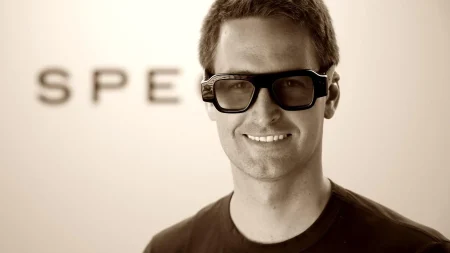







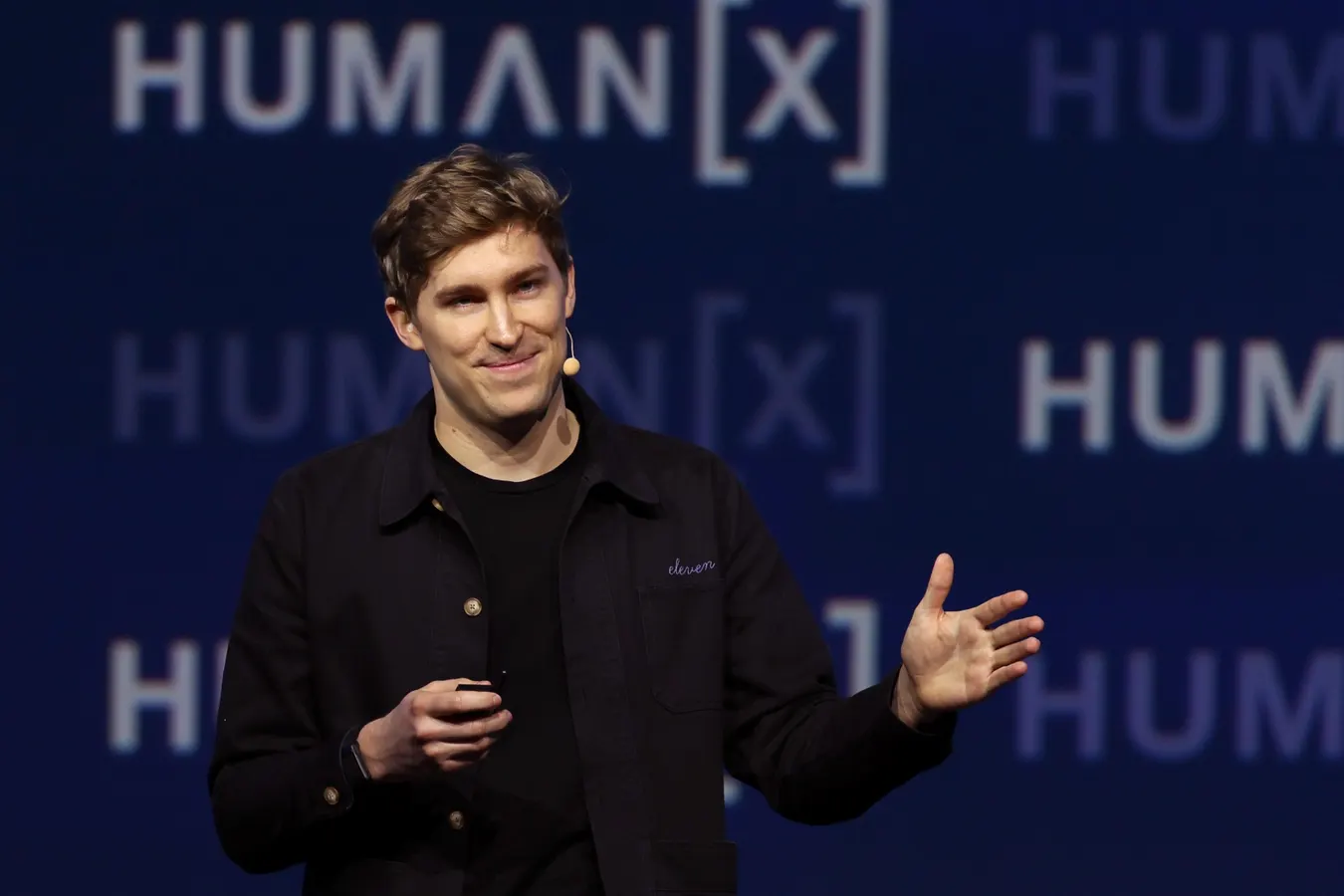
It started with badly dubbed films. In Poland, high school friends Mati Staniszewski and Piotr Dabkowski grew up watching American movies with clunky, lifeless voiceovers—an experience so jarring it planted the seed of what would become one of the most valuable AI companies in Europe. In 2022, with little more than their savings, they quit their jobs at Palantir and Google, respectively, and founded ElevenLabs to replace drab, robotic voiceovers with AI voices that could actually convey emotion. That bet has paid off in spectacular fashion. On Wednesday, ElevenLabs announced it had completed a $300 million employee share sale that doubled the company’s valuation to $22 billion. Each cofounder, holding an estimated 15% stake, is now worth $3.3 billion, up from $1.6 billion earlier this year. The startup, which has offices in New York and London, has become a key supplier of AI voice technology for businesses. Klarna and Revolut alone account for 55% of its revenue, and by December the company’s trailing 12-month revenue had reached nearly $200 million—with Forbes reporting it is likely on track to double that this year. Its AI agents now handle 15 million conversations every week. But the ElevenLabs story is not just a tale of two smart founders; it is a symbol of a broader turning point. In the past five months, a surge of megadeals and fundraising rounds has created eight new European billionaires and lifted the fortunes of six more, putting Europe firmly back in the AI race after years of anxiety about falling behind American and Chinese giants. The irony is not lost: an industry once defined by badly dubbed imports is now being remade by the founders who grew up watching them. For Staniszewski and Dabkowski, the leap from childhood frustration to corporate disruption took less than three years, and it transformed them from well-paid engineers into two of Europe’s most prominent tech billionaires. Their story captures the speed and scale of a moment in which European startups are no longer just selling to American giants—they are becoming the giants themselves.
The wave began in Berlin, not Silicon Valley. In May, n8n, a software startup that helps businesses automate workflows through more than 12,000 templates, received a strategic investment from SAP that doubled its valuation to $5.2 billion. The deal was enough to make founder and CEO Jan Oberhauser a new billionaire. According to German corporate filings, his estimated 45% stake is now worth $2.3 billion. Oberhauser, who did not respond to Forbes’ request for comment, represents a quieter kind of AI wealth: the kind built not on flashy chatbots or futuristic chips, but on the unglamorous work of making companies run more efficiently. n8n’s platform lets users connect apps and automate repetitive tasks without writing custom code from scratch—a service that has become increasingly valuable as businesses look for ways to do more with less. The SAP investment validated what Oberhauser had been building for years, and it sent a signal across Europe that strategic corporate money was ready to flow into AI infrastructure at eye-popping valuations. It also set the tone for a summer in which nearly every week brought news of another European founder becoming a billionaire overnight. For Oberhauser, who built the company in Berlin’s competitive but sometimes underappreciated tech scene, the windfall was more than personal: it showed that automation software, often dismissed as a back-office niche, could be a billion-dollar business. The deal was a sign of the times—an established enterprise giant betting on an AI-powered upstart, and an upstart founder suddenly worth more than many of the corporate executives who now wanted to partner with him. What made the moment notable was not just the valuation, but the fact that it happened outside the usual tech capitals. The money did not come from a Silicon Valley venture firm alone; it came from one of Europe’s largest companies, signaling that the continent’s industrial and enterprise base was finally waking up to the possibilities of AI.
Then came the young. In early August, 25-year-old British entrepreneur James Dacombe became Europe’s youngest self-made billionaire after raising $312 million at a $3.3 billion valuation for Olix, his fledgling chip company. Dacombe, who dropped out of high school to start his first company, owns an estimated 30% of Olix, Forbes reported. The chip industry is notoriously hard to break into, and for a founder in his twenties to command such a valuation speaks to the frenzy around AI hardware. Dacombe’s rise is not just a story about chips, however; it is also a story about how much nerve and ambition matter in an era when investors are willing to bet on youth, speed and defiance of convention. A few days later, Sweden’s Lovable closed a bumper $400 million fundraise that valued the AI-powered website app builder at more than $13.3 billion. That lifted the shareholdings of cofounders Anton Osika and Fabin Hedin to $3.1 billion each. Lovable is part of a new generation of tools that let people describe what they want in plain language and get a working application in return, effectively democratizing software creation. For Osika and Hedin, the fundraise confirmed that Europe could produce not just good engineering, but also the kind of hypergrowth that once seemed reserved for the United States. Combined, the two Swedish founders joined Dacombe in a remarkably short span of time, turning a European summer of AI dealmaking into a personal wealth-creation event for founders in their twenties and thirties. It is worth pausing to consider how quickly this happened: at the beginning of the year, none of them were billionaires; by August, they were worth billions. The valuations are dizzying, but behind each number is a founder who convinced some of the world’s most sophisticated investors that they could shape the next decade of computing.
The most stunning jump came a few days later, when another Swedish founder, Arvid Lunnemark, saw his net worth double after Elon Musk acquired Cursor, the AI coding startup Lunnemark cofounded with three friends at MIT in 2022. The takeover valued Cursor at more than $60 billion, with Lunnemark’s stake alone worth over $2.7 billion. Lunnemark, a former math olympiad champion, had already left Cursor in 2025 to launch a new startup called Integrous Research, focused on developing systems for safer AI. The Cursor deal made him one of the richest young founders in Europe—and one of the most enigmatic, since he was no longer even running the company he had cofounded. For Musk, the acquisition was a way to extend his influence over AI software development, which has become one of the most competitive corners of the industry. For Lunnemark, it was a validation of a career spent moving from pure mathematics to applied AI. The deal also underscored how important AI coding assistants have become. Tools like Cursor are essentially autocomplete for programmers, generating entire functions and files from natural-language prompts. They have turned software development from a manual craft into a collaborative process between humans and machines, and investors have poured hundreds of billions into the space. Lunnemark’s new venture, Integrous Research, suggests he is thinking about the next problem: making sure that as AI systems become more powerful, they can be trusted. It is a reminder that the same founders who are getting rich are also the ones asking the hardest questions about what happens next. The fact that this windfall came through an acquisition, rather than another fundraise, also highlighted a growing pattern: some of Europe’s most exciting AI companies are now being bought at prices that would have been unthinkable just a year ago.
Not all of the new European billionaires are household names, and not all of them are building visible products. Fluidstack, a data center startup founded in the United Kingdom, quietly closed a $1.5 billion round over the summer that valued it at over $18 billion, Forbes reported in September. The company, which projects revenue growing to $660 million this year, was based in London until it relocated to New York in December. Its cofounders—Gary Wu, 31, Jamie Cox, 29, and César Maklary, 29—are now billionaires, each worth $1 billion. Wu and Cox met while studying at Oxford before starting Fluidstack in 2017. Maklary, who previously worked in aerodynamics for a Formula One team, joined in 2020. The trio started Fluidstack as a marketplace that allowed gamers to rent out GPUs to AI researchers, an idea that seemed quirky at the time but turned out to be perfectly timed. As AI models grew larger, the demand for graphics processing units exploded, and Fluidstack evolved from a rental marketplace into a company that builds data centers across the United States, with Anthropic as one of its largest customers. The story of Fluidstack is a reminder that in the AI boom, even the most unglamorous part of the stack—plumbing, power, cooling and chips—can create enormous wealth. The fact that all three cofounders are now based in New York, after starting in London, also illustrates how European founders are increasingly moving to where the capital and customers are, while still keeping their roots in Europe’s talent pool. For Wu, Cox and Maklary, the billion-dollar mark arrived essentially without them having to seek publicity. They are the quiet billionaires of the AI boom, but their data centers are the concrete foundations on which much of the AI economy is being built.
The biggest deal of all came from France. Mistral, widely seen as Europe’s answer to OpenAI, closed a staggering new round in September, raising nearly $3.5 billion at a $24.3 billion valuation—the largest round ever raised by a European startup. The Paris-based cofounders, Arthur Mensch, a former Google DeepMind researcher, and Timothee Lacroix and Guillaume Lample, both Facebook veterans, founded Mistral in 2023 to build large language models that could compete with American AI labs and Chinese open-source models. The round pushed the value of each cofounder’s stake to $2.7 billion, up from $1.8 billion in April. Mistral has become the standard-bearer for European AI ambition, and its huge fundraise sent a message: Europe is not merely a place where talent gets trained before leaving for the United States; it is a place where billion-dollar companies can be built. Acquisitions have also created fortunes. Last month, Nvidia agreed to acquire Hugging Face, the open-source platform, for $12.9 billion. The deal made Hugging Face’s three French cofounders—Clément Delangue, Julien Chaumond and Thomas Wolf—freshly minted billionaires, each worth $1.7 billion, according to Forbes estimates. Hugging Face was founded in 2016 in New York as a playful chatbot for teenagers, but the cofounders quickly realized that the models powering the consumer app were more valuable than the app itself. Today, about 18 million developers and 200,000 companies use Hugging Face’s library of models and datasets, making it the de facto home for shared AI research. Though headquartered in New York, Hugging Face considers itself Franco-American, with most of its employees based in France. Delangue grew up in La Bassée, a small town in northern France with three siblings, while Wolf is based in London. Taken together, the summer of 2025 has been a stunning reversal of fortune for Europe’s tech ecosystem. From AI voices in Poland to automation in Germany, from Swedish app builders to Oxford data centers and French model makers, a new generation of European founders has emerged. They are not just selling to American tech giants; they are becoming competitors, partners and, in some cases, acquisition targets. The “brain drain” narrative that once haunted the continent has been complicated by a wave of megadeals that have generated eight new billionaires and boosted the fortunes of six more. Europe is no longer watching the AI race from the sidelines. Its founders are now among the people setting the pace.