


In the middle of a volatile political season at home, French President Emmanuel Macron is pushing forward with an ambitious, and potentially risky, plan to create a new European military presence in Lebanon as the United Nations peacekeeping mission there winds down. But the initiative is already running into serious headwinds. A key European ally, Italy, is reluctant to commit troops. Washington, meanwhile, is floating a lighter alternative that may not involve soldiers at all. Secretary of State Marco Rubio confirmed he had discussed the future of the United Nations Interim Force in Lebanon, known as UNIFIL, directly with Macron. Rubio suggested that the monitoring mechanism that replaces it could be civilian rather than military. “It doesn’t have to be a military mission. It could be a civilian mission,” Rubio said. The administration’s goal, he explained, is to create a credible system that can verify the delicate arrangement unfolding in southern Lebanon: Israeli forces pulling back from designated areas, the Lebanese Armed Forces moving in to take control, and the Iran-backed militant group Hezbollah being kept from returning. Rubio added that France could play a constructive role, but stressed that any new framework would have to be accepted by both Lebanon and Israel. The American position was reinforced by U.S. Ambassador to the United Nations Mike Waltz, who told Fox News Digital bluntly: “UNIFIL in its current form will not continue, and it must not continue.” Washington, he said, is already working with international partners to draw the mission down and hand responsibility to the Lebanese people and their own armed forces.
Macron’s proposal, by contrast, is far more muscular. The French vision reportedly calls for a multinational force that could eventually include thousands of European troops, deployed to support the Lebanese army once UNIFIL concludes its nearly five-decade presence. The exact size of the force, its mandate, and which countries would actually contribute personnel remain unclear. France has argued that pulling out entirely could create a dangerous security vacuum in southern Lebanon, a region with a long history of conflict and where Hezbollah remains deeply entrenched. But the plan has encountered immediate skepticism. Italy, which had earlier joined France in calling for some kind of international coalition to follow UNIFIL’s withdrawal, is not willing to put its own soldiers on the ground under the proposal that Paris has put forward, according to three sources familiar with the discussions. That is a significant blow. Italy has been one of the largest contributors to peacekeeping operations in Lebanon, and without its participation a new European force would face a steep recruitment problem. Other European capitals are also watching closely, waiting to see whether France can turn a broad idea into a concrete and credible mission, or whether Macron is overreaching at a time when his attention and resources are needed elsewhere.
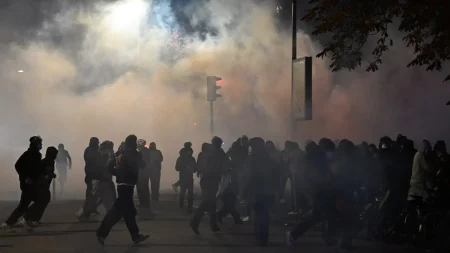
The timing could hardly be more complicated. Macron is struggling with mounting domestic crises that have left his government politically bruised and financially constrained. France has seen widespread demonstrations over rising living costs, stagnant wages, and deteriorating public services. These protests have made it even harder for his administration to push through its 2027 budget, as high public debt and deep political divisions limit room to maneuver, according to Reuters. Against that backdrop, the prospect of committing French troops to another overseas mission raises serious questions about the financial and military resources Paris can realistically spare—especially without firm backing from its European partners. Some analysts see this as a dangerous distraction. Simone Rodan-Benzaquen, senior envoy for Europe at the Foundation for Defense of Democracies, argues that replacing UNIFIL with another international military force would simply repeat the mistakes of the past. “UNIFIL’s mandate should end as scheduled,” she told Fox News Digital. “Hezbollah built up its military presence in southern Lebanon with international peacekeepers already on the ground. Keeping troops there under a new mandate would repeat an approach that failed to prevent that buildup.” Instead, she believes the foundation for a better approach already exists: the U.S.-brokered agreement that Israel and Lebanon reached in June. “France can help both sides put it into practice and move further,” she said.
The question of who would be responsible for verifying Hezbollah’s disarmament has already proven fiercely contentious. Reuters, citing Lebanese officials and foreign diplomats, reported in August that the United States and Israel had previously opposed France serving as a third-party verifier of Hezbollah’s disarmament. A Lebanese official also told Reuters that Beirut had rejected an earlier proposal involving private security companies. The core challenge is not just diplomatic, but practical. According to a Congressional Research Service assessment updated in November, Hezbollah continues to refuse disarmament, while Israeli forces maintain their positions in southern Lebanon. The framework agreement brokered by Washington in June linked a phased Israeli withdrawal to the verified disarmament of armed groups and the deployment of Lebanese forces. But implementation has stalled beyond the initial pilot areas, and negotiations in October ended without a deal. For Israel, the key requirement is credible proof that Hezbollah cannot reestablish itself in areas its troops eventually leave. For Lebanon, the concern is the opposite: that its army will move into contested areas, make commitments, and then have no guarantee that Israel’s withdrawal will follow as promised. Rodan-Benzaquen suggests France’s real leverage may not be military at all, but diplomatic. “France’s greatest leverage is notably in Beirut,” she said. The Lebanese cabinet has already outlawed Hezbollah’s military activity. Paris, she argues, should work with the Lebanese government to press the group to disarm, rather than sending more European soldiers to perform the same impossible task that UNIFIL has failed at for decades.
France has long been a key diplomatic player in Lebanon, and it has no intention of stepping away entirely. In a previous Security Council statement, the French Mission to the United Nations said: “France will support UNIFIL until the expiration of its mandate. It will contribute to defining the future international engagement in Lebanon, in support of its sovereignty and the implementation of resolution 1701.” But the international landscape around that engagement is shifting. In August 2025, the Security Council extended UNIFIL’s mandate for a final time, until December 31, 2026, and authorized an orderly withdrawal over the following year. Washington backed ending the mission amid longstanding concerns about UNIFIL’s inability to prevent Hezbollah from maintaining a military presence in southern Lebanon. The French government, by contrast, has repeatedly warned against leaving a vacuum that could trigger a new round of fighting. For now, the United Nations is watching these debates from the sidelines. U.N. spokesperson Stéphane Dujarric told Fox News Digital that Secretary-General António Guterres presented three options for a future U.N. presence in June, but the Security Council has not formally chosen any of them. Dujarric also confirmed that the United Nations is aware of discussions about a possible non-U.N. military presence in southern Lebanon, but is not directly involved in those negotiations.
Ultimately, Macron’s proposal faces a narrow and difficult path. With UNIFIL’s mandate approaching its expiration, he must secure agreement not only on which countries will contribute troops, but on what those forces would actually be allowed to do in a country where Hezbollah remains armed, Israeli troops have not yet fully withdrawn, and trust between the two sides is almost nonexistent. The problem is not a lack of interest in preventing another war; it is a lack of consensus about how to do it. Washington is skeptical of another military mission, Italy is hesitant, and France itself is financially stretched and politically fragile. Meanwhile, the people of southern Lebanon are left in a precarious position, caught between armed groups, foreign armies, and diplomatic processes that seem to move at a glacial pace. The human reality is that ordinary families in the region have endured decades of insecurity, and the failure of international mechanisms to deliver lasting peace has left many deeply wary of grand proposals that sound good on paper but produce few tangible results. Whether a civilian monitoring arrangement can work, whether a European force can actually be assembled, or whether the whole question gets postponed once again, the stakes for Lebanon are enormous. France still has influence in Beirut, and the United States has leverage with Israel. Finding a way to combine those forces effectively may be the only realistic path to a stable southern border. But as Macron is learning, good intentions and diplomatic ambition are not enough when the troops, money, and political will at home are all in short supply.