



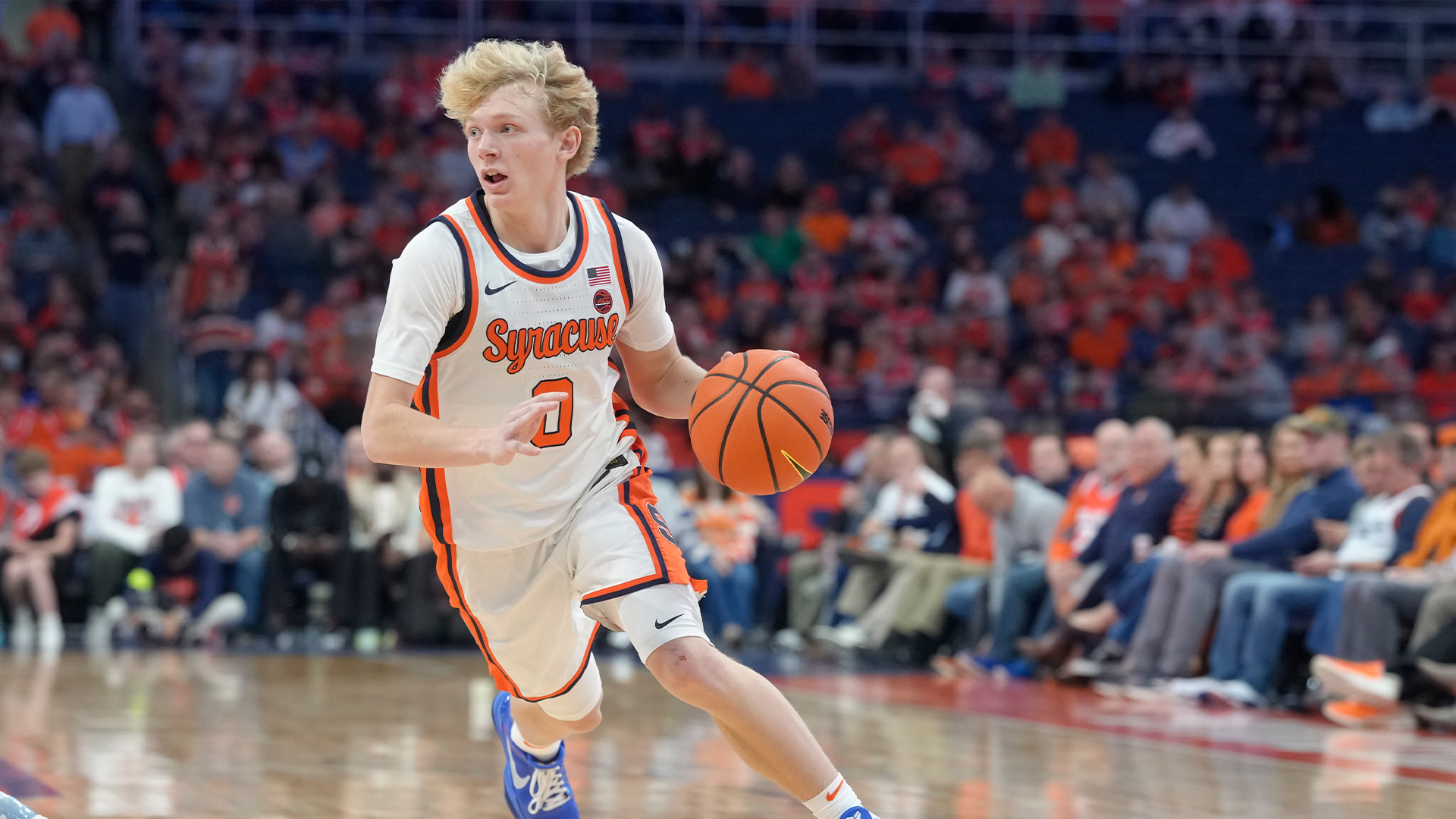
On a November Monday that looked like a harmless appetizer before the more glamorous holiday tournaments, college basketball refused to be quiet. By the end of the night, the scoreboards were full of stories: a 20-point, 20-rebound double-double, a freshman scoring record, a career-high night, and a coach facing the very team he used to lead. The closest and most dramatic game was Syracuse against Indiana. The two teams fought through the final minutes, with Indiana surviving 83–80. The real scene-stealer, though, was Syracuse freshman guard Ryan Moesch. Moesch is listed at six feet even—maybe, if the official measurement is generous. When he drove into the lane against Indiana’s 7-foot-2 center, Samet Yigitoglu, everyone in the building expected the worst. Instead, Moesch went straight at Yigitoglu, absorbed the contact, and finished. It was one play, but it explained Moesch’s entire approach. For a guard, fear of the paint can be paralyzing. There is always someone bigger waiting back there, someone whose wingspan seems to cover the entire rim. The ones who succeed are the ones who ignore that reality and trust their own quickness and instincts. Moesch has that rare mindset. He kept attacking, kept making plays, and helped keep Syracuse in the game until the very end. The Orange ultimately lost, handing head coach Gerry McNamara his first defeat in his new job. But against a solid Big Ten opponent in non-conference play, the performance was a reason for hope. A six-foot freshman who will run headfirst at a seven-footer is the kind of fearless building block a program can rally around.
If Moesch embodied fearlessness, Tatum West embodied relentless work. West is a senior forward at Northern Colorado, a program that doesn’t often get national attention, but on Monday she produced a stat line that would stand out anywhere. Against Northern New Mexico, West played only 22 minutes and still managed 24 points, 20 rebounds, two blocks, a steal, and two assists. She made nine of her twelve field goals and six of her nine free throws. Twelve of those rebounds came on the offensive end, which is especially impressive because she wasn’t cleaning up her own misses—she was shooting too well for that. She was chasing down other people’s misses, giving her team repeated chances, and generally being a nuisance under the basket. That is the kind of effort that doesn’t always make the highlight reel but absolutely changes a game. Of course, a Division I team is supposed to beat an NAIA team, and the level of competition matters. But West isn’t a one-game wonder. Last season she averaged 11.2 points and 9.1 rebounds for Northern Colorado while shooting just under 59 percent from the floor. She has improved every year she has been in college, and Monday looked like the next step in that progression. She wasn’t forcing anything; she was efficient and aggressive, moving without the ball, finding creases, and making the extra pass. One of her assists was a quick-thinking feed back outside to a teammate, the kind of unselfish touch that coaches love. In 22 minutes, she nearly averaged a point and a rebound for every minute she played. That’s the kind of production that wins conference player of the week honors. It also serves notice that Northern Colorado might be a sneaky team in the Big Sky. West is playing like someone who wants to be remembered.
The men’s scoring leader of the night was a freshman who looked like he had been here before. Jason Crowe Jr., a 6-foot-4 guard at Missouri, went off for 34 points against SIU Edwardsville. He did it with efficiency: 11-of-16 from the field, 4-of-8 from beyond the arc, 8-of-9 from the free throw line. He also added four assists and two rebounds, and he did it while setting the Missouri freshman rookie scoring record. That’s the kind of night that makes people stop and check the box score twice. Through three games, Crowe is averaging 21.7 points and 4.3 assists. Yes, it’s a small sample, and yes, his least efficient game came against the toughest opponent Missouri has faced—Saint Louis. But in that game he still dished out seven assists, which is encouraging. A lot of freshmen, when their shot stops falling, become invisible. Crowe found another way to affect the game. That’s a mature sign. It also means that when he does get hot, as he did Monday, he can be absolutely lethal. He can score from deep, get into the lane, draw fouls, and finish in traffic. He’s not a one-dimensional shooter, and the SEC will have to deal with him soon. The history of college basketball is full of freshmen who put up numbers against lesser non-conference teams and then vanished when the real schedule started. Crowe has the mentality to avoid that trap. He’s fearless, but he’s also patient. He takes what the defense gives him and doesn’t force the issue. Monday was a record-setting performance, but it might just be the opening chapter of a much longer story.
Penn State’s women’s team is off to a rough start, but Petra Božan gave the Nittany Lions something to hold on to. Božan, a 6-foot-4 junior transfer from Nebraska, scored a career-high 27 points against Dayton. She did it on 10-for-11 shooting, including five made threes on six attempts. She missed exactly one shot all game. That is a near-perfect offensive performance, the kind that leaves even opposing fans shaking their heads. The strange part is that she had only one rebound. Božan is not a conventional post player; she’s a wing in a forward’s body, and her job is to score, not to clean the glass. Monday, she was spectacular at that job. Her previous career high was 17 points, and it came last December in a game against Penn State—the same program she now plays for. College basketball can be delightfully strange that way. Unfortunately, her effort wasn’t enough. Dayton won 77–71, and Penn State is now 0–3 on the season. Božan was the reason the game was close, but a one-woman show can only do so much. The rest of the Nittany Lions need to step up, and they need to do it quickly. Still, Božan’s performance is a meaningful sign. Transfers need time to adjust to a new system, new teammates, and new expectations. Monday, she looked more than adjusted—she looked comfortable. If she can continue to create offense at that level, and if the team can start getting stops and rebounds, Penn State will eventually turn a corner. When that first win arrives, Božan’s career-high night will be the memory they point to as the start of something. It didn’t matter that the box score showed just one rebound; she was the most dangerous player on the floor, and that is exactly what Penn State needs.
Then there is Matas Vokietaitis, a name worth learning before the rest of the nation does. The Texas center is a giant at seven feet and 255 pounds, with the kind of body that makes him difficult to move under the basket. Last season, he led the SEC in field goal percentage, converting just under 62 percent of his shots. He has always been an efficient scorer when he’s on the court. The problem has been staying on the court. He led the SEC with 123 fouls last season, which meant he spent a lot of time watching from the bench. But Monday against Grambling, he showed what happens when he avoids foul trouble: 26 points on 8-of-12 shooting, nine rebounds, a block, and a steal. He controlled the paint on both ends, and he did it without constantly hearing the referee’s whistle. In two of his first three games this season, he has managed to stay out of foul trouble, which is a huge development for Texas. He’s averaging 22.3 minutes per game, but his per-40 numbers are ridiculous: 38.2 points and 13.1 rebounds. Those numbers are inflated by early-season competition, but they illustrate the leap in performance that comes when a player isn’t terrified of picking up his fifth foul. Vokietaitis has always had the talent to dominate. The question was whether he could be physical without being reckless. So far, the answer looks promising. If he keeps this up, Texas will have one of the most dangerous big men in the SEC. Opponents will have to double-team him, which will open up shots for everyone on the perimeter. On defense, he’ll alter shots and occupy space. In other words, he can be the monster everyone expected. That’s bad news for the rest of the conference and great news for Longhorns fans.
Finally, Monday included a reunion that put everything in perspective. UConn played Wagner, and the Huskies won 83–41, exactly as expected. Wagner is a tiny school with about 2,000 students, known for its academics rather than its athletics. But Wagner has a special place in college basketball history as a launching pad for coaches. One of those coaches is Dan Hurley, who led the Seahawks from 2010 to 2012 before moving on to Rhode Island and ultimately UConn, where he has become a national champion. When Hurley looked across the court Monday, he didn’t see just another opponent. He saw the place where he learned to coach with everything on the line. After the game, he described his Wagner experience with a laugh: “I felt like I was coaching the Celtics. I felt like the fate of the free world depended on whether we won or lost games or not.” It’s a great line, but it also reveals why Hurley is where he is today. He treated every game at a tiny program like the most important game of his life. That intensity has never left him. It’s the reason UConn is ranked No. 4 and remains one of the most dangerous teams in the country. It’s also a nice way to wrap up a busy Monday of college basketball. The games weren’t all pretty, and the competition wasn’t always elite. But they were full of real moments: a freshman guard attacking a seven-footer, a senior forward grabbing 20 rebounds, a record-setting scorer, a transfer having a career night, a big man staying out of foul trouble, and a coach remembering his roots. This is what makes college basketball so compelling. It’s not just about the final scores. It’s about the people who make them, and the stories behind every box score. Monday’s stories were good ones.