

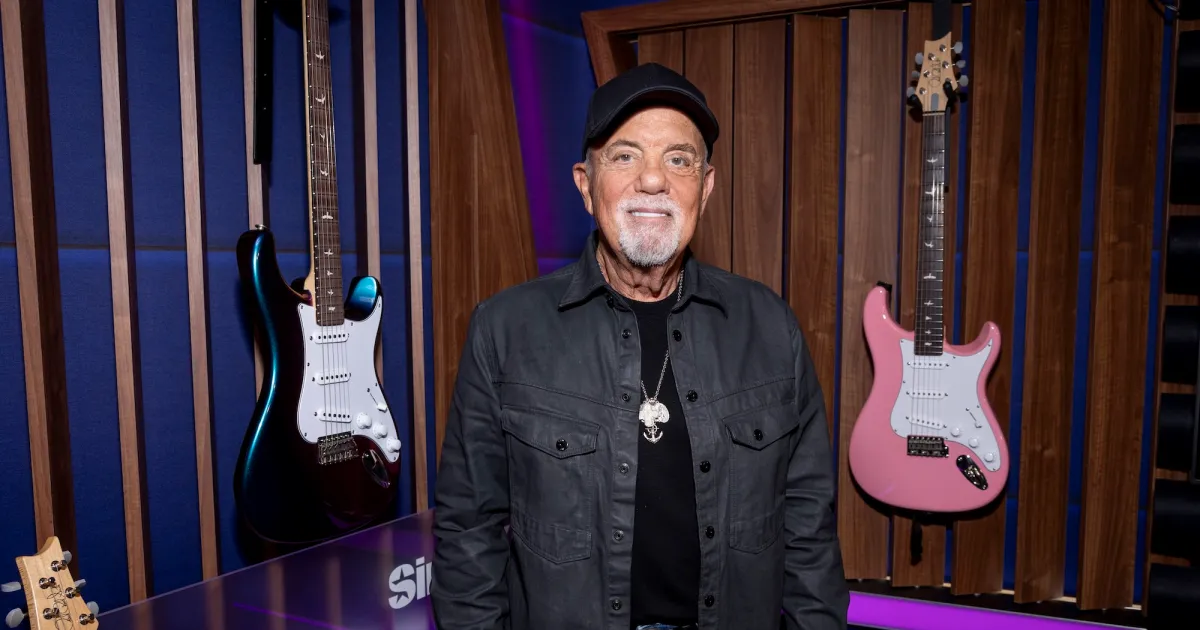
After months of anxious silence and an even longer season of health scares, Billy Joel is finally making his way back toward the stage. The news arrived on Monday, November 9, 2026, via his official Instagram account, in a post that was equal parts understated and electrifying. It read: “Florida Atlantic University will welcome singer, songwriter and composer Billy Joel for Billy Joel: An Evening of Questions & Answers …And a Little Music at 7 p.m. on Monday, December 14, 2026.” For the legions of fans who had been holding their breath since the legendary Piano Man first revealed his diagnosis, those words felt like a lifeline. For a man who has spent more than five decades translating the messy, beautiful, heartbreaking chaos of ordinary life into songs that feel like old friends, it was a quiet but unmistakable sign that the music wasn’t finished yet. The event, which will be held at Florida Atlantic University, is not a typical arena spectacle, nor is it the sort of high-octane stadium show that has defined so much of his later career. Instead, it’s something more intimate, more conversational: an evening of questions and answers, with a little music woven in. That distinction matters. It suggests not only a practical accommodation for his current health limitations, but also a deeper shift in what this particular performance is meant to be. It won’t be about proving anything, or breaking records, or filling a football stadium with tens of thousands of screaming voices. It will be about connection—simply being in a room with an audience, trading stories, and reminding everyone present that the man who wrote “New York State of Mind” and “Just the Way You Are” still has something left to give. Tickets, notably, will be available exclusively to currently enrolled FAU students starting Thursday, November 12, 2026. That choice says something too. It isn’t aimed at big-money ticket buyers or nostalgic boomers; it’s aimed at young people, the ones who might have grown up with their parents’ record collections but who still know every word to “Piano Man” anyway. It’s a gift, in many ways, to the next generation of listeners—a chance to sit at the feet of a master before the curtain ever has to come down for good.
That the announcement feels so miraculous is because of how dark the past year and a half has been for Joel and those who love his music. In May 2025, the singer made a disclosure that shook the entertainment world. He had been diagnosed with normal pressure hydrocephalus, a condition that sounds terrifying in its clinical phrasing and is, in many ways, just as serious as it sounds. The Cleveland Clinic describes NPH as a condition that occurs when cerebrospinal fluid builds up inside the skull, putting pressure on the brain and causing a cascade of neurological symptoms. For Joel, the diagnosis meant an immediate halt to everything. In his May 2025 Instagram statement, he announced that he would be canceling all scheduled concerts and stepping away from live performance entirely to focus on his health. It was a statement written with the kind of matter-of-fact vulnerability that Joel has never been particularly comfortable displaying, but which age and illness have forced into public view. The diagnosis itself was not sudden, of course. It had been lurking in the background for months, perhaps longer, in subtle changes that are easy to dismiss and impossible to ignore once the pattern becomes clear. Joel, 77 years old and with a history of iconic performances stretching back into the 1970s, was facing something more frightening than a canceled tour or a lost paycheck. He was facing the very real possibility that the machinery behind his music—the memory, the coordination, the balance, the sharpness—was being slowly compromised. For a man whose entire identity has been built around his ability to command a room, to sit at a grand piano and turn the world’s chaos into three-minute stories of hope and heartbreak, the thought of losing those abilities was devastating. In July, however, Joel attempted to ease fans’ fears. He insisted that the condition made things “sound a lot worse than what I’m feeling,” a message meant to reassure both himself and everyone listening that the end was not anywhere near. But the reassurance could only go so far. The fear, the waiting, the uncertainty—it was all still there, hovering over every update like a storm cloud that refused to break.
Then, in September 2025, Joel gave fans a new reason to hope. In an interview on SiriusXM’s The Billy Joel Channel, he opened up not only about his diagnosis but about the raw, physical details of what he had been experiencing. It was Joel at his most honest and unguarded. He described noticing that his balance had gone wrong, that something as simple as standing still felt like being out at sea. “I had this sense of being on a boat, like this rocking motion,” he said. “I wasn’t steady on my feet. I didn’t know why that was.” Those words will likely strike a chord with anyone who has watched a loved one age, or who has themselves experienced the creeping dread that comes when your own body starts to feel unfamiliar. It’s one thing to have a hip replaced or a knee repaired; it’s another thing entirely to suspect that something is happening inside your brain. Joel’s symptoms—the unsteadiness, the cognitive fog, the feeling that his balance and memory were slipping—are the kinds of changes that terrify people, because they point to the fragile architecture of consciousness itself. And yet, in his telling, there was no melodrama, no self-pity. Instead, there was a simple, almost matter-of-fact explanation of what came next. His neurologist recommended a shunt—a flexible plastic tube that drains excess cerebrospinal fluid from the brain and relieves the pressure that has been building up inside the skull. Joel agreed to the surgery, and the procedure was performed. He would later describe the outcome in remarkably straightforward terms: “It actually improved things. My memory got better, my balance got a little better, my ability to function was better.” Those are not the words of a man who was cured overnight, but they are the words of a man who was given a second chance. The surgery didn’t erase the condition, but it did something perhaps even more vital: it gave him room to breathe, to think, to imagine a future that included music again. It also gave him the clarity to admit his own vulnerability. “You know, I don’t want to lose my marbles,” he said, in a moment of humor that felt both heartbreaking and deeply human. Because isn’t that what everyone wants, in the end? To keep the lights on upstairs, to maintain the ability to remember the faces of the people we love, to remain ourselves even as the years accumulate.
But even with the success of the surgery and the slow return of his faculties, the road back to performing has been anything but simple. In October 2026, just a month before the FAU announcement, Joel spoke to The Hollywood Reporter and laid bare the difficult truth of his recovery. He was, he admitted, still required to undergo a series of tests before doctors could know whether he would ever truly be able to perform live again. And there were restrictions in place that he was honest about, even when they frustrated him. “But I can’t drive right now. I’m not allowed to drive,” he said, a small but potent symbol of how the diagnosis has stolen some of his independence. The bigger obstacle, though, was live performance itself. According to his neurologist, simply doing a show is like sustaining a concussion each time. That is an image that loses none of its power the more you think about it. For a performer like Joel, concerts have always been a full-body experience: the pounding volume of the speakers, the blinding intensity of the stage lights, the adrenaline, the pressure, the roar of a crowd, the sheer emotional and physical stress of standing up in front of fifty thousand people and laying yourself bare. That kind of activity is not merely exhausting for a brain already under stress; it can actively be dangerous. Joel explained it in his own inimitable way: “Rock ‘n’ roll is loud, man. Rock ‘n’ roll made me deaf already. So it’s the lighting, the sound, the stress of the show, the audience, the energy of the performance. There’s a lot going on when you’re on stage. And they said, ‘Well, you really shouldn’t be doing that right now.’” Those words carry a kind of hard-earned wisdom, but also a deep sadness. Imagine being told that the very thing you were born to do—the thing that has defined your life, your identity, your relationships, your legacy—is the thing that might hurt you most. Imagine being told that the applause you have spent fifty years chasing is, at least for now, too much for your own brain to handle. It is a cruel irony, and Joel does not pretend otherwise. He acknowledged that he wants to be back on stage, that he would like nothing more than to feel that familiar rush of energy again, but he also knows that the era of reckless abandon is over. He has to be patient. He has to wait for test results, for doctors’ appointments, for a clearer picture of what his future as a performer can honestly look like.
This is what makes the Florida Atlantic University event so significant. It represents a middle path, a way for Joel to reconnect with audiences without pushing his body to its breaking point. An evening of questions and answers is not the same as a full-blown concert; it is, in many ways, a different kind of performance entirely, one that prioritizes conversation, storytelling, and intimacy over spectacle. The “little music” in the title is a masterstroke of understatement, acknowledging that the event will not be a concert while still letting fans know that there will be moments of song, little miracles of melody and memory that remind everyone why they fell in love with Joel’s music in the first place. It’s also a deeply human way to navigate a difficult situation. Rather than disappearing from public life entirely, or, conversely, rushing back into a punishing tour schedule that could endanger his health, Joel is choosing to meet his audience somewhere in the middle. He is choosing to show up, to be present, to share what he can, at his own pace, with his own limitations. There is something profoundly brave about that. It is one thing to perform when everything is working perfectly, when the voice is strong and the stage is a kingdom and the night belongs to you. It is another thing entirely to stand in front of people when you are not at your best, to answer tough questions, to be vulnerable, and to trust that the audience will meet you with grace and patience and love. That takes courage, and it takes a kind of humility that age often teaches but rarely makes easy. For the students at Florida Atlantic University who will be lucky enough to attend, it will be a once-in-a-lifetime lesson in resilience, in the art of growing older without losing the spark that makes life worth living. They will see a living legend not as an invincible icon but as a human being, navigating the same fears and uncertainties that all of us face, but doing it in the spotlight, with the eyes of the world upon him.
For the rest of us, the news of Joel’s return is more than just an item in an entertainment feed. It is a reminder that music, at its best, is not about perfection. It is about truth. Billy Joel has spent his career telling us stories about ordinary people trying their best to get by—the waitresses and bartenders, the lovers and losers, the dreamers and cynics who populate songs like “Scenes from an Italian Restaurant” and “Vienna.” He has written about aging before, with more grace and wisdom than most: “Vienna waits for you,” he sang, a reminder that life does not have to be a race, that there is value in slowing down and taking stock of what really matters. Now, in his late seventies, after surgery and recovery and countless tests and months of uncertainty, he is living out the philosophy he has been singing about all along. He is not pretending that he is young again. He is not pretending that the power of a full arena concert would not cost him something. Instead, he is doing what so many of us are forced to do as we age: adapting, accepting, and finding new ways to do what we love. The FAU event, with its gentle title and its student-only ticket policy, feels almost like a gift from an old friend—a chance to say goodbye on his own terms, or perhaps, more optimistically, a chance to say, “I’m still here, and I still have something meaningful to share.” The date is still months away, and there is no guarantee that he will ever return to the massive tours that made him a global superstar. But for now, that almost doesn’t matter. What matters is that Billy Joel, after all this time, is coming back. The piano is still waiting. The stories are still inside him. And on a warm December evening in Florida, in a room full of young faces hungry for connection, the Piano Man will sit down, begin to speak, and prove once again that the things that make us human—love, memory, music, and the stubborn refusal to give up—are always worth the fight.