

On a quiet Tuesday in Washington, a family that has spent generations turning private grief into public memory walked into a federal courthouse with a plea as urgent as any its members have ever made. The children of the late Senator Robert F. Kennedy filed a legal request to stop the Trump administration from building a 250-foot arch near Arlington National Cemetery, warning that the towering structure would be a permanent desecration of the gravesites where their parents and family members now lie. In a filing before the U.S. District Court for the District of Columbia, they asked for an injunction against the project, which was planned for a traffic circle situated between the cemetery and the Lincoln Memorial. For the Kennedy family, this was never a question of politics in the ordinary sense. It was about the sacred, the final, the unmovable. The filing used the phrase “permanent denigration,” a term that does not mean merely inconvenience or unsightliness. It means to darken, to degrade, to blacken something that was once pure and sacred. The family argued that the arch, once built, would physically cast shadows over the graves of President John F. Kennedy, Senator Robert F. Kennedy, and other loved ones. It would also rob the resting place of a view that President Kennedy himself had loved and that had always been part of the meaning of the spot where he was laid to rest. For them, the arch was not a memorial but a wound. They did not object to national monuments. They objected to placing a giant structure beside the quiet ground where their father and mother now face eternity.
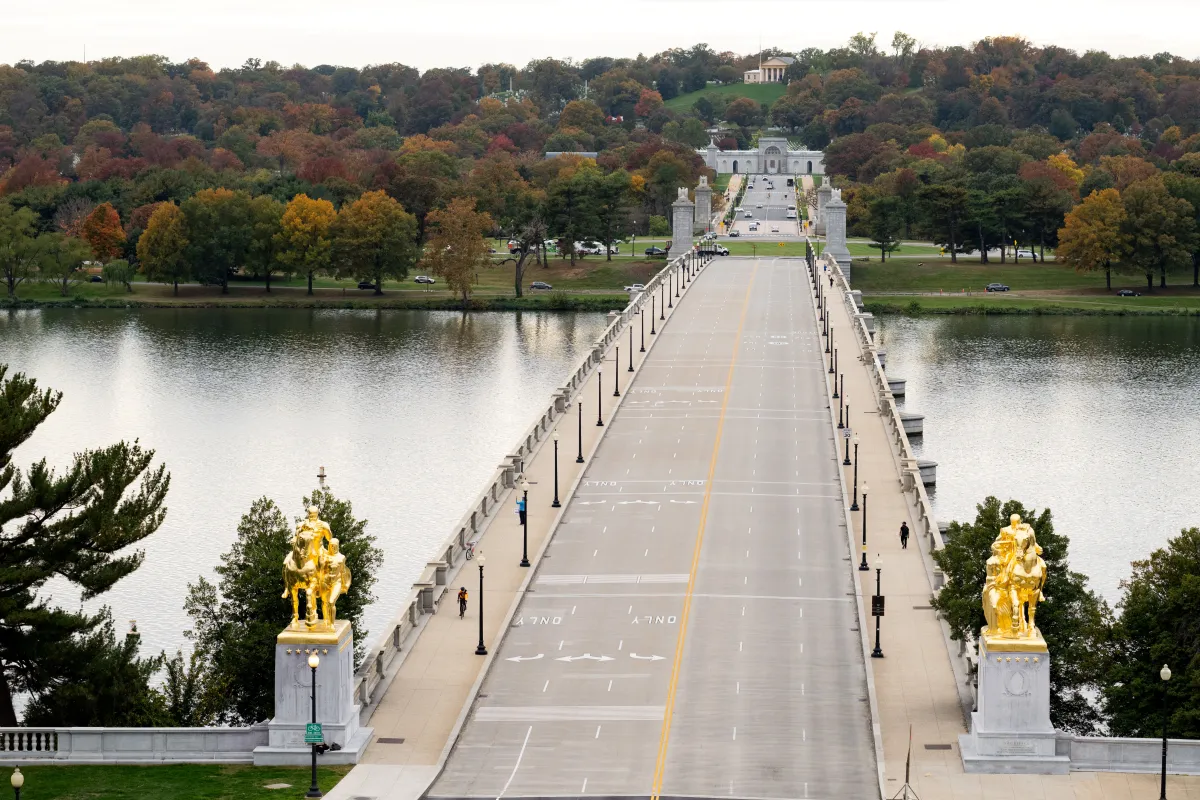
The location at the heart of the case is one of the most important and visible pieces of American ground. The traffic circle between Arlington National Cemetery and the Lincoln Memorial is not just a convenience for tourists; it sits at the threshold of a national cathedral of honor. From the slopes of the cemetery, visitors can look out over the Potomac River, past the bridges and the monuments, all the way to the Washington Monument and the Capitol beyond. It is a landscape carefully designed to inspire reflection, to connect the sacrifice of the dead with the endurance of the republic. The proposed arch, rising 250 feet into the air, would dominate that entire scene. It would be impossible to ignore, a massive emblem planted at the edge of a place that asks visitors to bow their heads, not crane their necks upward. The Kennedy family’s legal filing explained this in restrained but devastating terms. The arch would not only stand as a physical shadow over the Kennedy plots, but it would also destroy the sense of openness, peace, and continuity that the family and so many others have always felt when walking through the gates of Arlington. For generations, mourners have come to the Kennedy grave and taken comfort in a view that seemed to stretch into infinity. The family argued that after the arch was built, that view would be gone forever. No photograph could preserve it. No memorial could replace it. The quiet openness that made the grave a sacred place would be replaced by the looming presence of a massive construction, a permanent interruption between the living and the dead.
The language in the court filing carries the weight of decades of loss, but it also carries legal precision. “That constitutes nothing less than a permanent denigration of the Kennedy Gravesites and the final resting place for Plaintiffs’ parents and grandparents,” the family wrote. They went on to explain that the Kennedy graves at Arlington should remain unimpeded and unhampered as a solemn memorial to the legacy of the family, including Senators Robert F. Kennedy and Edward M. Kennedy, both of whom served with honor and sacrificed greatly for their country. There is a particular heartbreak in the phrase “as always intended.” It implies a promise, an understanding between a family and its nation, that the ground where Jack and Bobby were buried would never be treated like ordinary real estate. The family also said the arch would significantly damage the memorial to the Kennedys and to the heroes who eternally rest at Arlington. That final phrase is essential, because it moves the argument away from the private grief of one famous family and toward the broader sacredness of the entire cemetery. Arlington is not a park. It is not a museum. It is a graveyard for hundreds of thousands of Americans who served their country, and for many it is the only monument they will ever receive. The Kennedy family’s filing asked the court to consider what it means when the government decides to build a giant structure over the visual horizon of that resting place. Is there no limit? Is there no place too sacred to protect? The family’s answer is clear: if a 250-foot arch can be built beside the graves of a president and a senator who were assassinated in service to their country, then no grave is safe.
To understand the depth of the family’s emotion, one must pause and think about what Arlington actually looks like and feels like. The cemetery stretches across rolling green hills, with row after row of white headstones laid out in perfect, heartbreaking symmetry. On the hill where President Kennedy is buried, an eternal flame burns, lit by his widow and kept alive ever since as a symbol of the promise that America would never forget him. Robert F. Kennedy lies nearby, beneath a simple white cross and a stone that has become a place of pilgrimage for thousands of people every year. His wife, Ethel, who spent more than half a century guarding the family’s legacy, was buried beside him in 2024. Their children now sit as plaintiffs in this case, but they are also simply children standing before the graves of their mother and father. They have come to this cemetery, year after year, for birthdays and anniversaries and ordinary days when grief simply called them. They have stood in the cold rain and the blazing sun, watching strangers place flowers and flags at their father’s grave. They have felt the weight of history and the weight of love in the same breath. The arch would change all of that. It would turn their father’s grave into a landmark beneath a monument. It would make the cemetery itself feel smaller, as if the white stones were merely decorative details for a larger architectural statement. The family is not asking for special treatment. They are asking for what every family wants for the people they love: a place to visit that remains the same, a place where memory can breathe, a place where no shadow falls unless it is the shadow of a cloud moving across the sun.
The legal fight comes at a time of intense debate about how the United States should commemorate its past and celebrate its heroes. There are broad disagreements in American life about statues, monuments, flags, and public art. But the Kennedy family’s lawsuit is not an attempt to settle that debate in the abstract. It is an attempt to protect one specific piece of sacred ground from what they see as a reckless and irreversible act. They asked the court for an injunction, a simple legal mechanism that would halt construction until the issues could be properly examined. They wanted the judge to see that once an arch of this size is built, it cannot be unbuilt, at least not without enormous harm to the landscape and to the people who loved it. The legal arguments in their filing are grounded in the idea that cemeteries deserve special protection, that they are not ordinary public land, and that the government’s responsibility to honor the dead does not include the power to disturb their final resting place. On November 5, a judge agreed, at least for the moment, and temporarily blocked construction. It was a victory for the family, but a temporary one. The case will continue, and no one can say with certainty how it will end. What is certain is that the Kennedy family will not simply stand aside and watch their father’s grave be cast into shadow without a fight. They have been through too much, buried too many people, and carried too many memories to remain silent.
In the end, this story is not really about an arch. It is about the oldest question in human experience: how should we honor those who have gone before us? There are people who believe that great deeds deserve great monuments, that the tallest structures are the truest expressions of gratitude. But there are others, and the Kennedy family is among them, who believe that true honor is quieter. It is found in the careful upkeep of a grave, in the preservation of a view, in the way a family kneels in silence beside a stone and feels that the person they loved is still close. The Kennedy family has given this country presidents, senators, soldiers, and leaders. They have also given the country a long and painful lesson in how to grieve. They have buried a father on the floor of a Senate building, a brother at Arlington, a son in the ocean, a nephew in a small plane off the coast. They know that monuments cannot replace presence. They know that stone cannot hold a hand. And they know that a giant arch cannot make a single soldier more noble or more remembered than he already is. Their plea before the court was not an act of defiance but an act of love. They are asking the nation to leave their father in peace, to leave their mother in peace, to leave the view that John F. Kennedy loved exactly as it was. That is not too much to ask. In a country that often seems to measure respect by the size of its sculptures and the height of its towers, the Kennedy family reminds us that reverence can also be measured by what we choose not to build—and by the shadows we choose not to cast.