



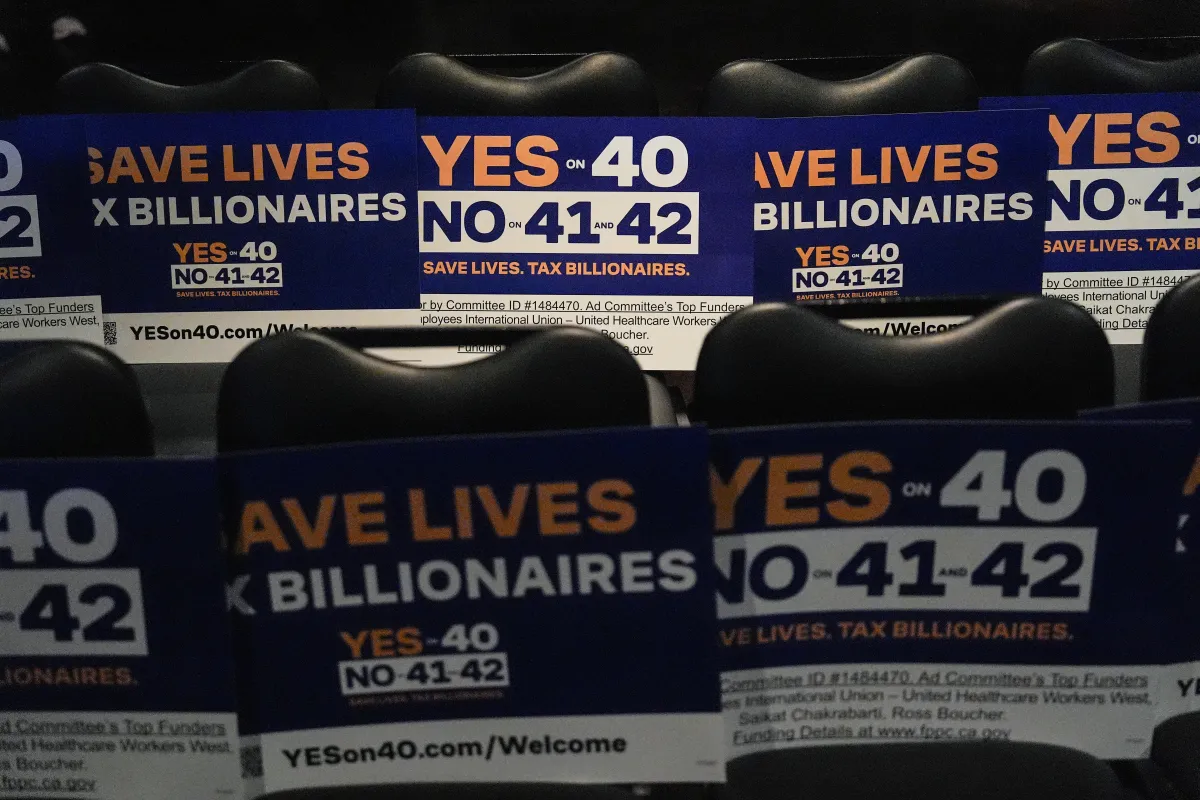
California voters have said no to Proposition 40, rejecting a proposal that would have made the state the first in the nation to tax billionaires on their net worth. The Associated Press called the race on Monday, six days after Election Day, and the margin was clear. In the Secretary of State’s semi-official count, 5,789,026 voters, or 52.9 percent, opposed the measure, while 5,159,356, or 47.1 percent, supported it. What made the defeat so significant was not just the policy, but the battle around it. This was supposed to be a historic experiment: a direct tax on the fortunes of the wealthiest people in America, not just on their income. It would have forced billionaires living in California to pay a price for simply being billionaires. The campaign split the Democratic Party at the top. Governor Gavin Newsom, who is considering a run for president in 2028, opposed the tax and warned that it would drive the state’s wealthiest residents away. Senator Bernie Sanders and Representative Ro Khanna, two of the most recognizable progressive voices in the country, embraced it as a moral test. The money race was lopsided from the start. Building a Better California, the committee that led the opposition, raised more than $333 million. Google co-founder Sergey Brin alone contributed more than $100 million. Supporters were outraised by about ten to one. It was a reminder that the people who would have paid the tax had every reason and every resource to stop it. And they did. Yet the result cannot be blamed solely on money. Many ordinary voters had genuine doubts. In a state where housing costs are crushing, where the budget is unpredictable, and where people are already leaving, the idea of chasing away billionaires felt risky. Proposition 40 asked voters to believe that taxing fortunes would make life better for everyone else. In the end, enough of them were not willing to take that chance.
The tax itself was unlike anything California had ever seen. It was not an income tax, which taxes what people earn, or a property tax, which taxes what people own in real estate. It was a tax on net worth—the total value of a person’s assets, including stocks, shares in private companies, real estate, yachts, art, and cash, minus debts. Under the measure, any person who was a resident of California on January 1, 2026, and whose net worth exceeded $1 billion would have faced a one-time tax equal to 5 percent of that net worth, with the bill due in 2027. The money would have been dedicated to specific purposes: 90 percent to health care, and the remaining 10 percent to education, food assistance, and the administrative cost of running the tax. The measure was sponsored by SEIU-United Healthcare Workers West, a union with a strong interest in health care funding. The union projected that the tax would raise about $100 billion. The nonpartisan Legislative Analyst’s Office, which writes impartial analyses for the voter guide, was more careful. It estimated the tax would raise “tens of billions of dollars spread over several years,” and it also warned of a “possible ongoing decrease of less than $1 billion per year” in state income tax collected from billionaires. That warning was crucial, because the tax could not be evaluated in isolation. If billionaires left California to avoid it, the state would lose not just the new wealth tax revenue, but also the income tax revenue those billionaires had been paying. The measure’s supporters insisted the tax was a fair way to make the ultra-wealthy pay their share for the public services that helped them become rich in the first place. Opponents called it a recipe for losing the very people who helped make California’s economy the fifth largest in the world. Both sides had a story, and the official voter guide told voters they had to choose between them. The idea was simple, but the mechanics were not. How do you value a privately held company? What about stock options? The measure would have required the state to assess the wealth of the richest people on earth, a task that would have produced years of litigation and uncertainty.
Economists who studied the measure disagreed so sharply that voters were left with two completely different pictures of what would happen. A paper from the Hoover Institution, a conservative think tank at Stanford, estimated that the tax would raise only about $30 billion—less than a third of what supporters claimed. The paper’s authors argued that nearly 30 percent of the people who would owe the tax had already left California or would leave before the residency cutoff. When the study counted the income tax revenue that the state would lose as those billionaires departed, it concluded that the measure’s net value to California would be negative $38.9 billion. In other words, the state would be worse off, not better. That was a powerful argument for voters worried about budget deficits and a shrinking tax base. But the people who wrote Proposition 40 rejected that analysis entirely. They pointed to a paper from the National Bureau of Economic Research, co-authored by one of the measure’s own drafters, which estimated that the tax could raise about $100 billion. That paper found that California’s billionaires currently pay only about 0.2 percent of their wealth per year in state income tax. That tiny percentage amounts to about $3.2 billion, or 2.4 percent of all the state’s income tax revenue. The point was simple: billionaires were not paying their fair share. A tax on their wealth would not destroy the economy; it would simply make the richest people contribute something proportional to what they have. The two studies were repeated endlessly in ads, speeches, and mailers. Each side chose the number that suited its message, and neither side could convince the other. At its core, the debate was about human behavior. Would billionaires stay in California even if they had to pay a wealth tax, because California is where their companies, their networks, and their lives are? Or would they relocate to Texas, Florida, or Nevada, where there is no state income tax at all? Voters were being asked to bet on a theory. They were not given certainty. They were given two carefully chosen sets of numbers and a choice about who to trust. In the end, the more cautious number won.
Money did more than pay for advertisements; it changed the structure of the election itself. The opposition committee, Building a Better California, did not just fight Proposition 40. It also sponsored Propositions 41 and 42, which were written to create legal conflicts with the wealth tax. The Legislative Analyst’s Office warned that if either measure received more “yes” votes than Proposition 40, courts could block the billionaire tax even if a majority of voters approved it. That strategy was unusual, and it added another layer of confusion to an already complicated ballot. In the end, the countermeasures were not needed to stop Proposition 40, but Proposition 42 appeared to be passing anyway. As of Monday afternoon, it was leading 51.7 percent to 48.3 percent, with 5,612,642 votes in favor and 5,244,738 against. The Associated Press had not called the race, but the measure drew about 450,000 more “yes” votes than the wealth tax did. If it passes, Proposition 42 would write a ban on new taxes on financial assets and on most retroactive taxes into the California Constitution. That would create a permanent obstacle to any future wealth tax, which would first require voters to amend the constitution again. The people who would have been taxed were not waiting around to see how the race ended. Sergey Brin and fellow Google co-founder Larry Page had already begun moving away from California before the January 1 residency cutoff, according to public records and reports. Mark Zuckerberg, the chief executive of Meta, took a different approach. In October filings, Meta disclosed a deal in which Zuckerberg committed to stay in California for eight years, barring “material unforeseen circumstances.” In exchange, he received non-voting shares that he could sell to cover a tax bill without losing control of the company. The deal was a clear sign that the threat of a wealth tax was real enough to make billionaires rethink their personal finances. Whether those actions were prudent or panicked is hard to say. But they gave opponents a powerful talking point: the tax was already driving wealth out of California, before a single dollar had been collected.
The political fight over Proposition 40 was as intense as the economic one, and it exposed a deep fault line in the Democratic Party. Senator Bernie Sanders endorsed the tax in December 2025 with a post on X that captured his view in a single sentence: “Our nation will not thrive when so few own so much.” Representative Ro Khanna, whose district includes much of Silicon Valley, went even further. In an October post on X, he called Proposition 40 “the most important ballot initiative in America.” Khanna’s support came with personal consequences. In late December 2025, hedge fund manager Bill Ackman, a former supporter, wrote on X: “Ro Khanna has lost his way. I used to support him.” That was just one example of the pressure that progressive politicians faced from the tech and finance world. Governor Gavin Newsom took a position that put him at odds with the national progressive wing of his own party. He has instead called for a federal minimum tax on the very wealthy, starting at $100 million in net worth. He praised Sanders’ focus on inequality as “spot-on,” but on the ballot measure itself he said, “we fundamentally disagree.” That left California voters without a clear message from the top of the Democratic Party. Progressives argued that the tax was necessary because the ultra-rich had captured the economy and the political system. Moderates and business-friendly Democrats argued that a wealth tax would drive out the very people who create jobs, fund startups, and donate to philanthropy. The debate was not really about arithmetic; it was about values. Do you tax great wealth in order to fund public goods, or do you protect great wealth because it lifts everyone? Polls showed how narrowly divided the public was. Newsweek reported in October that a UC Berkeley poll found 45 percent of registered voters supported the measure, 43 percent opposed it, and 12 percent were undecided. Those undecided voters were the real targets of every ad and every argument. In the end, they broke against the tax. The Democratic split likely gave them permission to vote no. When the governor of their own state, a Democrat, could not support the measure, it was easier to doubt it.
Now that Proposition 40 has been defeated, the question is what happens next. If Proposition 42 passes, as it appeared to be doing, any future wealth tax in California would require voters to amend the state constitution again. That is a high barrier, and it would make it very difficult for a similar measure to appear on the ballot anytime soon. But the people who backed Proposition 40 are not treating the campaign as a complete failure. They are treating it as the beginning of a longer fight. As ballots were being counted, California Federation of Labor Unions President Lorena Gonzalez said the campaign was “showing other states that you can look them in the eye.” That phrase captured something important. For a few months, California forced billionaires to defend the fact that they hold enormous wealth in a state where many people struggle to afford basic needs. It forced them to spend hundreds of millions of dollars to maintain their position. It also showed how much the wealthiest people in America are willing to do to avoid paying an extra 5 percent on their fortunes. Some billionaires left the state. One of them made a private deal with his company to protect his shares. The mere possibility of a wealth tax changed their behavior. That is a measure of the proposal’s power, even in defeat. The campaign also changed the national conversation. It made the idea of taxing wealth, not just income, feel less radical to millions of people. Even if the ballot measure failed, the underlying problem it addressed has not gone away. Inequality in California and across the United States remains enormous, and the gap between the very rich and everyone else is still growing. The legal and political barriers constructed by Proposition 42 may slow down the next attempt, but they cannot erase the anger that gave rise to Proposition 40. Counting is still underway, and the results have not yet been certified. The margins could shift slightly, but the outcome is clear. California will not become the first state to tax billionaires’ net worth. The debate, however, is far from over. It will return in another form, in another state, or at another time. For now, the state has chosen caution. But the question of what billionaires owe the communities that made their fortunes possible is not going to disappear.