

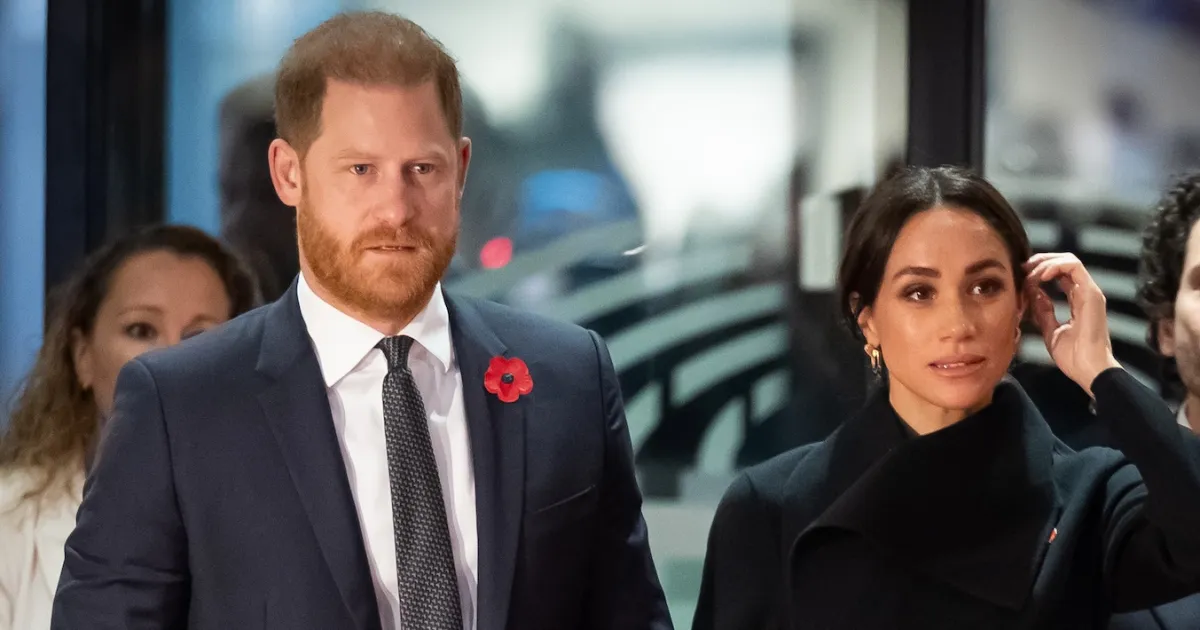
There are moments in public life when the personal and the professional collide with such force that the only response is to simply keep moving. Meghan Markle and Prince Harry arrived at the European Parliament in Brussels on Tuesday, November 10, looking composed, connected, and resolute. The occasion was the opening of the Lost Screen Memorial, a tribute to children who have died after enduring harm on social media. Dressed in a minimalist black coat, Meghan walked beside Harry, who wore a navy suit, their fingers interlaced in a gesture that seemed both loving and protective. It was her first public appearance since the news broke that her estranged father, Thomas Markle Sr., had been arrested in Florida on suspicion of possessing child pornography. The arrest had taken place four days earlier, on Friday, November 6, and the charge—one count of possession of child pornography—had immediately become international news. When reporters shouted questions as the couple entered the building, Meghan and Harry did not respond; their silence was a clear boundary, a way of saying that some wounds should not be probed for cameras. Their presence at the memorial was itself a form of communication, a signal that their commitment to child safety would not be derailed by private turmoil. It is never easy to stand in public with a composed face while your family story disintegrates in headlines. But that is what Meghan did, with Harry beside her, in a moment that required both courage and compartmentalization. For a woman who has spent years being scrutinized, judged, and reduced to tabloid caricatures, simply walking through those doors was an act of quiet defiance. It was also a mother’s choice: to show that no matter what private grief or outrage churns beneath the surface, the work of keeping children safe remains non-negotiable.
The Lost Screen Memorial is more than a ceremonial title. It is an effort to put human faces and names on a crisis that too often gets lost in statistics and policy jargon. The event honors children who have lost their lives after experiencing harm on social media, and later in the day, Meghan and Harry were scheduled to participate in a debate on how to protect children from harm while browsing the internet. This is not a comfortable topic, and it cannot be solved with a single speech or a well-lit photo opportunity. But the couple’s presence in the European Parliament was intended to generate political will and to remind lawmakers that behind every number is a child with a name, a family, a future. For Meghan and Harry, this issue has become central to their philanthropic identity. As parents themselves, they have spoken about the dangers of the online world with a particular urgency, knowing that Archie and Lilibet will grow up in a digital landscape filled with both wonder and danger. Their hand-holding on that Brussels morning was not just affection; it was mutual support in a moment of extreme stress. The juxtaposition of the setting—a grand building filled with delegates and advocates—and the raw family scandal trailing behind them was stark. Yet, in a strange way, the tragedy in their personal lives may have made their advocacy even more poignant. They know what it means to feel exposed, to fear for children, to want to build a barrier between the vulnerable and the cruel. Their participation in the debate was not a distraction from their pain; it was a way of transforming pain into purpose.
To understand what was running through Meghan’s mind, one must return to the allegations against Thomas Markle Sr. They are serious, disturbing, and still unproven in a court of law. The U.S. Attorney’s Office for the Central District of California alleged that the 82-year-old kept child sexual abuse material in storage containers he rented in the Los Angeles area for nearly two decades. Investigators seized approximately seventy-eight items, including slides, film negatives, and books containing suspected child abuse material. Among the material, prosecutors alleged, were two images of a man believed to be Thomas Sr. with a nude prepubescent girl. Other photos “appear to show Markle with children in various stages of undress.” Thomas Sr. was taken into federal custody in Florida on Friday, November 6, and released on bond the same day. He has denied the allegations. It is important to remember that these are accusations, not convictions, and that the legal system will determine what is true. But the details, if proven, are sickening, and the fact that they involve a family already so publicly fractured makes them even harder to process. For Meghan, the news must have landed like a thunderbolt, a horrifying development in a relationship she had already spent years distancing herself from. She had long said that her separation from her father was rooted in a desire to protect her children, but now that decision seemed eerily vindicated, while simultaneously raising new and painful questions about her own history. No daughter should have to read such things about the man who raised her, even a daughter who has been estranged for years.
The path that led to this moment is tangled and sad. In October, Meghan’s half-brother, Thomas Markle Jr., told The Sun newspaper that he had discovered material depicting child sexual abuse in storage boxes at his father’s home in the Philippines and had informed the authorities. The arrest followed weeks later. The Markle family has long been fractured, with public feuds, tell-all interviews, and bitter accusations playing out in the tabloids. Meghan’s father famously did not attend her wedding, and he later gave interviews criticizing her and the royal family in ways that seemed designed to wound. Her half-brother and half-sister have also made public statements that painted her as cold and ungrateful. For years, the world watched this family drama unfold as if it were a soap opera. But this latest chapter is not entertainment. It is a criminal case with grave implications, and it has reopened old wounds in a family that never found a way to heal. Whatever the legal outcome, the bond between father and daughter already carries a burden that cannot be undone. It is impossible to know what memories or emotions this stirs for Meghan—perhaps childhood moments that now feel tainted, perhaps a complicated mix of pity, anger, and grief. What is clear is that the family’s painful past, once played out in royal pages and talk shows, has now collided with an even darker reality. Half-brother and half-sister, father and daughter, public accusations and private loyalties: it is a tangle of human pain that no court case can fully untie.
In the middle of this storm, Meghan spoke. In a statement to Us magazine, she said, “I am deeply distressed at the news that has come to light in the last 24 hours, and my thoughts are with any children who may have been harmed.” She also revealed something important: she became aware of allegations against Thomas Sr. back in 2018. “In 2018, a letter was sent to the Metropolitan Police and Royalty and Specialist Protection. That letter was subsequently shared with me. It made troubling and disturbing allegations against my father and I was given assurances that these were being investigated,” she said. Then came the sentence that reframed years of public judgment: “I hope it can now be understood that, despite certain media publications’ distortion over the years, any distance from my father and my choice to not allow him to have contact with our children was for one reason: to protect them. I trusted that the authorities were doing the same for other families.” This is the heart of the matter. For years, Meghan was portrayed as the one who broke up her own family, who abandoned her father, who traded a simple life for a royal fantasy. In a few measured sentences, she offers a different narrative: distance as protection. She is not calling for vengeance or issuing dramatic accusations. She is simply telling the truth as she experienced it, and asking the public to understand that her choices were made from a mother’s love. The statement is careful, legal, and deeply maternal. It acknowledges that children may have been harmed, and it centers their wellbeing above all else. It also reminds us that behind the celebrity headlines is a daughter and mother trying to hold onto something sacred in the middle of a tabloid disaster.
By the time Meghan and Harry walked into the Lost Screen Memorial, they were doing more than attending an event; they were modeling resilience. The juxtaposition of family scandal and child-safety advocacy was not lost on anyone in that room. It may even be why the couple continues to press forward—because public service can be an anchor in personal storms. The road ahead will be long. Thomas Markle Sr. will have his day in court, and the legal process will reveal more details, some of them possibly devastating. The media will continue to probe and speculate, and Meghan will continue to be scrutinized in ways that most of us will never have to endure. But her path is clear: she has chosen to center her children and the cause of child protection. She has said she kept her father at a distance to protect her children, and now she is using her platform to push for protections for all children, both in their homes and online. This is a powerful human response to unbearable circumstances. It does not erase the pain, and it does not answer every question. But it shows that even when the past rises up in terrible forms, it is possible to remain focused on the future. For anyone experiencing child abuse, help is available by calling or texting the Child Help Hotline at 1-800-422-4453. And for the rest of us, the story is a reminder to approach with compassion, to remember that public figures are human beings experiencing private grief, and to keep the most vulnerable people in mind. A mother’s love, a spouse’s support, and a public stage—sometimes that is enough to keep moving forward, one hand held tightly in another, into a room built to remember the lost.