

1. The Heartbeat of a Nation in Turmoil
There is a moment in the life of a country when the ordinary rhythm of daily existence stops, and the streets become the stage for a collective, anguished cry. France experienced that moment on Thursday, as tens of thousands of citizens poured out of their homes, workplaces, and classrooms to join a nationwide wave of strikes and protests. The air was thick with purpose, a mixture of anger, frustration, and stubborn hope. Across the country, from the gleaming boulevards of Paris to the cobbled streets of provincial towns, a massive display of civil mobilization unfolded. To maintain order, France deployed an astonishing 70,000 police officers—a number that speaks volumes about the tension simmering beneath the surface. In the capital, the iconic Eiffel Tower, that eternal symbol of French elegance and romance, stood silent and closed to visitors, its shut doors a melancholy metaphor for a nation pausing its celebration of beauty to confront its own internal pain. The scenes were chaotic and deeply human: chanting workers, students with paint-streaked banners, teachers walking out of classrooms, and families huddled together, all united by a simple, yet profound, demand for a better life. This was not a spontaneous eruption; it was a carefully orchestrated mobilization by left-wing groups and unions, a collective reckoning with issues that had been festering for months. As the morning sun rose, the scale of the unrest became undeniable. Sophie Binet, the head of the powerful left-wing CGT union, captured the sentiment perfectly, telling reporters with a quiet intensity, “We need to turn up in big numbers on the streets today.” And they did. An official close to Interior Minister Laurent Nuñez estimated that by early afternoon, approximately 270,000 people had already participated in 180 rallies outside the capital—a staggering statistic that only hints at the emotional weight carried by each marcher.
2. Voices From the Crowd: The Human Toll of Economic Strain
To understand the depth of this mobilization, one must listen to the stories whispered and shouted within the crowds. These were not faceless agitators, but people whose lives had been touched by an unrelenting economic squeeze. A middle-aged factory worker from Lyon, his face etched with worry, explained between chants that his wages had remained stagnant for years while the cost of everything—fuel, food, rent, gas, electricity—had climbed relentlessly. He was not alone. The main unions, in a rare show of unity, had released a joint statement that resonated with millions of households: “Fuel, food products, rent, gas, electricity… everything’s going up except wages and pensions.” This simple arithmetic of survival was the driving force behind the protest. In the working-class suburbs, mothers pushed strollers alongside seasoned activists, their presence a testament to the desperation that transcends political affiliation. Teachers, too, were out in force. About a third of France’s high schools were closed or unable to operate, some due to student blockades, others because educators were on strike. These teachers spoke not just of their own salaries, but of the crumbling state of public services, of classrooms overflowing with students, of resources running dry. For them, the protest was a defense of the very idea of a Republic that cares for its people. Near Toulouse, the fire that ravaged a high school the night before felt like a dark omen, a physical manifestation of the rage that had been building. Yet, within the crowd, there was also a resilience—a feeling that this was a necessary fight, a moment to reclaim their future. They chanted not just against policies, but against a sense of powerlessness that had crept into their lives, turning daily existence into a struggle for basic dignity.
3. Flashpoints of Confrontation and the State’s Response
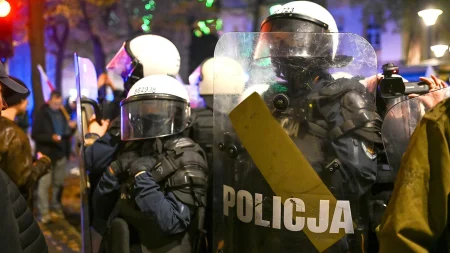
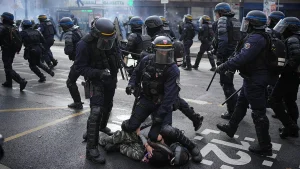
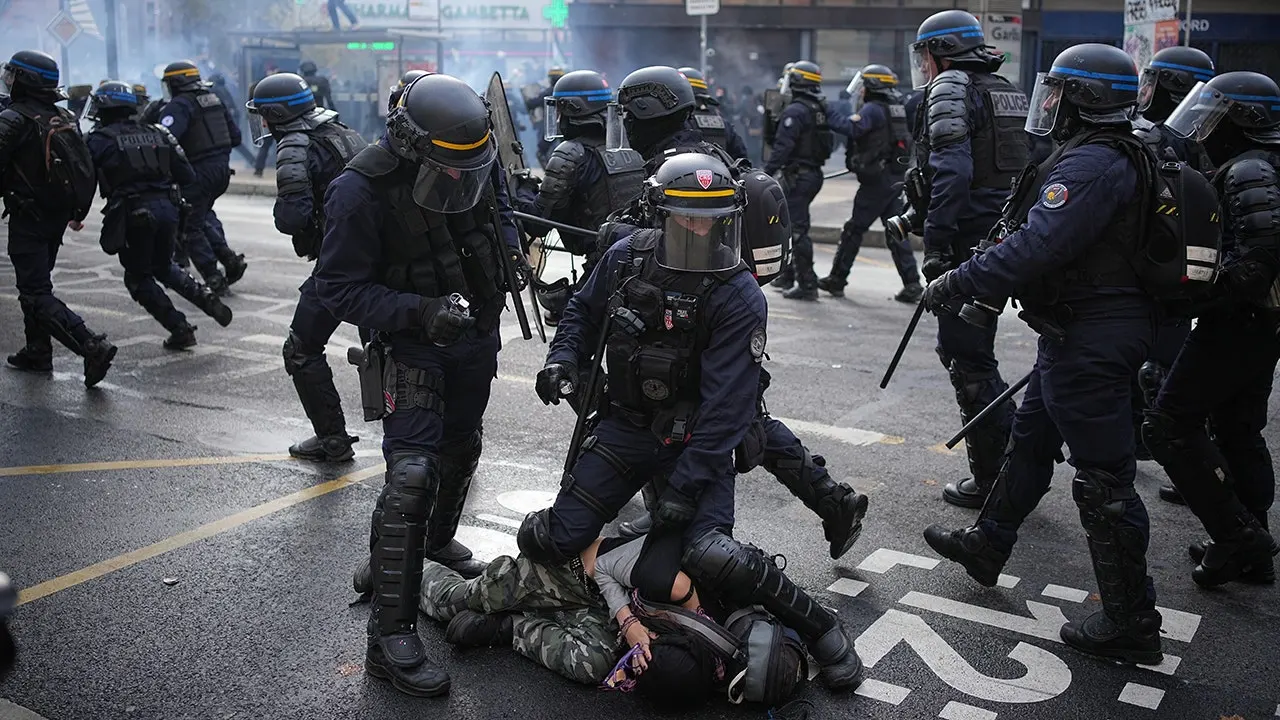
As the day wore on, peaceful demonstrations occasionally gave way to raw, explosive confrontation. In Lyon, the air filled not only with the sounds of protest, but also with the acrid sting of tear gas. French riot police charged a group of demonstrators, and the chaotic dance between the shield-wielding forces and the masked, stone-throwing youth became a brutal spectacle. In the western region of Brittany, authorities reported that “masked individuals” had attempted to block roads in Rennes, and that some had committed “serious acts of violence,” including hurling steel balls at the police—a chilling tactic designed to cause maximum injury. The state’s response was overwhelming and meticulously planned. The 70,000 police officers were not alone; they were backed by armored vehicles, drones buzzing ominously overhead, and helicopters thundering in the sky, creating a sense of a country under siege from itself. Every flashpoint was monitored, every street corner watched. For the ordinary protester, the presence of such force was terrifying; for the authorities, it was a necessary measure to prevent the kind of widespread destruction that had rocked the nation the previous October. During those earlier protests, buildings had been torched, shops looted, and clashes had left dozens injured. Outgoing President Emmanuel Macron had blamed that violence on “ultra-left groups whose aim is to bring down the Republic,” a stern accusation that underscored the deep political fissures. Thursday’s violence was less widespread, but it served as a stark reminder that the anger simmering in French society is never far from boiling over. The steel balls in Brittany and the burning school near Toulouse were isolated incidents, but they created a pervasive atmosphere of anxiety, leaving many to wonder if peaceful protest is still possible in a country so divided.
4. Political Shadows: The Search for a Successor
The unrest unfolded against the backdrop of an even more consequential drama: the race to succeed Emmanuel Macron. The president, constitutionally barred from seeking a third consecutive term, is nearing the end of his mandate, and his political shadow loomed large over the protests. The demonstrations quickly became a platform for political parties seeking to capitalize on the palpable discontent. For the left, the strike was a vindication of their argument that Macron’s policies had favored the wealthy and abandoned the working class. For the far-right, and its charismatic leader Marine Le Pen, the unrest was evidence of a failed system, a Republic in chaos that only she could tame. Le Pen, according to recent polls, is now the favorite to win the presidency, a prospect that had once seemed unthinkable but now appears increasingly plausible. The protesters themselves had mixed feelings about the political opportunism. Some waved flags of socialist and communist parties, while others expressed a deep cynicism, believing that no politician truly cared about their plight. This political vacuum at the heart of France adds another layer of uncertainty to an already volatile situation. The next election, scheduled for next May, is not just a test of policy, but a battle for the soul of the nation. Will France embrace the xenophobic, nationalist populism of Le Pen, or will a fragmented left find a way to unite? The streets are filled with passionate voices, but the political machinery remains cold and calculating. Macron, weakened by his failed reforms and the October protests, is now a spectator to his own country’s unraveling. His speech blaming “ultra-left groups” was an attempt to frame the narrative, but it did little to calm the streets. Instead, it further entrenched the divisions, leaving many citizens feeling that they are not just fighting for their monthly salary, but for the very future of their democratic institutions.
5. The Weight of Economic Despair on Daily Life
Behind the grand political gestures and the scenes of intense violence, there was the quiet, grinding weight of economic despair. The unions had warned that France was on the brink of recession, and that layoff plans were multiplying. For many, Thursday’s protest was a last resort, a desperation move to be heard before the factories closed, before the bills became unpayable, before the dreams of a comfortable retirement dissolved into dust. The statistics are cold, but the human consequences are warm with fear. A nurse from a public hospital in Marseille, who had postponed her morning shift to march, spoke of being forced to choose between buying groceries and paying for her son’s school supplies. A retired pensioner, who had served her country for forty years, held a sign that read, “My pension is not a privilege, it is a right that is being stolen from me.” The emotion in the crowd was palpable and contagious. Even those who had not personally suffered expressed a deep sense of societal grief, a mourning for a France that once guaranteed a certain quality of life for its citizens. The strikes also had a profound impact on daily mobility. Train services were reduced, schools were shuttered, and countless businesses in city centers closed their doors, either out of support or fear. Paris, often described as the “City of Light,” seemed darker, less romantic, its grand avenues stamped with the footprints of the disgruntled. This is not a country that has collapsed, but it is a country that is straining at the seams. The economic anxiety is not just a matter of numbers on a spreadsheet; it’s the knot in the stomach of every parent who looks at their paycheck, the anxiety in the eyes of every young graduate who sees no future, the grim determination of every worker who feels their labor is no longer valued.
6. A Nation Watching, and a World in Awe
From across the Atlantic, the U.S. Embassy had issued an urgent security alert for Americans in France, warning travelers to brace for severe disruptions, sudden curfews, and the potential for violence. It was a sobering advisory, transforming the protests from a local French affair into an international news event. The world watched with a mixture of fascination and concern, as pictures of the Eiffel Tower closed to tourists and tear gas clouding the streets of Lyon flashed across television screens and social media feeds. For tourists, the timing was especially cruel. This is the season for holiday lights, winter markets, and romantic getaways, but instead of sipping café crème and strolling along the Seine, visitors found themselves navigating barricades and queues of armored vehicles. The shutdown of tourist attractions is not just a symbolic blow to French culture; it is a financial wound to a sector already recovering from pandemic losses. Yet, even amid this disruption, the protests carry a deeper meaning. They remind the world that democracy is not a frozen institution, but a living, breathing struggle. The French are often characterized as a proud, rebellious people, quick to take to the streets when their rights are threatened. Thursday was a testament to that national character. It was messy, loud, and contradictory, but it was also deeply democratic. Every hi-vis vest, every union banner, every blistered foot was a declaration that ordinary people still matter, that they will not passively accept a future crafted without their input. As the day drew to a close, the sun setting over the silent Eiffel Tower, the scale of what had been accomplished was unclear. Did the protests change anything? The immediate answer is perhaps no, but in the hearts of those who marched, something shifted. They had stood up, they had been heard, and in a world that feels increasingly uncontrollable, that act of resistance in itself is a form of victory. France is entering a perilous winter, but its people have shown that they are wide awake.