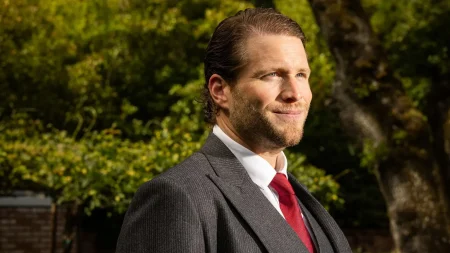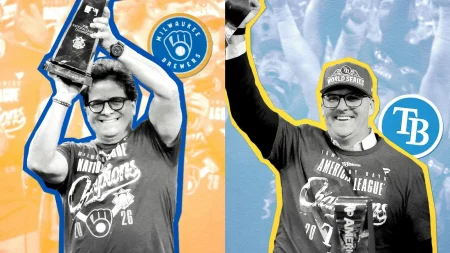



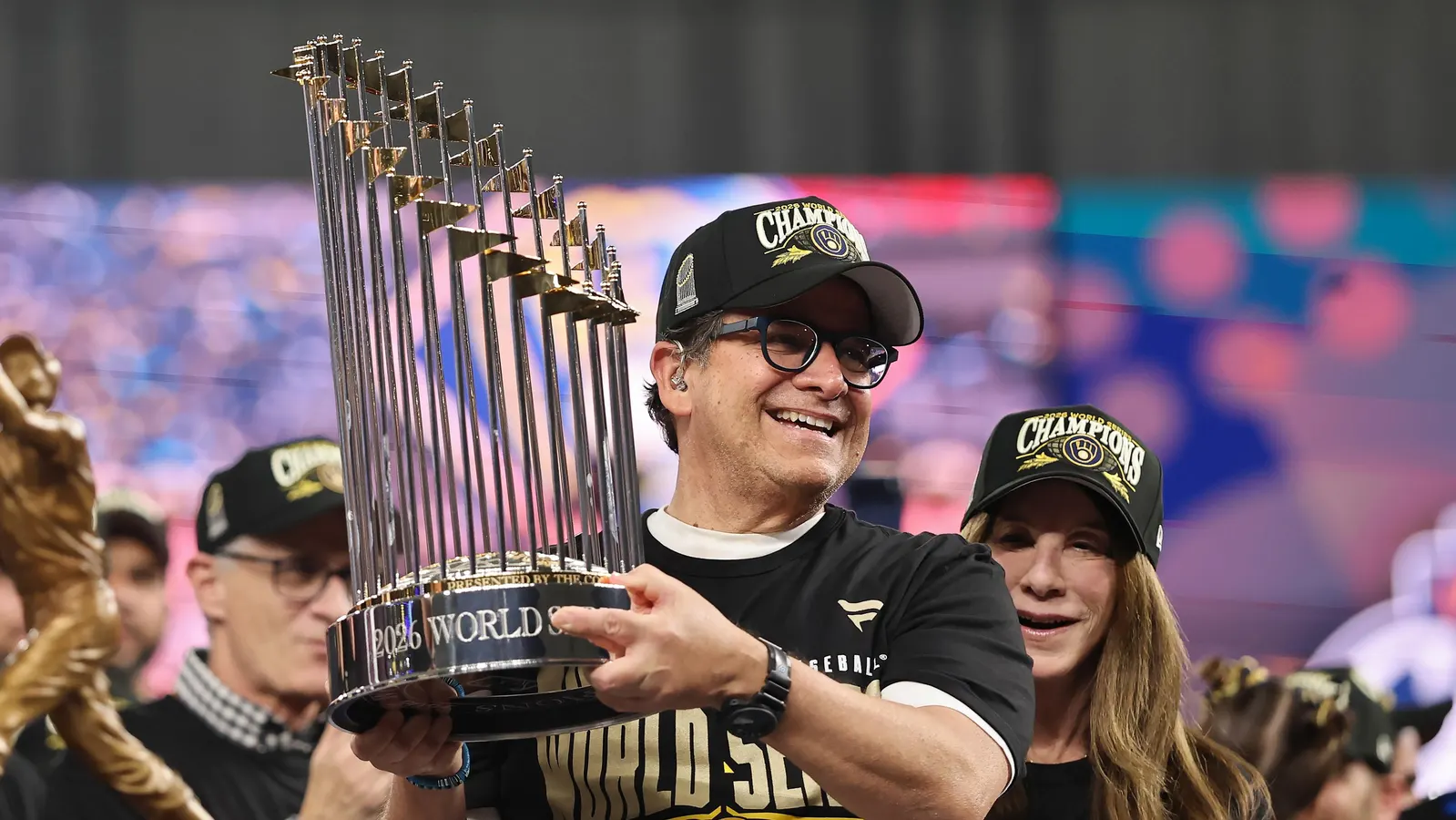
For more than two decades, Mark Attanasio had imagined what this moment might feel like, but even he couldn’t have prepared himself for the rush of emotion that came when the final out settled into a glove at Tropicana Field. The Brewers had just beaten the Tampa Bay Rays, 4-1, in Game 5, and the weight of 44 years of waiting, longing, and near-misses lifted all at once. It had been an agonizing 12-inning loss in Game 4, the kind of defeat that can haunt a team and make a city wonder whether destiny was cruel after all. But Wednesday night belonged to Milwaukee, and Attanasio—the 69-year-old who bought the franchise in 2005—was standing in the center of it all, grinning like a kid who had just watched his Wiffle Ball shot clear the imaginary fence. Surrounded by players, coaches, and executives on the on-field stage, he hoisted the Commissioner’s Trophy high, and the image was one of pure, unguarded joy. “Milwaukee has waited 44 years, and Milwaukee, you have your world championship!” he said, his voice carried across the stadium and back to the tens of thousands of fans gathered at American Family Field, watching together in a collective exhale. “I know that we’ve got tens of thousands of fans at American Family Field—we appreciate that you’ve all been with us the whole way, and everyone in the state of Wisconsin has gotten behind us.” It was a scene that felt both inevitable and surreal, because this was not a championship built on a dynasty’s payroll or a decade of playoff misery finally breaking. It was a championship built the hard way, the patient way, the way that has defined Attanasio’s ownership and given a baseball-crazy state a reason to believe that dreams, even old and battered ones, can still come true.
That belief was hard-won over a season that already seemed remarkable before the final celebration. The Brewers won a franchise-record 103 games during the regular season, playing with a relentless energy that made them the best team in baseball from April through September. But the true test came in the postseason, where they swept the Los Angeles Dodgers in the National League Championship Series, avenging a loss to the same team in the same round a year earlier and doing it with a calm confidence that suggested this was always part of the plan. What made the achievement even more striking was how little it resembled the formula of the sport’s biggest spenders. The Brewers play in the country’s 41st-largest metropolitan area, and their $146 million payroll ranked only 19th among MLB’s 30 teams. The Rays, their World Series opponent, had a payroll ranked 28th, and the contrast between these two small-market finalists and the financial giants of the sport was impossible to ignore. It adds a fascinating twist to the labor storm brewing beneath the surface, with baseball’s collective bargaining agreement set to expire in December. Team owners, including Attanasio, have been pushing for a salary cap, arguing that the current system leaves too many franchises unable to compete. But the players’ union has long suspected that the real motivation behind the cap is not competitive balance but franchise value—a way for owners to protect and increase the value of their investments. Whatever the merits of that debate, the World Series stage was proof that money alone does not create champions, and that a well-run organization with smart scouting, deep analytics, and a genuine culture of player development can still beat the giants at their own game.
Attanasio’s own journey to this moment was as unconventional as the path his team took to the title. He grew up in Pelham Bay, a predominantly Italian American neighborhood in the Bronx, where nearly everyone bled Yankee blue and the idea of one day owning a baseball team seemed like the kind of fantasy that gets left behind in childhood. He and his brother spent countless hours playing Wiffle Ball in a church parking lot, and when the Yankees lost the 1964 World Series to the St. Louis Cardinals, a 7-year-old Attanasio walked through the neighborhood in tears. That love of the game never left him, even as he went on to graduate from Columbia Law School in 1982 and spent three years at the elite New York firm Debevoise & Plimpton. He could have climbed the ladder toward partnership, but that path didn’t stir his soul, so he left for investment banking and moved to California, where he joined Drexel Burnham Lambert, the Wall Street firm that helped popularize junk bonds. He worked in mergers and acquisitions before finding his true calling in trading, and in 1991 he co-founded Crescent Capital Group, a Los Angeles-based investment firm specializing in corporate debt that now manages $53 billion in assets. His brother Paul, an Academy Award-nominated screenwriter, remembered the improbable nature of it all when Mark reached an agreement to buy the Brewers from the family of Bud Selig in 2004. “I grew up with my brother flipping baseball cards, and now he’s buying a Major League Baseball team—it’s an American dream,” Paul told the Los Angeles Times. That dream carried a price tag of $223 million at the time, roughly $394 million in today’s dollars, but 21 years later Forbes valued the franchise at $1.9 billion. Attanasio, who owns an estimated 45% stake, has seen his own personal fortune grow to an estimated $1.9 billion, a testament to both his business acumen and the soaring value of professional sports franchises.
Turning that ownership dream into a winning franchise, however, was another challenge entirely, and Attanasio quickly discovered that buying a baseball team was the easy part. When he took over, the Brewers were coming off 12 consecutive losing seasons, a stretch of mediocrity so entrenched that it felt less like a slump and more like a curse. There was no quick fix, and Attanasio resisted the temptation to throw money at expensive free agents in an attempt to force a turnaround. Instead, Milwaukee focused on developing young talent from within, building a pipeline of homegrown players that would become the backbone of the organization. The payroll never ranked higher than 13th during Attanasio’s ownership, but the front office expanded from roughly 130 full-time employees to more than 400, with investments in analytics, scouting, and player development that consistently produced one of the top-ranked farm systems in the game. President of baseball operations Matt Arnold won MLB’s Executive of the Year Award in both 2024 and 2025, recognition of a behind-the-scenes operation that had become the envy of the sport. “We feel we have to get up this way every morning—that whatever the system is, however it looks like the cards are stacked against us, we’re going to compete,” Attanasio told MLB.com this year. “We’ve done that for 21 years.” That quote captures the identity he has instilled in the organization: a stubborn refusal to accept excuses, a belief that hard work and intelligence can overcome structural disadvantages, and a quiet pride in being the team that nobody expected to be standing at the end. It is the same spirit that carried a boy from the Bronx through law school and Wall Street, and it is the same spirit that carried a small-market franchise to the top of the baseball world.
The results have been nothing short of transformative. In Attanasio’s first season as owner, the Brewers finished 81-81, a 14-game improvement that snapped the streak of 12 consecutive losing seasons and signaled that something had changed. Three years later, they reached the playoffs for the first time since 1982, and what had once felt like an impossible dream became a recurring reality. The Brewers have made eight postseason appearances in the last nine years, captured four consecutive National League Central titles, and led MLB in regular-season victories in each of the past two years. This World Series championship is not a fluke or a single magical run; it is the culmination of a sustained excellence that has made Milwaukee one of the most respected organizations in baseball. Attanasio’s ambitions, however, extend beyond the diamond. He also owns Norwich City, a second-division English soccer club, and has invested in the Milwaukee Admirals minor league hockey team, the Athletes Unlimited Softball League, and the PGA Tour’s commercial arm. Back in Wisconsin, American Family Field is undergoing a major renovation, backed by roughly $500 million in public funding and a commitment of more than $100 million from the team as part of an agreement that will keep the franchise in Milwaukee through at least 2050. Among the improvements is a new premium space called the Truss Club, set to open in 2027, part of a broader effort to make the ballpark a destination for generations to come. The championship trophy will be displayed there, a permanent reminder that the long wait was worth it.
For now, however, the future can wait. There is an unsettling uncertainty hanging over the sport, with the widespread assumption that MLB is headed for a lockout starting in December, and next season is far from guaranteed. But on this night, none of that mattered. The fans gathered at American Family Field, the players hugging on the field, and the 69-year-old owner hoisting the trophy and smiling with an emotion that could not be faked—they all understood that this was a moment to be treasured, not analyzed. Attanasio had waited more than two decades to see his team reach this mountaintop, and the city of Milwaukee had waited 44 years since its last World Series appearance and 57 years since the franchise had hosted a championship celebration. When he stood on that podium and looked out at his team, he was not just the billionaire owner or the former Bronx kid who used to cry over a Yankees loss. He was the steward of a community’s faith, the man who had promised that the Brewers would find a way to compete no matter the odds, and he had delivered. “Milwaukee, you have your world championship!” Those words echoed beyond the stadium, into the streets and bars and living rooms across Wisconsin, into the church parking lot where a boy once swung a Wiffle Ball bat, into the long history of a franchise that had known mostly heartbreak. Mark Attanasio waited more than two decades for this moment, and now it was his. It was Milwaukee’s. And as he held the Commissioner’s Trophy aloft, surrounded by the people who had helped make the impossible real, it was impossible not to feel that this was always the plan—that baseball’s long, winding road had finally led home.