


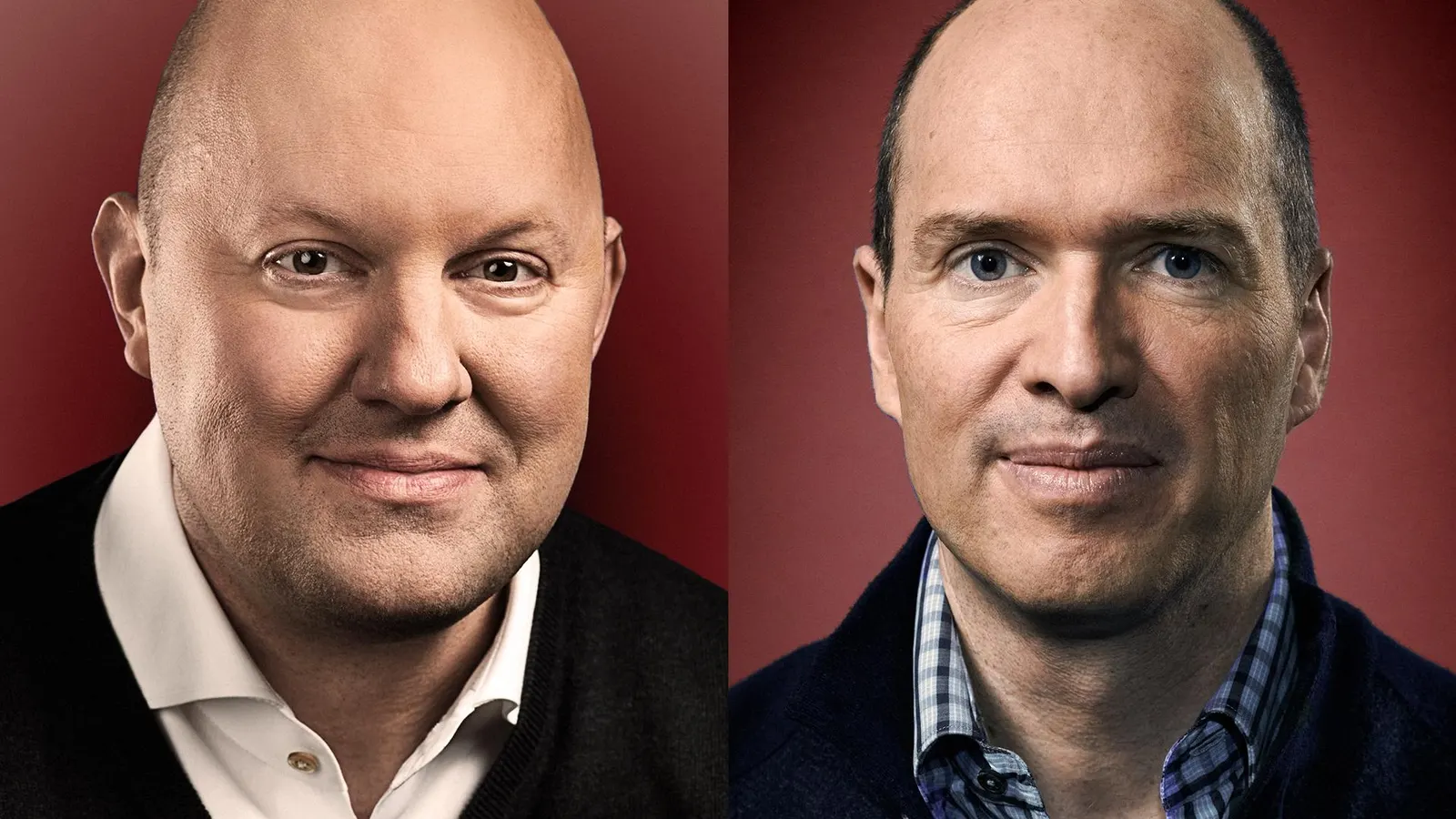
In January, Andreessen Horowitz, the Silicon Valley venture capital firm known to everyone as a16z, announced it had raised $15 billion in new funds. It was a staggering haul for a 17-year-old firm, pushing its assets to more than $90 billion—nearly double what it controlled in 2024. By March, after another $5 billion had been added, the firm was managing over $106 billion, making it by far the largest venture capital operation in the United States. The fundraising announcement was also a statement of purpose. In a blog post, co-founder Ben Horowitz wrote that “the fate of new technology in the United States rests partly on our shoulders,” and described the firm’s mission as “ensuring that America wins the next 100 years of technology,” starting with the key architectures of the future: AI and crypto. Forgive him if that sounds boastful. The numbers are on his side. Andreessen Horowitz has been one of the winningest tech investors of the past decade, and its co-founders are now among the richest venture capitalists in the country. Forbes estimates Marc Andreessen is worth $18.6 billion and Ben Horowitz $18.1 billion, behind only Peter Thiel and the legendary John Doerr. But the money has never been the whole story. What makes a16z different is its belief that it is not merely picking startups but shaping civilization—and that belief has led its founders to pour hundreds of millions of dollars into politics, betting that the future can be bought, lobbied, and built.
The story begins in the 1990s, when Andreessen co-founded Netscape, the web browser that helped ignite the internet era, and Horowitz worked there as a product manager. After selling Netscape to AOL, the two co-founded Opsware, an enterprise software company that they sold to Hewlett-Packard for $1.6 billion. In 2009, they launched Andreessen Horowitz from an office on Sand Hill Road in Menlo Park, the legendary corridor of venture capital. From the start, they wanted to build a firm unlike the old, small, secretive partnerships that dominated Silicon Valley. Their pitch deck sought out a new generation of “megalomaniacal” founders who, like Steve Jobs, would use technology to “put a dent in the universe.” Their philosophy was simple and, at the time, unusual: be the venture capital firm they wished had existed when they were entrepreneurs. So they hired marketers, recruiters, legal teams, and business development experts to help startups with everything beyond the check. “We come into it having been entrepreneurs our whole careers,” Andreessen told Forbes in 2012. “We’re doing it based on our experience, not based on theory.” The strategy worked spectacularly. Within three years, the firm had quadrupled its investment in Skype when Microsoft bought it for $8.5 billion, and a $250,000 bet on Instagram returned a monstrous windfall when Facebook bought the app for $1 billion. Airbnb co-founder Brian Chesky once described them as “the most aggressive and most bullish. They weren’t waiting for the market. They had their own beliefs.” That combination of nerve and service helped them back Airbnb, Twitter, GitHub, Instacart, Plaid, Substack, and Roblox—and, beginning in 2013, they quietly built one of the earliest major crypto portfolios, betting on Coinbase and Ripple years before crypto went mainstream.
Their recent performance has made those early instincts look prescient. Andreessen Horowitz first invested in OpenAI in April 2023, when the company was worth $29 billion; by March of this year, OpenAI’s valuation had reached $852 billion, and a public offering could push it past $1 trillion. SpaceX, another a16z portfolio company, went public in June at a $1.8 trillion valuation, a 13-fold return on their investment, and two months later acquired Cursor, an AI coding startup also backed by a16z, for $60 billion—a 150-fold return. Databricks, another key holding, closed a funding round in August valuing it at $190 billion, a stunning ascent from the $47 million valuation when the firm first invested. The exits have been just as fruitful for the firm’s own backers: a16z distributed $25.4 billion to its investors between 2011 and August 2025, a figure that rises to $37 billion if you include reinvested funds. Stanford professor Ilya Strebulaev, co-compiler of the 2026 Strebulaev-Jackson AI Venture ranking, which placed a16z at No. 1, says the firm’s size has become an advantage in the age of AI. “As companies stayed private longer and grew faster, there was a need for more capital and the traditional VC business model didn’t accommodate this,” he said. “With AI, there’s a lot of demand for large funding rounds and many VC firms can’t do it.” The firm’s deep bench—11 of its partners made the top-100 AI VC list, more than any other firm—has helped it court successful founders. Daniel Nadler, billionaire CEO of medical AI firm OpenEvidence, says a16z brings more than just money: “Their investing team brings more than just capital, they’re a true partner. They understand both enterprise sales and how a product gets adopted by individual users, which is important for a product like ours, where doctors are the customers.”
Given how much their fortune depends on friendly tech policy, it was perhaps inevitable that Andreessen and Horowitz would eventually wade into politics. For years, they were long-time Democrats who had donated a combined $2.5 million between 2009 and 2022. But in 2023, they published an essay announcing a new approach: they would support candidates who embraced an “optimistic technology-enabled future” and oppose those who aimed to “choke off important technologies.” “Every penny we donate will go to support like-minded candidates and oppose candidates who aim to kill America’s advanced technological future,” Horowitz wrote. The pivot accelerated under the Biden administration, which the pair felt was unreachable on their core issues of AI and crypto. “We didn’t have a relationship with the administration. We couldn’t get one. It drove me crazy,” Horowitz later said. In July 2024, Andreessen and Horowitz had a three-hour dinner with Donald Trump at his golf club in Bedminster, New Jersey. Ten days later, they discussed the presidential election on their podcast and publicly endorsed Trump. Horowitz, who had never before supported a Republican for president, acknowledged the backlash. “I’m going to have a lot of friends who are probably pissed off at me,” he said. “But the future of our business, the future of technology and the future of America is literally at stake. We think Donald Trump is actually the right choice.” They threw $85 million into the 2024 election, with $67 million going to the pro-crypto super PAC Fairshake. Andreessen gave more than $5 million to Trump and his committees, Horowitz gave $2.5 million, and after Kamala Harris replaced Biden on the ticket, Horowitz donated $2.5 million to a pro-Harris super PAC as well—a hedge that reflected the tangled relationship between personal history and political necessity.
After Trump’s victory, the two billionaires did not hedge anymore. Each gave $3 million to Trump’s inauguration fund. Andreessen became a frequent visitor to Mar-a-Lago, helping shape tech policy and vetting personnel, with two partners from the firm joining the administration. Horowitz attended the signing of the pro-crypto GENIUS Act in July 2025, and the pair have appeared alongside Trump at state visits, including with Saudi leaders and with King Charles III. In January, Horowitz’s blog post announcing the new funds read less like an investment memo than a political manifesto, urging the U.S. government to adopt AI and crypto to “defend and advance American interests” and warning that “if we fail to push the policies of the country in the right direction, America will likely lose its position as the global leader in technology.” That mission has translated into unprecedented spending. So far in the 2026 election cycle, the two have contributed $92 million, making them the fifth biggest donors in the country, behind Elon Musk, the Uihleins, Jeff Yass, and George Soros. The largest beneficiary is Leading the Future, a pro-AI super PAC they helped launch alongside OpenAI president Greg Brockman in August 2025. The PAC’s stated goal is “identifying, maintaining and growing pro-AI candidates.” They contributed $50 million of its funding, and through a network of PACs, it has spent $39 million so far, with about $28 million going to support Republicans and oppose Democrats. They’ve also given $12 million to Trump’s MAGA, Inc. super PAC, $5 million to other Republicans, just over $500,000 to Democrats, and $24 million to pro-crypto PACs. For two men who spent most of their careers outside partisan politics, it is a breathtaking embrace of political power—driven, in their telling, by an existential conviction that the future of American technology depends on winning the fight over AI.
So far, that bet has paid off. The Trump administration and the Republican-led Congress have not imposed major regulations on AI development. Trump has called AI fears a “hoax,” and Republican leaders have resisted calls for broad pauses or moratoriums. In September, Trump hosted leading AI executives at the White House and signed a one-page document asking AI firms to self-police their models; Andreessen and Horowitz were not there, but their ally Greg Brockman attended and signed the accord on behalf of OpenAI. The light-touch regulatory environment has helped fuel the industry’s skyrocketing valuations, which in turn has made a16z even richer. But the future is not guaranteed. After November 3, a rising tide of opposition to AI and data centers could vault skeptical lawmakers into Congress, threatening the friendly climate that has been so profitable. Andreessen and Horowitz have positioned themselves as the architects of an American tech century, using their vast fortune to shape both the companies and the politicians that will define it. They have remade venture capital, helped remake a political party, and inserted themselves into the highest levels of government. To their supporters, they are patriots ensuring that the next hundred years of innovation happen in the United States; to their critics, they are oligarchs using their billions to bend democracy to technology’s will. For now, they remain the most powerful venture capitalists in the world, convinced that they are doing more than making money—they are deciding who wins the future. The next election will be one of the biggest tests yet of whether that conviction is wisdom or hubris.