


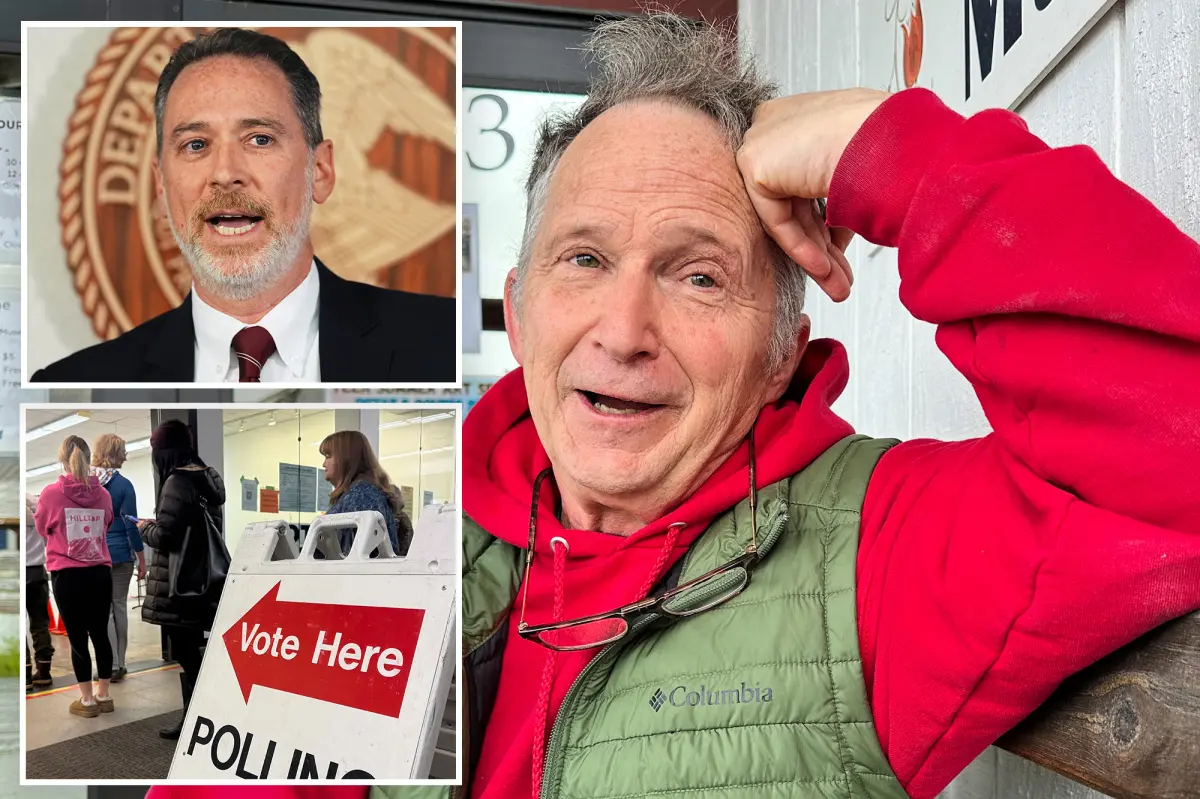
In Anchorage, on a grey and restless afternoon, U.S. Attorney Michael Heyman stepped before a bank of microphones and delivered a message that sounded less like a routine legal update and more like a warning shot across the political landscape. The Trump administration, he announced, was surging federal law enforcement resources into Alaska in response to “troubling new revelations” in an ongoing criminal investigation into an apparent Democratic scheme to siphon votes away from incumbent Republican Senator Dan Sullivan. What had been a quiet, months-long inquiry into the so-called “Decoy Dan” election plot was suddenly moving at full throttle, with investigators around the country taking coordinated steps that Heyman said he could not discuss in detail. He did make one thing clear: the Justice Department was treating allegations from a blockbuster New York Times report with extraordinary seriousness. “Every Alaskan deserves a fair election,” Heyman said, “and they’re going to get one.” He vowed that anyone who tried to deceive voters or interfere with the democratic process would answer for it. In a state where elections can turn on a handful of votes and where the memory of political scandal runs long, those words carried real weight. The investigation, already active for several months, had just become one of the most consequential federal election probes in the nation. According to the Times, the plot involved recruiting a person named Dan Sullivan to run as a decoy candidate, confusing voters who intended to cast their ballots for the incumbent. And now, with federal agents, prosecutors, and at least thirty subpoenas converging on the Last Frontier, Alaska had become a national flashpoint.
The scheme itself, as described by former Peltola campaign manager Elisa Rios and other anonymous sources, seemed almost too strange to be real, which is exactly why it was so dangerous. Imagine walking into a voting booth, scanning the ballot for the name you know and trust, and then pausing because there, right beside your intended choice, stands another person with the same name. In a crowded Senate race, with mail-in ballots and ranked-choice voting, that moment of confusion can be all it takes. According to the New York Times report, Democratic campaign aides were instructed to search for people named Dan Sullivan who could be persuaded to jump into the race, not as serious candidates but as human speed bumps designed to intercept votes meant for the Republican incumbent. Rios, who once managed Mary Peltola’s campaign, said that Peltola herself was not directly involved in the recruitment effort but was “definitely aware” of it. That single phrase, attributed to a former insider, transformed a bizarre political side-story into a full-blown criminal matter implicating the campaign of the Democratic nominee and, by extension, the Democratic Senatorial Campaign Committee. Heyman said the new information had triggered a significant surge of law enforcement assets to Alaska, including several attorneys from his own office assigned to the case and federal investigators across the country taking active steps. The investigation was no longer a regional matter; it was a national priority. And the sheer audacity of the alleged plot, deploying a decoy candidate simply to trick people into voting for the wrong person, struck many Alaskans as a cynical game played with the most sacred act of democracy.
Mary Peltola’s first public response to the scandal arrived with a mixture of defiance and frustration. Speaking at a campaign event on Thursday, she insisted she “knew nothing about any other candidate on the ballot except for me and the incumbent.” She said she was not interested in tricking voters, a statement that seemed aimed at defusing a political bomb that had exploded in the middle of her campaign. But her words did little to quiet the storm. President Trump, characteristically blunt, called on Peltola to drop out of the race and be criminally prosecuted in the wake of the report. For a candidate who had positioned herself as a fresh, hopeful voice in Alaskan politics, the accusation was devastating. Her former campaign manager’s account painted a different picture from the one Peltola offered: a campaign aware of the decoy effort, quietly allowing it to proceed, perhaps even encouraging it, while keeping the candidate herself at arm’s length. Whether voters ultimately believed her denial or Rios’s account, the damage was already done. Trust, once fractured, is not easily repaired in a community as close-knit as Alaska’s political class, where everyone seems to know everyone and loyalties run deep. Peltola’s insistence that she knew nothing may have been sincere, but it was also politically convenient, and that was the problem. The investigation was now probing not just the shadowy operatives who allegedly recruited a decoy candidate, but the very people who stood to benefit from the confusion. In the court of public opinion, being “aware” is often enough to convict.
Beyond the politics, a complex legal battle was unfolding in parallel. Heyman explained that the criminal investigation was running alongside a civil investigation into the scheme, and the Justice Department had already filed a lawsuit even before the Times report surfaced, seeking to delay the certification of Alaska’s Senate election results. That filing raised eyebrows among legal observers, but Heyman was careful to frame it as a protective measure, not an attempt to influence the outcome. “The department is not asking the court to declare a winner or loser or change the votes in any way,” he said. “It’s simply to preserve those ballots.” In other words, the government wanted to make sure that if criminal conduct had occurred, the evidence, in the form of the ballots themselves, would not disappear before investigators could examine them. This is not an unusual step in a federal election investigation, but it nevertheless carried a chilling implication: the government believed the integrity of the election itself was at stake. Heyman said the Department of Justice planned to ask the judge overseeing the case to grant expedited discovery by Monday, a request that signaled prosecutors were in a hurry. The urgency made sense. Every day closer to the final certification was a day closer to the point of no return. And in a race this tight, with a seat in the U.S. Senate hanging in the balance, the legal fight was not just about one election. It was about setting a precedent for how the country handles allegations of election manipulation. Heyman also disclosed that he had previously been recused from the investigation because he was being considered by the White House for a judicial nomination. That nomination, he said, had gone to someone else, allowing the recusal to be rescinded and freeing him to take direct control of the case. It was a small procedural detail, but it explained why the US Attorney had, until now, stayed on the sidelines.
The political implications of the investigation rippled far beyond Alaska’s borders. For Democrats, the scandal threatened to undermine their broader message on voting rights and election integrity, handing Republicans a powerful talking point just as the midterm season reached its fever pitch. For Republicans, it was a gift, proof, as they argued, that the other side would stop at nothing to win, even if it meant deploying fake candidates and sowing confusion at the ballot box. But for ordinary Alaskans, the implications were more personal. Elections are how communities make sense of their future. When confidence in that process is shaken, it doesn’t just cost a candidate votes; it erodes the very foundation of citizenship. Heyman’s words, intended to reassure, also served as a stark reminder of how fragile democratic norms can be. “Anyone who tries to illegally deceive voters and interfere with the election will answer for it,” he said. That is a powerful promise, but it is also a tall order in a country where election laws are complex, overlapping, and often difficult to enforce. The surge of federal resources to Alaska was a statement of commitment, but it was also a recognition of how much work lay ahead. Investigators were now sorting through a tangle of text messages, campaign emails, witness accounts, and subpoenaed documents, trying to determine who knew what, when they knew it, and whether any crime had actually been committed. The line between dirty politics and criminal behavior is not always clear, and this case seemed destined to test that boundary.
As the investigation continues, one question hangs over Alaska like the long, uncertain light of an Arctic summer: what will happen to the election itself? The ballots have been cast, the votes have been counted, and yet the outcome remains suspended in legal limbo, preserved not as a final verdict but as evidence. Federal investigators are moving swiftly, state officials are bracing for a prolonged battle, and voters are left to wonder whether their voices will ultimately be heard or lost in a fog of allegations and counter-allegations. For Mary Peltola, the coming days will likely determine whether her political career survives the storm. For Dan Sullivan, the incumbent, the scandal offers both vindication and a reminder that even a comfortable lead can be erased by chaos. And for Heyman and his team, the pressure is immense: they must uncover the truth without further poisoning the well of public trust. In a state where “the last frontier” is more than a slogan, where independence and self-reliance are deeply valued, the idea that outside political machines might have tried to rig an election is particularly offensive. Alaskans have always prided themselves on doing things their own way, and they do not take kindly to being treated as pawns. The investigation is far from over, and there are more questions than answers. But one thing is certain: the eyes of the nation are now fixed on Alaska, and the outcome of this inquiry may very well determine not just who represents the state in Washington, but whether Americans can still believe that their ballots mean what they say. In the quiet of that Anchorage press conference, with microphones still humming and cameras rolling, a simple promise was made: every Alaskan deserves a fair election, and they are going to get one. Whether that promise can be kept remains to be seen. But for now, at least, the machinery of justice is moving, and the people of Alaska are watching closely, hoping that truth will be found before trust is lost forever.