


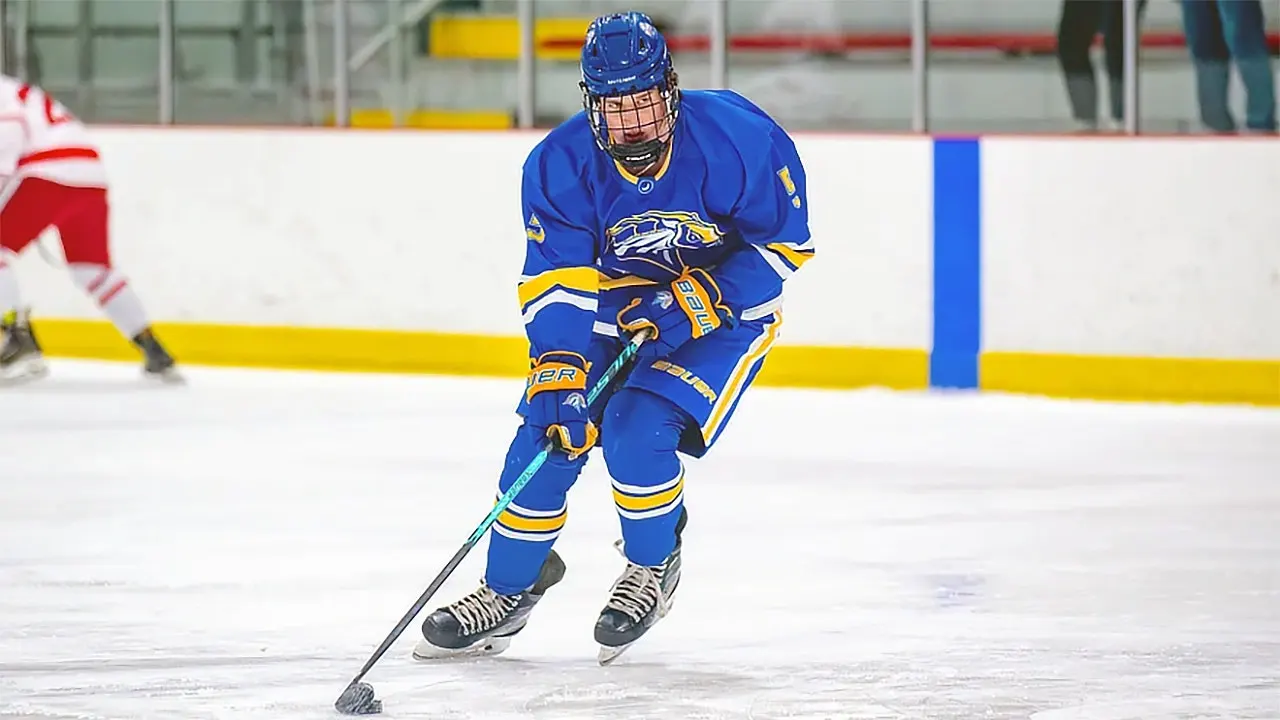
On an autumn night in Connecticut, the ordinary act of driving home became an unthinkable tragedy. Ryan O’Shea, a 21-year-old senior from Stony Point, New York, had spent the evening doing what he loved most: playing hockey. As captain of the University of New Haven men’s club hockey team, he was used to late-night drives back from the rink, his car full of the joyful, tired energy that follows a game. But on Oct. 16, on Interstate 91 in North Haven, that ordinary drive was shattered forever. A Chevrolet Silverado, traveling in the wrong direction, slammed head-on into Ryan’s Honda Accord. The impact was so violent that it sent his car into another lane, where a Jeep struck it, and then drove it onto the right shoulder, where a third vehicle hit it. By the time the wreckage came to rest, Ryan was gone. He was pronounced dead at the scene. The driver of the Silverado, 31-year-old Guillermo Carmona-Lopez of Bridgeport, was taken to Yale New Haven Hospital with serious, life-threatening injuries, while three other people suffered only minor injuries. It was an ending no one saw coming—no warning, no slow motion, just a single moment of light and metal and noise, and then a community left to struggle with the numb, disbelieving weight of loss.
The details of the crash, released by Connecticut State Police, paint a horrifying sequence. Ryan was driving south on the highway in his Accord, likely heading back to campus or home after the hockey game. The Chevrolet Silverado was coming up the same highway the wrong way. The two vehicles met head-on in a collision that likely left no time for evasive action or fear. Ryan’s car was thrown into another travel lane, struck again by a Jeep, then pushed onto the shoulder and hit by a third vehicle. For Ryan, the injuries were immediately fatal. For the other people involved, the night ended with scrapes, bruises, and a lingering horror. The Connecticut State Police Collision Analysis and Reconstruction Squad responded to the scene, and the investigation remains ongoing. These are the cold facts that appear in reports and bulletins, but they cannot capture what actually happened in that fleeting, violent instant: a young man with plans, with family, with friends, with a full life still waiting to be lived, was taken away. In an instant, his parents lost a son, his teammates lost their captain, his future colleagues lost a man who wanted nothing more than to protect and serve his community. A highway that had likely been quiet and ordinary became the site of a loss so profound that words feel hollow, even as investigators work to explain how it all happened.
Ryan O’Shea was not just a hockey player; he was a person who carried purpose everywhere he went. He grew up in Stony Point, New York, and had chosen to study criminal justice with a concentration in police science at the University of New Haven. That decision was not casual. Ryan wanted to make a difference. Over the summer, he interned with the New York City Police Department, learning firsthand what it meant to walk toward danger while others walked away. His dream was to join the NYPD after graduation, and later to pursue a career with the Drug Enforcement Administration. To those who knew him, this was no abstract ambition. Ryan had a deeply felt desire to help others, to be part of something larger than himself, to stand on the side of justice in a world that often feels unjust. His academic advisor, Lorenzo Boyd, remembered him with quiet warmth, telling the university, “Ryan wanted to go into public service in order to help others. He was engaging in the classroom and will be missed greatly.” Those are the words people use when a student is more than a name on a roster—when they are a presence, a questioner, a young man who showed up not just to earn a grade but to become something good.
Hockey was another place where Ryan left his mark. As senior captain of the men’s club hockey team, he was not just a leader on the ice but the emotional center of the locker room. Devin Bertrand, the team’s general manager, described Ryan as someone whose “infectious personality lit up our locker room the moment he walked in.” That kind of presence is rare. Often, we remember the loudest voices or the most vocal leaders, but Ryan seemed to understand that leadership was about connection: making people feel seen, making them laugh, making them believe that the game and the group mattered. He also served as president of his Kappa Sigma fraternity chapter, where his brothers knew him as someone who was always ready to help, always ready to lift a mood. The fraternity wrote in a social media tribute, “Ryan was not only a great leader, but he was a caring friend to anyone around him. He always knew how to light up a room and make people laugh, no matter the time.” Those words linger with a particular sadness now. Ryan was returning from a hockey game when the crash occurred—a fitting detail, because hockey was so central to his life. He had given everything to his teammates on the ice, just as he had given himself to his studies, his fraternity, and his dream of public service. His death leaves more than an empty chair in a classroom or a missing number on a jersey; it leaves a silence where laughter used to be.
As Ryan’s community mourned, another layer of the story emerged, one that turned personal grief into a national conversation. The Department of Homeland Security confirmed to Fox News Digital that Guillermo Carmona-Lopez, the driver of the wrong-way Silverado, was a Mexican national who had repeatedly entered the United States illegally after previously being removed. According to DHS, in May 2013, Border Patrol arrested Carmona-Lopez after he illegally entered the country. He was issued an expedited removal and sent back to Mexico. That same month, he reentered the United States illegally near the Rio Grande Valley and was arrested by Border Patrol again. On May 30, 2013, he was issued a final order of removal. Yet he later reentered the country at an unknown time and place, and remained in the United States for years until that October night on I-91. The revelation added a painful, complicated dimension to an already unthinkable tragedy. For Ryan’s family and friends, no policy debate could bring back a son, a teammate, a friend. But in the public arena, the case became a stark illustration of how immigration enforcement and public safety can collide in the most devastating way. A DHS spokesperson made the agency’s position clear, saying, “Under President Trump and Secretary Mullin, if you break the law, you will face the consequences. Criminal illegal aliens are not welcome in the U.S.” For some, that message was a call for accountability; for others, it was a reminder that silence still surrounds how Carmona-Lopez slipped through the cracks for so many years.
In the end, the story of Ryan O’Shea is not just about a crash, or a legal status, or an immigration system that failed. It is about a 21-year-old who wanted to wear a uniform and protect strangers, who laughed in locker rooms and led his fraternity brothers, who was weeks or months away from beginning the career he had worked for his entire young life. The investigation into the crash remains ongoing, and the answers may take time. But for those who loved Ryan, the only answer that matters is one that will never come: why him? Why that night? Why that highway? Grief is not neat, and it does not follow the rules of journalism or law. It is messy, it comes in waves, and it searches for meaning in a senseless act. What remains is memory. The memory of a young man who lit up rooms, who dreamed of public service, who was on his way home after playing the game he loved. The memory of a family left behind, of teammates who lost their captain, of a university community that will forever associate a hockey jersey and a classroom seat with both pride and pain. In the face of all that loss, perhaps the most human response is to remember that Ryan was not a statistic or a headline. He was a son, a friend, a leader, a future protector. And his story, however heartbreaking, is a reminder that life is fragile, that leadership is about care, and that the promises we make to each other—to serve, to protect, to lift up—are the only things that can make any sense out of a night when the lights go dark too soon.