

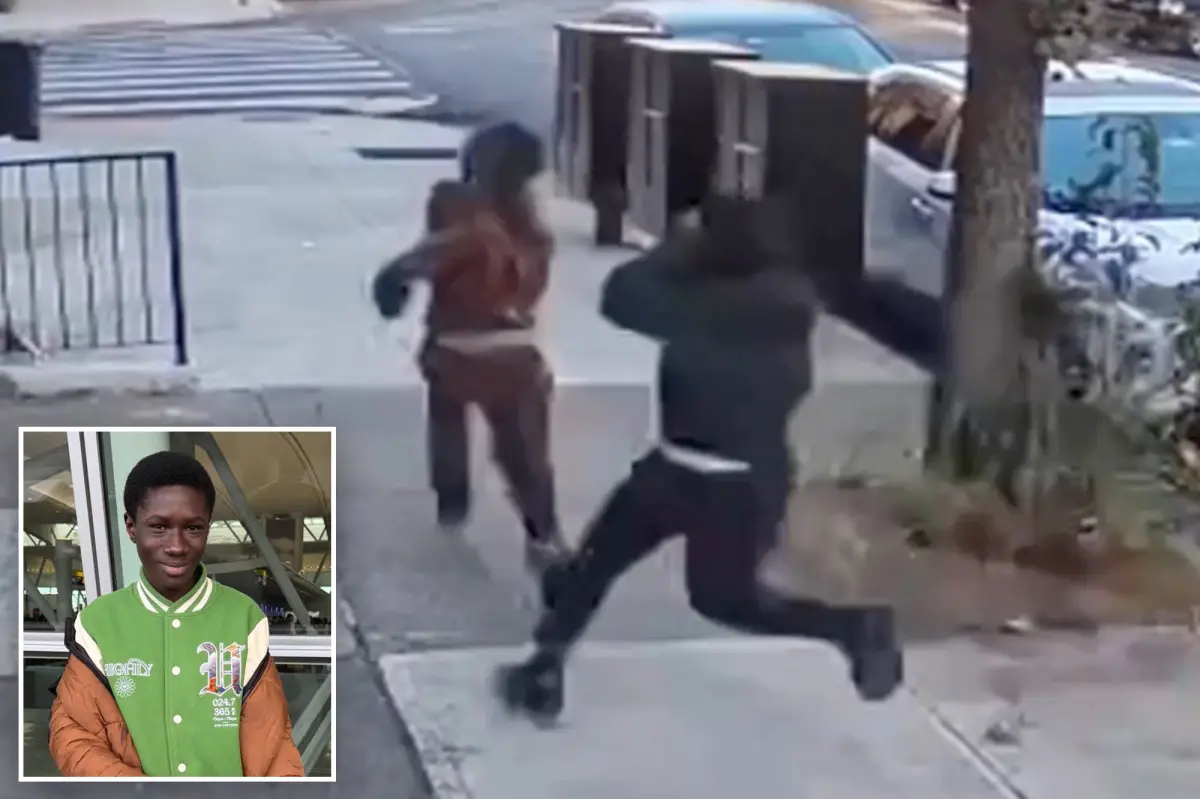
The video is the kind that makes you stop breathing. A 15-year-old boy in the Claremont section of the Bronx, Javits Frimpong, is seen sprinting down the street, running for his life. Another figure, dressed all in black, is beside him at first, then stops, while Javits keeps going. The boy had been on his way to school Thursday morning. But he never made it. Around 9:25 a.m., at East 171st Street and Third Avenue, he fell to the pavement, struck by a bullet to the stomach. Police and law enforcement sources said he was taken to a hospital and initially listed in stable condition, but the wound was too much. Javits later died. The brief, heartbreaking span between a morning that began like any other and the moment a family was destroyed has been reduced to surveillance footage and police reports. For his father, Thomas Frimpong, 60, it is an unbearable reality. The boy had recently immigrated from Ghana to America, full of hope. Now his father stands in a country that was supposed to offer safety and opportunity, trying to understand why his son was gunned down on a city street. The principal of The DreamYard Preparatory School, where Javits was a student, had called Thomas just two days before the killing. The message: Javits, a quiet boy, was being bullied. Two boys had been fighting with him, the principal said, and the two boys had been suspended. Thomas had absorbed that news with concern; what parent wouldn’t? He never imagined the call on Thursday would be so much worse. The principal called again to say his son had been shot. The boy with the quiet voice, the immigrant kid who tried to stay out of trouble, had become a statistic in a city too familiar with tragedy.
Rushing out the door, Thomas Frimpong hurried to St. Barnabas Hospital, desperate to see his boy with his own eyes. He found Javits there, fighting to hold on. But the light flickered out. With grief pressing down on his chest, Thomas had to make another call—the worst call any father can make. He dialed Ghana, to the boy’s mother, to the wider family they had left behind. “I just called his mother [in Ghana] and even I can’t hear her voice, crying, crying, crying. All the family members are crying,” he said, his own voice breaking, unable to separate his tears from the ones flowing across the ocean. It is impossible to know how a mother in Ghana processes the news that her child, sent off to a new country with the promise of a better life, will never come back. The distance of thousands of miles only made the pain sharper. Thomas was alone in the Bronx, surrounded by a strange city, carrying the weight of a mission that had failed in the most brutal way possible. He had brought Javits to America for school, for safety, for dreams. Instead, he was now making funeral arrangements. He was now explaining to relatives in Ghana that the boy they remembered, the boy who had waved good-bye at the airport, was gone. The principal’s earlier call about bullying now echoed in his mind. The principal had told him his son was being bullied; two boys were fighting with his son; the two boys got suspended. For a moment, Thomas may have thought the school was handling it. But bullying does not always end in a principal’s office. Sometimes it follows you out the gate. Sometimes it catches up on a street corner. The father could not say with certainty who pulled the trigger or why, but he believed the shooting was tied to the bullying. It was the only explanation that made sense to him—and the one that made the loss even harder to accept.
Detectives were left with a grim scene and few clear answers. Three males wearing all black, believed to be between 16 and 18 years old, were seen fleeing after the burst of gunfire, according to police. The motive was still under investigation, and no arrests had been made. The young age of the suspected shooters only added to the horror: teenagers gunning down another teenager, the same age group that should have been in classrooms or playing ball, not running through parks with guns. An 18-year-old woman named Karolinne Guerrero was walking to school when she heard the gunshot. She described seeing two males dressed in black, wearing facemasks, running in the park. At first, she wasn’t sure what she had heard: “I heard like a gunshot. I’m like, ‘Am I tripping?’ It came from, like, inside the park.” She recognized the danger instantly. She went straight to school, trying not to be involved, trying not to be another witness who ends up in the crosshairs. But fear stayed with her. “I feel scared ’cause I live right there. I’m like, yo, I’m scared.” That is the atmosphere that has settled over the neighborhood: fear, numbness, and the knowledge that gunfire can erupt at any moment. Guerrero did what she could to distance herself, but the memory of the shot, the mask, the running figures, will stay with her. She lives right there, in the same block where a boy fell and bled, and now her walk to school will never feel safe. The suspects vanished into the park, swallowed by a city that knows how to hide violence. Police would spend Friday canvassing, looking for witnesses, trying to piece together the moments before the shooting. But a neighborhood that has learned to keep its mouth shut, that fears retaliation and parole checks and police scrutiny, does not always open up. The silence is part of the tragedy.
Another witness, a man who watched from his window, offered the most chilling account of the attack. He declined to give his name because, he said, he didn’t want to put himself in danger or jeopardize his parole. From his window, he saw what looked like an ambush. Two boys “ran after him, shot him, ran off into the park,” he said. The word “ambush” carries a particular cruelty: it suggests planning, intention, a coordinated act designed to make sure a boy had no chance. Javits may have been running not just for his life but in a panic, trying to escape. The video shows that final burst of movement, that impossible instant when the body outruns the bullet for a few steps but cannot outrun the damage inside. Then he collapsed. The witness sat there, watching. He says the boy lay on the ground for about half an hour before police came. “People were just walking by him,” he said. That sentence is hard to read. How could people walk past a wounded child? But fear can do that to a community. Maybe they assumed someone else had called. Maybe they were afraid to get involved. Maybe they didn’t want to be the next one shot. The witness did not call 911 because, as he admitted, he didn’t want to jeopardize his parole. He feels guilty, or at least he says he feels really guilty. Guilt is a heavy companion. He is not the only one. It was a woman from a nearby homeless shelter who finally came out and called 911. She was frantic, he said. It took a stranger living in a shelter to do what the rest of the block could not or would not do. That image is painful: the boy lying in the street, the everyday foot traffic continuing, and then one person breaking through the inertia to ask for help. It should not have taken thirty minutes. But by the time Javits reached the hospital, the damage was done. It is possible no amount of speed could have saved him, but the long wait haunts the story.
Whoever they are, the three young males in black are still out there. Their identities are unknown to police; their motive unclear. But the neighbor’s voice carried an exhaustion born of years of seeing this happen: “It’s like back in the day. Nothing ever changes. They’re still shooting each other.” Those words sound like a summing-up of a neighborhood where each new shooting echoes an older one. The same corners, the same parks, the same all-black clothing, the same mother crying on a phone from another country. Nothing changes, but everything is lost. Javits Frimpong was not a gang member, as far as anyone has said. He was a recent immigrant from Ghana, a student on his way to school, a quiet boy who was bullied. His death is not the kind of story that fits neatly into a narrative of urban violence; it is a story about a family who believed in the American dream and watched it turn into a nightmare. The father came to this country, probably worked hard, tried to give his son a foundation. He sent him to school on Thursday, expecting him to come home. Instead, he got a call from the principal, then a race to the hospital, then a phone call to Ghana. Now he is left to sit in a new country with an unthinkable question: Why? Why was his son targeted? Was it the bullies from school? Were the shooters the same boys who were suspended, or their friends, or a different group entirely? The police have not connected the shooting to the bullying officially; they say the motive remains under investigation. But for Thomas, the connection is as clear as the grief in his eyes. A principal called him about bullying on Tuesday. On Thursday, his son was shot. That sequence of events does not feel random. It feels like a warning that escalated into a killing, a failure of every adult and every institution that was supposed to protect Javits.
At the time of this writing, no one has been arrested. The investigation continues, but an arrest will not bring Javits back. It will not erase the image of a boy running down a Bronx street. It will not heal the mother in Ghana whose voice has dissolved into tears, or the father who will have to return to an empty home, if he has the strength to return at all. For a community, the shooting has become another scar, another caution, another reason to look over your shoulder. For a family, it has become the end of everything. Javits Frimpong was fifteen years old. He had already crossed an ocean in search of a better life. He was trying to go to school, to learn, to become someone. His father called him “very quiet.” That quiet boy is now a name in the news, a face in the video, a body on a stretcher. He is also a reminder that bullying can be lethal when it is left to fester, that a school’s suspension is not always a shield, and that a community’s fear can leave a child lying in the street for thirty minutes. The woman from the homeless shelter who called 911 did the right thing. The neighbor who didn’t call is now carrying his own guilt. The other witnesses are passing through their own memories. And somewhere, three young men in black are living with what they did, or trying to pretend it didn’t happen. They may be caught; they may be arrested; they may stand in court. But they cannot undo the phone call Thomas Frimpong made to Ghana. They cannot bring Javits back to his mother’s arms. The sun will rise over Claremont tomorrow, and children will still walk to school through those streets. But one of them will be missing. The grief will remain, and the questions will remain, and in the quiet moments, the father will hear his son’s name and see him running, running, running until he collapses. “Nothing ever changes,” the neighbor said. But maybe change has to begin with a willingness to see the boy, to call 911, to break the silence. That is the cruel, human lesson of this tragedy: We can no longer bring back Javits Frimpong, but we can remember that behind every distance and every difference, every boy on every street is a family waiting for him to come home. No one should have to wait for a call like that.