
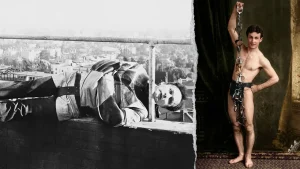


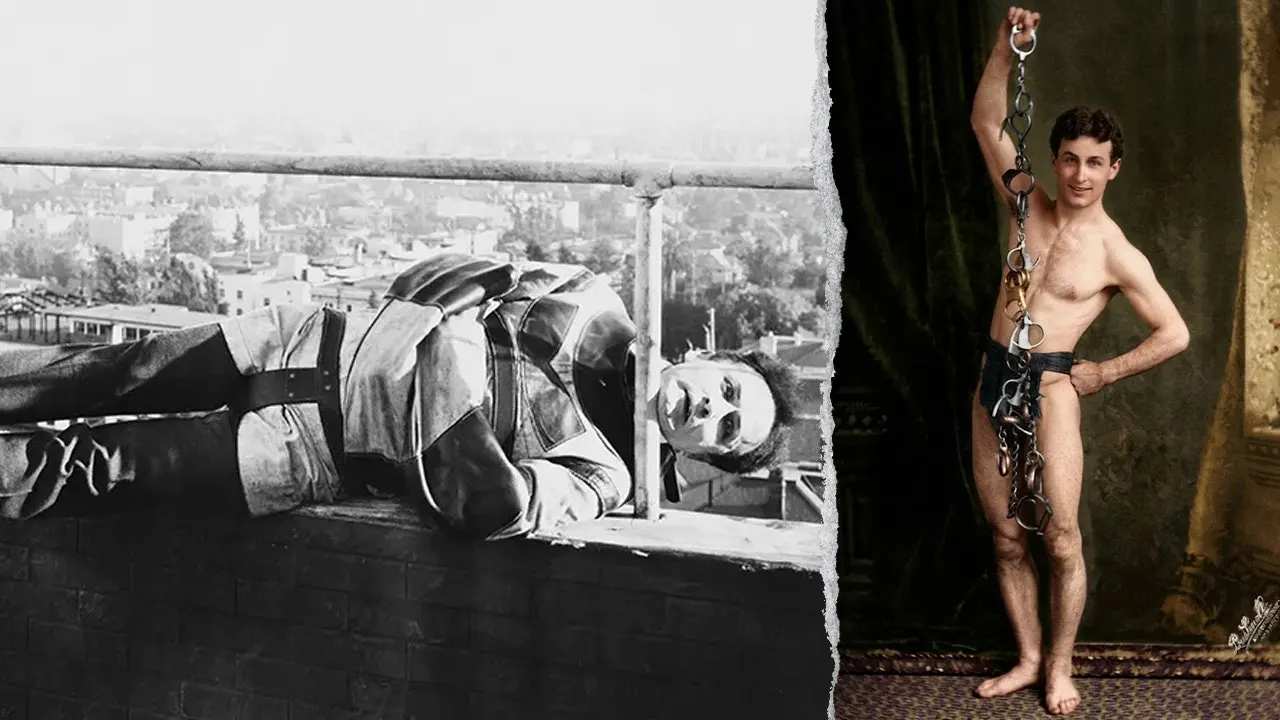
Even in death, Harry Houdini left the world a riddle—and a hundred years later, we are still trying to solve it. The man who escaped handcuffs, jails, sealed boxes, and watery graves could not escape the one mystery that has followed him since Halloween night in 1926. Born Erik Weisz in Hungary, Houdini immigrated to the United States with his family as a four-year-old child. He grew up to become the most famous magician and vaudeville performer of his age, a dazzling showman whose name became a verb for getting out of impossible situations. But when he died at the age of 52 on October 31, 1926, the official cause of death was listed as peritonitis, a catastrophic infection caused by a ruptured appendix. That straightforward medical explanation, however, never satisfied the public’s imagination. From the moment his breath stopped, theories began to multiply. Some whispered that a sudden, violent punch to his stomach had triggered the deadly appendicitis. Others insisted he had suffered from an intestinal blockage. Still more suspected something far darker: that Houdini had been killed by the very spiritualists and mediums he had spent years exposing as frauds. And then there was the persistent myth, fueled by a 1953 Hollywood film, that Houdini had finally met his match in his own famous Water Torture Cell, unable to escape in time to save himself. As Houdini historian and biographer John Cox told Fox News Digital, “There’s plenty of room for speculation, for conspiracy theories, and so it continues. It continues to this day.” Now, in the new three-part Fox Nation series “Houdini: Back from the Dead,” artificial intelligence allows Houdini to appear as if he is sitting down for a modern-day interview, telling his own story of struggles, relationships, and legendary feats. But even with that imagined conversation, the mystery of how he died—and why he continues to haunt us—remains as alive as ever.
The most famous and fateful moment in the timeline of Houdini’s death is a seemingly casual encounter in a Montreal dressing room on October 22, 1926. That date is now etched in legend as the day a university student named J. Gordon Whitehead asked the great Houdini if he could test his famous ability to withstand a blow to the stomach. According to historians, Houdini was resting on a couch, still in his costume or perhaps in his street clothes, when the young man approached him. Houdini, ever the showman and eager to prove his toughness, gave his consent. But before he could properly brace himself, Whitehead began punching him—hard. The blows continued until someone else in the room shouted for Whitehead to stop. It was an ugly, chaotic incident, and one that likely changed the course of Houdini’s life. Roger Dreyer, president of the Houdini Revealed museum in New York, has studied the story for decades. He and many other historians now believe that Houdini was already suffering from the early symptoms of appendicitis at the time of the attack, but he was so focused on the pain and humiliation from those punches that he ignored the growing pain in his abdomen. As Cox explained, Houdini did not seek treatment in time. The appendix ruptured, spilling infection into his abdominal cavity, and in 1926, without modern antibiotics or surgical techniques, that was a death sentence. “Had he not been punched, this pain would have come out of nowhere, and he might have gone and sought medical attention sooner,” Cox said. “So the punch was very likely just a very poorly timed accident that caused him to not pay attention to what was really happening to him medically.” It is an almost unbearably ironic end for a man whose entire life was about being in control of his own body and fate. Instead, he was undone by bad luck, stubborn pride, and a few seconds of unchecked violence in a quiet room.
Yet the strange twist of that tragic accident is that it ended up providing for Houdini’s family in a way he might never have expected. At the time of his death, Houdini was, in fact, deeply in debt—thousands of dollars owed, despite all his fame and spectacle. His lifestyle, his lawsuits, and his relentless pace of performing had caught up with him. But because the blows to his stomach were blamed for his death, his life insurance policy paid out double. As Dreyer explained, Houdini had a life insurance policy for $25,000, and the agreement included a clause that if he died from an accident, his beneficiaries would receive another $25,000. In today’s money, that extra sum would be worth nearly half a million dollars. It is a darkly poetic sort of justice: the very violence that many believe hastened his death also saved his family from financial ruin. But the circumstances of Houdini’s final days only fed the stories that grew around him. Some of those stories were born from Houdini’s own lifelong obsession with death. He had always danced with danger, performing escape stunts that seemed to invite catastrophe, and he was morbidly aware that one day his luck would run out. He had even made a pact with his beloved wife, Bess Houdini: whoever died first would try, from beyond the grave, to contact the other. After Houdini died, Bess took that promise seriously. For ten straight years, on every Halloween—the anniversary of his death—she held a séance, hoping to hear from her husband. She sat in darkened rooms, with mediums and believers, waiting for a sign, a whispered word, a secret code. None of her attempts succeeded. Eventually, she gave up, publicly concluding that communication with the dead was simply impossible. For a woman married to a man who had spent so much of his career exposing fake mediums as frauds, it was both a heartbreaking and strangely fitting conclusion.
Houdini’s crusade against spiritualism had been one of the defining passions of his later life. He had watched grieving families hand over their savings to people who claimed they could speak with dead children, dead parents, dead lovers—and he was enraged by the cruelty of it. He used his own knowledge of magic and illusion to demonstrate how many mediums were using tricks: hidden wires, ventriloquism, cold readings, and theatrical props. He became a kind of ghostbuster of his era, and his efforts earned him the hatred of those he exposed. Some of them threatened him, and a few even sued him for defamation. For Houdini, this was not just a performance; it was a moral mission. He knew that grief made people vulnerable, and he believed that exploiting that vulnerability was one of the worst crimes a person could commit. He wanted to protect the vulnerable, and he paid a price for it. Yet because he had spent so much time denouncing the dead as unreachable, some theorists have suggested that the spiritualists themselves may have arranged his death as revenge. There is no evidence to support that claim, but it has become one of the most enduring conspiracy theories of the last hundred years. What is certain is that Houdini was not a man who lived quietly in the shadows of mystery; he was a man who actively tried to strip away layers of deception in the world around him. That makes it all the more painful that his own death became clouded by stories he would have fought to debunk.
When we look back at Houdini today, one hundred years after his death, it is tempting to focus on the dark drama of his final days. But as Roger Dreyer insists, Houdini’s legacy is not about how he died—it is about how he lived. Dreyer calls him the top “social influencer” of his time, a true pop icon long before the term existed. Houdini remains a household name, still synonymous with the idea of escaping any tricky situation, whether literal chains or the metaphorical traps of life. But Houdini was more than just a stuntman or a magician. He was deeply devoted to spreading a positive message, one that encouraged ordinary people to believe in their own power to overcome obstacles. His escapes were never simply about showing off his physical skill; they were demonstrations of the human spirit’s ability to find a way through almost anything. He performed for factory workers and royalty, for children and presidents, and he never lost the sense of wonder that had driven him as a boy. He wanted people to walk away from his shows feeling that the impossible might be possible—that if they used their brains, their courage, and their determination, they might find a way out of their own locked boxes. His motto, Dreyer recalled, was simple and profound: “My brain is the key that sets me free.” That is the Houdini who still inspires us today. It is why Dreyer, as the “chief wizard officer” of Fantasma Toys, tries to carry on Houdini’s tradition of surprise and wonder, hoping to ignite the same spark of joy in a new generation of young magicians and dreamers. It is why his story is not a sad one, even though his death was premature. He left behind an idea: that courage and ingenuity are the greatest escape tools we will ever have.
Perhaps that is why, a century after his death, we still cannot stop talking about Harry Houdini. It is not because of the mystery of his final illness, or the theories about punches and revenge, though those stories will always be a part of his legend. It is because Houdini, in his life, represented something eternal: the belief that we can free ourselves from the things that hold us back. He was a poor immigrant boy who taught himself to become famous, a man with no superhuman powers who created his own miracles through practice, willpower, and an uncompromising refusal to accept limitations. His escapes were metaphors for our own struggles, and that is why they still resonate. Even the historians who have spent decades studying him are still fascinated. As John Cox put it, “We’re still trying to figure out how Houdini did what he did.” And maybe we always will be. Because the true magic of Houdini is that he makes us believe that even the most impossible-looking situation might have a hidden door, a secret latch, a way out—if only we are willing to search for it. That is a lesson that never grows old. It is why his name still appears in our everyday language, why his photos still stare out from books and documentaries, and why a new AI-powered series can make him seem to speak again from beyond the grave. He was a man of flesh and bone, who suffered, loved, grieved, and died too young. But in another sense, Houdini never really left. He escaped the finality of being forgotten. And that may be the greatest trick he ever performed.