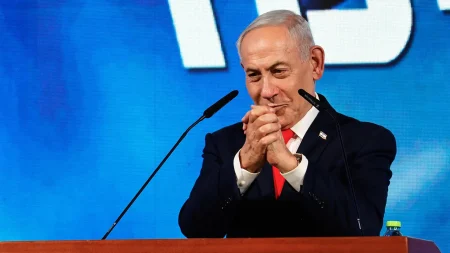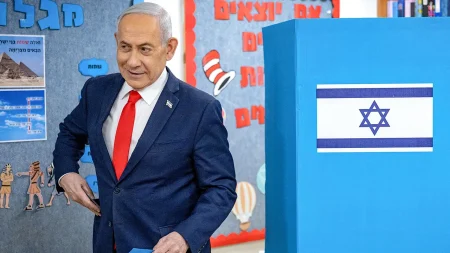



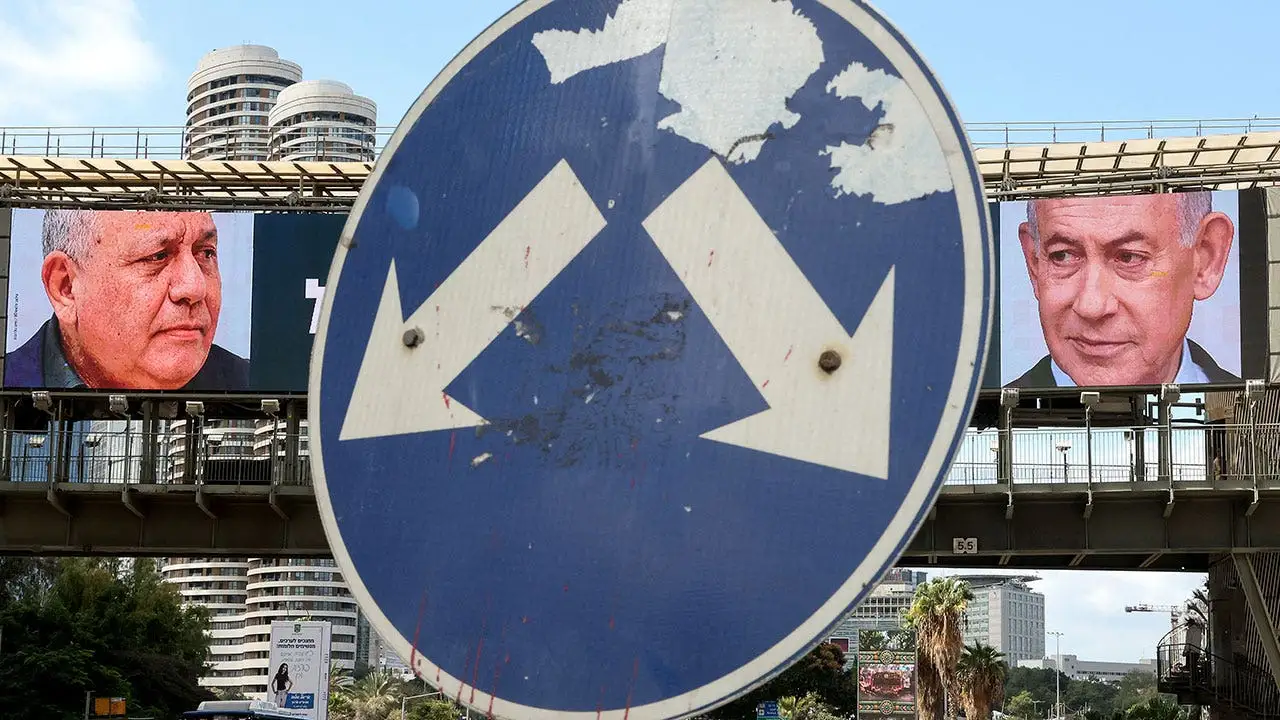
Israel woke up to a dramatically altered political map on Thursday, and the morning after the election was anything but the straightforward victory that Prime Minister Benjamin Netanyahu’s camp had hoped for. With nearly 94 percent of ballots counted, including the special double-envelope votes cast by soldiers, diplomats, prisoners, and others that often reshape the picture after election night, Netanyahu’s right-wing and religious bloc was projected to hold just 53 seats in the 120-member Knesset. That fell well short of the 61 needed to govern, and it was a stark comedown from the momentum Netanyahu had seemed to enjoy just hours earlier, when exit polls briefly suggested he might be edging closer to a majority. The opposition bloc, led by former military chief Gadi Eisenkot, was projected at 48 seats, while two predominantly Arab parties were on track to win a combined 19 seats. Add those numbers together, and the potential anti-Netanyahu parliamentary majority stood at 67, a figure that suddenly made the veteran prime minister look more vulnerable than at any point since the political crisis that followed the October 7 attacks. Netanyahu’s Likud remained the largest single party with 26 seats, followed by Eisenkot’s Yashar party with 21 and former Prime Minister Naftali Bennett’s Beyachad party with 12, but those individual totals did not translate into an obvious governing path. The results were still preliminary, and the possibilities ranged from difficult coalition negotiations to another election, but one thing was already clear: the political terrain had shifted in ways that neither the prime minister nor his opponents could safely ignore, and the country was bracing for a prolonged period of uncertainty in which the loyalty of small parties, the influence of outside actors, and the unresolved trauma of October 7 would all collide.
The most striking story of the night was not the performance of the established parties, but the extraordinary surge in Arab voter participation, a development that appeared to reshape the country’s political balance almost overnight. Arab voter turnout reached approximately 80 percent, according to the Israel Democracy Institute, compared with just 53.2 percent in the 2022 election, and that surge translated directly into seats. The Joint List was projected to win 11 seats, while Ra’am was projected to take eight, giving the Arab parties a combined 19 seats and nearly doubling their representation from the 10 seats they won in the previous election. Overall voter turnout across the country reached 77.7 percent by the official 10 p.m. closing time, the highest level at that hour since 1999, and the numbers from Arab communities were the driving force behind that figure. The implications were potentially decisive. During the campaign, Eisenkot and several other opposition leaders had ruled out including Arab parties in a formal governing coalition, but that did not mean the Arab lawmakers would have no influence. Their parliamentary support, even if offered only from outside the government, could allow the opposition to replace Knesset Speaker Amir Ohana, a close Netanyahu ally, and to gain meaningful control over the legislative agenda even before a new government was formed. In the context of Israeli politics, that procedural power was enormous. It meant that Netanyahu could find himself under pressure not only from the possibility of losing the premiership, but from the very chamber of parliament itself, with the opposition potentially able to shape committee assignments, push for investigations, and advance its own priorities over the prime minister’s objections. For many Israeli voters, particularly those in Arab communities who had stayed home in past elections, the message was simple: this time, their votes mattered, and the consequences were being felt in the corridors of power.
The political stakes became even more explosive later in the day, when Channel 12 reported that substantial sums originating in Qatar may have been transferred to influence voter participation in Arab communities. The report alleged that some of the funds traveled through financial channels previously used to transfer money to terrorist organizations, including currency exchanges, although the claims were not independently substantiated and investigators had yet to establish whether any foreign financing actually occurred or whether election-related crimes had been committed. According to Channel 12, Shin Bet Director David Zini presented intelligence concerning suspected foreign interference to Central Elections Committee Chairman Justice Noam Sohlberg, and the judge ordered the domestic security agency to investigate the allegations and identify evidence that could either substantiate or disprove them. Sohlberg requested findings within one week, citing the limited time available during the election count, and his letter did not publicly identify Qatar as the suspected foreign actor, leaving that identification to Channel 12’s reporting. The response from Doha was swift and emphatic. Qatari Foreign Ministry spokesperson Dr. Majed Al-Ansari categorically denied any interference in Israeli elections, accusing Israeli politicians and their media allies of launching a “disinformation campaign” and suggesting that if the accusations were to be believed, Qatar would apparently own all of Israel. He insisted that Qatar should not be used as a scapegoat for the political failures of certain Israeli politicians and said the Gulf nation would continue its diplomatic and humanitarian efforts in the region. At the same time, acting Central Elections Committee director general Dean Livne rejected the allegations, writing that the Knesset elections were conducted lawfully, that the integrity of the voting process was rigorously safeguarded, and that there was no basis for claims of systematic violations. That did little to calm the political firestorm, as Netanyahu and Likud immediately seized on the reports to challenge the legitimacy of the Arab parties’ electoral gains, accusing them of stealing the election through alleged voter fraud before the Qatari reports even emerged, and then arguing that suspected foreign interference made cooperation with Ra’am and the Joint List unacceptable.
The allegations quickly became another weapon in the already bitter confrontation between Israel’s political camps, and the battle over their meaning unfolded in real time on Israeli news programs and social media. Likud said in a statement that, after it became clear that foreign actors attempted to take control of the Knesset, it was obvious that no Zionist party should cooperate with Ra’am and the Joint List, replace the Knesset speaker using votes bought with cash, or establish a government dangerous to Israel. The assertion that parliamentary seats were obtained through purchased votes had not been established by the investigation, and critics were quick to point out the political convenience of the claim. Hauser Tov, a political reporter for Haaretz, noted on X that the statement revealed Likud’s immediate objective: preventing the opposition from using its potential parliamentary majority to replace the Knesset speaker. Journalist Amir Tibon went further, writing that the main reason the speaker replacement was so feared was that the Knesset could vote to establish a state commission of inquiry into October 7, an investigation that could delve into Qatari involvement in Gaza and Israel and would likely place Netanyahu and his government in an extremely uncomfortable position. Eisenkot responded after meeting with Shin Bet Director David Zini, calling foreign involvement in Israel unacceptable and profoundly serious, particularly when it involved a country that funds and supports Hamas. He said such conduct was serious whether it occurred in the Prime Minister’s Office or in the electoral process, and he called on the Shin Bet to investigate thoroughly and take the strongest possible action against anyone found to have attempted to compromise the election’s integrity. But he also accused Netanyahu and his allies of conducting an illegitimate influence operation targeting the Israeli public, saying its purpose was to delay the publication of the results and undermine the legitimacy of the newly elected Knesset. Political commentator Amit Segal cautioned against assuming the allegations would lead to the cancellation of election results, noting that the likelihood of an entire election being invalidated was extremely slim given the time constraints, and suggested the developments could instead intensify discussions about a unity government or another election. Meanwhile, Yair Golan, leader of the Democrats party, urged opposition leaders to move quickly toward forming a new government, writing that the people had spoken and that 67 seats demanded change. He said he intended to leave no stone unturned, act in every possible way, and do everything necessary to fulfill the voters’ will, underscoring the central question emerging from the election: whether parties united in their opposition to Netanyahu could overcome their deep differences, particularly over cooperation with Arab lawmakers.
Beyond the accusations and counteraccusations, the arithmetic of the Knesset left no clean path forward, and every possible coalition looked painful for someone. Netanyahu’s projected 53-seat bloc included 14 seats held by the ultra-Orthodox parties Shas and United Torah Judaism, which had traditionally aligned with him and would likely remain loyal, but even with them he was still short of a majority. Eisenkot’s 48-seat opposition bloc and the Arab parties’ 19 seats together pointed to a potential 67-seat majority, but that coalition existed only on paper, because party leaders had spent the campaign ruling it out and because the ideological gap between the secular center-left and the Arab parties was enormous, particularly on matters of security and national identity. Another route mathematically involved the ultra-Orthodox parties switching sides, since those 14 seats combined with Eisenkot’s 48 would produce a 62-seat majority. But that scenario was almost impossibly complicated, because Eisenkot had promised to expand military conscription to ultra-Orthodox men, while the religious parties had spent years fighting to preserve exemptions for yeshiva students, and any attempt to bridge that gap would alienate voters on both sides. The presence of Bennett’s Beyachad party added another layer of uncertainty, as Bennett had served alongside Netanyahu and then against him, and his 12 seats could potentially fit into a number of different configurations, though his own political history made him an unpredictable partner. There was also the question of Netanyahu’s far-right allies, particularly National Security Minister Itamar Ben-Gvir and Finance Minister Bezalel Smotrich, whose presence in the current government had become deeply controversial, especially after October 7 and the ongoing war in Gaza. Any unity government that sought to include them would face enormous criticism, while any attempt to exclude them would likely collapse Netanyahu’s existing coalition and provoke their furious opposition. The result was a political map in which no party could govern alone, no two blocs could comfortably merge, and every conceivable alliance required someone to swallow a deeply held principle or abandon a long-standing pledge.
Into that already tangled picture stepped the Trump factor, bringing with it another layer of high-stakes speculation about what kind of Israeli government Washington wanted to see. President Donald Trump had publicly endorsed Netanyahu ahead of the election, but according to Israeli reports, sources close to Trump said the president wanted to ensure that Ben-Gvir was excluded from the next Israeli government, and that Smotrich might be excluded as well. Ynet diplomatic correspondent Itamar Eichner reported that Trump associates had contacted Israeli political figures to assess the prospects for a unity government and expressed a preference for a stable coalition without Ben-Gvir. A separate Ynet report said those associates had been making calls to gauge whether Netanyahu and Eisenkot could somehow work together, despite their mutual recriminations and the bitter campaign that had just ended. Trump himself did not publicly endorse a specific unity arrangement, but when asked by Axios on Wednesday whether he would become involved in efforts to establish a Netanyahu-led unity government, he replied simply, “I will take a look.” That one sentence was enough to set off a fresh wave of speculation, because American involvement in Israeli coalition politics, while never entirely absent, has rarely been so openly anticipated in the immediate aftermath of an election. A unity government involving Likud and Yashar would still face substantial obstacles, not least Eisenkot’s repeated pledge during the campaign not to join a Netanyahu-led government, and the deep personal and political distrust between the two men and their teams. It would also require Netanyahu to distance himself from the far-right parties that had helped bring him back to power, a move that would anger his base and could split his own party. But for Trump, the appeal was obvious: a broad government that excluded the most controversial figures would be more stable, more predictable, and easier to work with at a moment when the United States was deeply involved in Middle Eastern diplomacy and trying to broker peace arrangements that extended far beyond the current conflict. For Israelis, the possibility was both hopeful and unsettling, because it suggested that the shape of their next government might depend not only on their own votes and compromises, but on the preferences of a foreign leader with his own agenda in the region. For now, Netanyahu remained caretaker prime minister, a role that allowed him to stay in office until a new government was formed, but the process could take weeks or even months, and the uncertainty showed no signs of resolving itself quickly. The election had delivered a verdict, but the meaning of that verdict was still being fought over, and every new report, every statement from a party leader, and every whisper from Washington only made the next chapter of Israeli politics more unpredictable.