


The announcement landed with the weight of a long-ignored problem finally being pulled into the light. The Department of Justice revealed that more than 400 noncitizens were found registered to vote in Washington State, and that many of them had actually cast ballots—sometimes not just once, but repeatedly, across multiple election cycles. These were not all people living in the shadows. Many were green card holders, lawful permanent residents who had gone through official channels to build lives in the United States. Yet somewhere along the way, they ended up on voter rolls, receiving ballots in the mail and casting votes in elections they were not legally entitled to participate in. Acting U.S. Attorney Neil Floyd described the finding as only the tip of the iceberg. The discovery didn’t come from random chance or partisan accusation; it came from a painstaking review of immigration records, matching names and histories against voter registration data. The result was a stark reminder that the machinery of American democracy, however well-intentioned, can fail in quiet ways that carry enormous consequences.
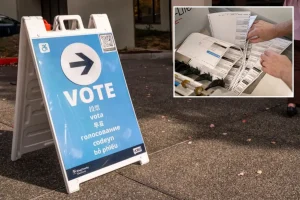
The details of the investigation paint a picture that is both striking and unsettling. Floyd’s office counted roughly 1,500 instances of noncitizens casting ballots in Washington State, and the earliest example they found went all the way back to 1984. That means some individuals had been voting in American elections for decades, possibly believing they were doing nothing wrong, or possibly knowing they were violating the law. Some of the names on the list had voted only once or a handful of times, while others appeared to have voted as many as twenty-seven times. The investigation was built by cross-referencing U.S. Citizenship and Immigration Services records with voter files. People who had applied for immigration benefits, such as green cards or work authorizations, were checked against official voting records. The match was unmistakable. The sheer scope of the discovery—over four hundred registered noncitizens in a single state, with more than a thousand individual ballots cast—raises difficult questions about how such a breakdown could persist for so long. In Washington, where vote-by-mail is the standard, a ballot sent to an ineligible person is not just a theoretical concern. It is a physical envelope that arrives in the mailbox, gets filled out, signed, and returned. The system, with all its checks and balances, apparently failed to catch the problem for years.
This Washington investigation is part of a much larger federal effort that has unfolded with remarkable speed and scope. In California, the Department of Justice has been fighting to set aside roughly twenty thousand mail-in ballots sent to individuals whose citizenship status is in question in Los Angeles County. That legal battle has drawn national attention, with opponents arguing that such a move could disenfranchise legitimate voters, while supporters insist that election integrity demands verification. The federal push extends beyond voting rolls. Immigration officials told Fox News Digital that dozens of noncitizens had been arrested nationwide in a voter fraud crackdown, and at least eighteen of those individuals had voted in federal elections. The suspects came from a wide range of countries, including Mexico, Somalia, Honduras, Guyana, Cuba, Germany, Nicaragua, Venezuela, Vietnam, El Salvador, Cambodia, Guatemala, Portugal, and Italy. Their alleged offenses were not limited to voting. Many also faced charges for counterfeiting, fraud, kidnapping, DUI, sexual offenses, assault with a dangerous weapon, drug possession, and burglary. The arrests underscored a broader reality: the individuals caught up in this investigation were not all innocent bystanders caught in a bureaucratic accident. Some were accused of serious crimes that had nothing to do with voting.
At the heart of the Washington State case is a systemic failure that may have ensnared people who never intended to break the law. Federal officials pointed to the state’s Motor Voter program, which automatically registers eligible residents to vote when they apply for or renew a driver’s license or state ID. The program is designed to make voting easier and more accessible, but in practice, it appears to have swept up noncitizens who simply walked into a Department of Licensing office to handle routine paperwork. Green card holders, many of whom have lived in the United States lawfully for years, discovered that they had been registered to vote without their knowledge. When those individuals later received a ballot in the mail, they made a reasonable assumption: the government must have considered them eligible. They filled out the ballot, signed it, and sent it in. The official notice from the Department of Justice was blunt about this dynamic, acknowledging that some green card holders were registered against their knowledge and then mistakenly believed they were legally allowed to vote. That nuance is important. It does not excuse the act of voting as a noncitizen, which is a crime, but it does suggest that the root of the problem lies not only in individual wrongdoing but also in a registration system that failed to verify citizenship before adding people to the rolls.
The consequences for those caught up in this tangled situation are severe, especially for people who hoped to one day become American citizens. Voting as a noncitizen is not a minor administrative mistake. It is a federal crime that can derail immigration applications, lead to deportation, and create permanent barriers to citizenship. Federal officials warned that individuals identified in the investigation could face criminal charges, including making false statements in a naturalization application or fraudulent voter registration. For a green card holder who has spent years building a life in the United States, perhaps even raising a family, working a steady job, and paying taxes, the discovery that they voted in an election they were not eligible for can be devastating. The Department of Justice and Department of Homeland Security have made clear that they intend to pursue these cases seriously. They are not treating this as a minor paperwork problem. They are treating it as a breach of one of the most fundamental rights and responsibilities of citizenship. And while some may argue that these cases are rare and isolated, federal officials insist that the numbers tell a different story. The four hundred registered noncitizens in Washington State alone, they argue, are likely just a fraction of the true total, especially when considering the wider population of undocumented immigrants who have had no official contact with immigration agencies and thus cannot be identified through existing records.
What emerges from this investigation is a complex and uncomfortable picture of American election integrity. On one hand, the right to vote is precious, and protecting it means ensuring that those who cast ballots are legally entitled to do so. The Department of Justice is asking Washington State to set aside ballots cast by the identified noncitizens until their citizenship status can be confirmed. That request is not an accusation against every voter on the list; it is a demand for caution and verification. On the other hand, the investigation reveals how a well-meaning system can go wrong, pushing people into legal trouble they never imagined. The human side of this story is difficult to ignore. There is the green card holder who received a ballot in the mail and thought they had finally become part of the process. There is the immigrant who made a mistake and now faces the collapse of a carefully planned future. There is the election worker who faithfully processed registrations, unaware that errors were slipping through the cracks. The nation is left to wrestle with hard questions: How should registration laws be enforced without discouraging eligible citizens from voting? How can states maintain the convenience of automatic registration while guaranteeing that only citizens are included? For now, federal investigators are pushing forward, determined to uncover the full extent of the problem. Washington State is on notice. Other states may soon follow. The promise of American democracy has always been that every eligible citizen’s voice can be heard—but that promise depends on the willingness to ensure that no one who is not eligible is allowed to drown out the voices of those who are. The investigation, for all its uncomfortable implications, is a necessary step toward honoring that ideal.