


The New Map of Disorder: Inside France’s 287-Group Protest Machine
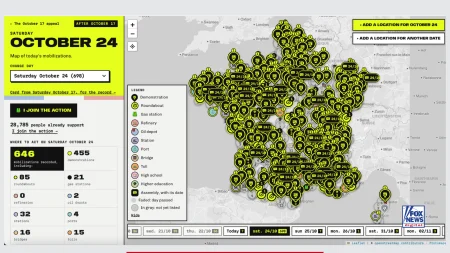
In an era when political upheaval often seems to erupt overnight, Fox News Digital’s “Who’s Who in Chaos Inc.” has taken on the ambitious task of mapping the hidden infrastructure beneath the streets. The project’s latest installment dissects France’s protest ecosystem, identifying 287 distinct organizations that have played a part in the country’s recent wave of demonstrations. This is far more than a simple roll call of radical groups. It is a carefully constructed organizational chart of a movement, distinguishing between the groups that conceive and coordinate protests, those that provide support and amplification, and those that attach their names to solidarity calls. What emerges is a portrait of protest as an interconnected web: local neighborhood collectives linked to national federations, national federations tied to international networks, and seemingly unrelated causes—antifascism, student rights, labor demands, climate activism, Palestine solidarity, and feminist organizing—converging in shared street actions. The database, continuously updated and organized by country, reveals that modern protest is less a single movement than an ecosystem, one in which a high-school student in Orléans and a retired trade-unionist in Marseille are connected through a chain of organizations they may barely know exist.
The most striking feature of the French ecosystem is the sheer weight of its ideological core: more than fifty antifascist groups form the largest single category, ranging from well-known Parisian collectives to regional outfits with names like the Antifascist Guard of Mayenne, the Antifascist Crew of Vannes, and the Feminist Antifascist Collective of Saône-et-Loire. Many of these organizations were bound together by their participation in an October 24–25 national antifascist mobilization in Orléans, coordinated under the banner of Ciao Fachos—”Goodbye Fascists”—a call signed by dozens of groups across the country. Alongside these antifascist networks stand 27 communist, socialist, and Trotskyist organizations, from the historic French Communist Party and La France Insoumise to more obscure revolutionary formations like the International Communist League and the Organization for Communist Reconstruction. These groups bring with them established infrastructure, publication networks, and—crucially—experience in turning street energy into sustained political campaigns. The French Communist Party’s leader appeared publicly with student demonstrators; Trotskyist publications like Révolution Permanente and the World Socialist Web Site provided ideological framing, connecting school blockades to broader critiques of capitalism and austerity. What the database makes clear is that this is not a random collection of angry individuals, but a layered network with deep organizational roots, at least 77 groups deep before one even reaches the unions and civic associations.
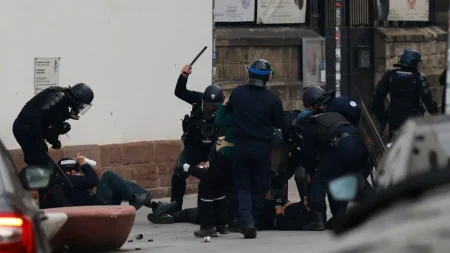
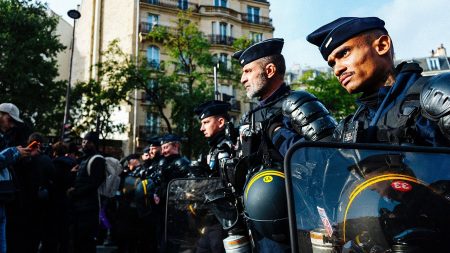
What sparked this particular wave of unrest, however, was not the ideological left but something far more spontaneous: French high school students. The database catalogs 27 student and youth organizations, and it is here that the October movement found its energy. Starting in early October, high schoolers began blocking their schools, initially around issues of educational conditions, budget cuts, and the treatment of Palestinian solidarity protests on campus. Groups like the National High School Coordination, the High School Students’ Renewal, and the High School Students’ Union (USL) helped organize blockades, while university student unions—including the historic UNEF, the Federation of General Student Associations (FAGE), and the more militant Student Union—carried the momentum onto university campuses. The hashtag #générationz trended as young demonstrators, some carrying Palestinian flags, some shouting revolutionary slogans, faced police kettling and arrests of minors. The human dimension here is impossible to ignore: these are teenagers risking disciplinary records and police encounters to march for issues they believe affect their future. Their energy was quickly embraced by older leftist organizations, who saw in the students’ rebellion a spark that might reignite a broader social movement. When a Bordeaux student group posted a video of protesters chanting “only one solution—revolution” outside the mayor’s house, and when the Permanent Revolution organization declared solidarity between high school and university students, the youth movement was being consciously framed as the opening act of something larger.
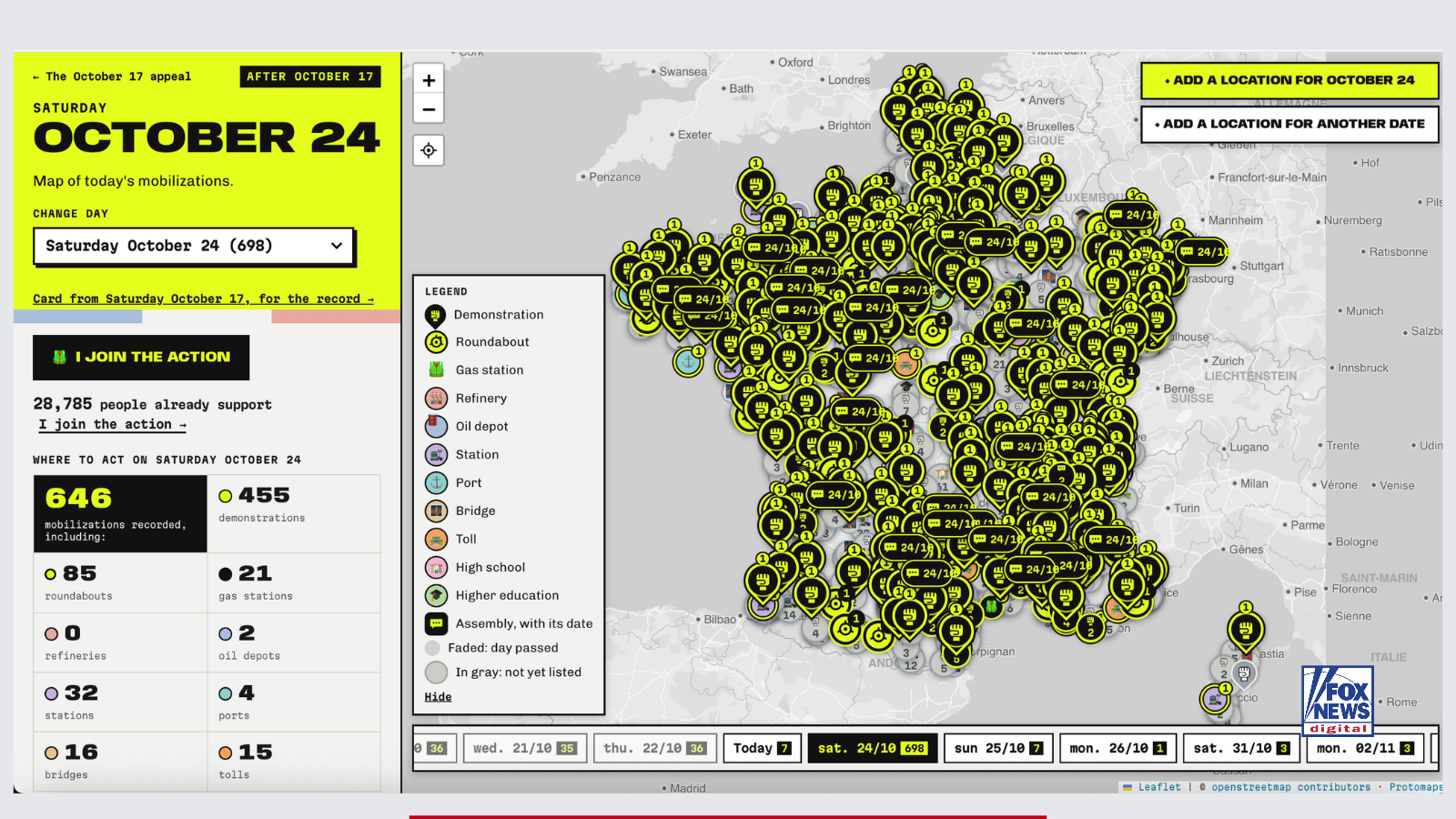
That something larger arrived with the October 17 cost-of-living mobilization, and the labor unions were ready for it. The database identifies 24 labor unions and union federations as active participants, from the mighty General Confederation of Labor (CGT) and Workers’ Force (FO) to more locally rooted organizations like Solidaires and SUD Education. These unions brought what students could not: numbers, discipline, and a direct line to working-class grievances. The CGT, France’s largest union confederation, supported the school mobilizations and joined the cost-of-living protests; the Peasant Confederation called on agricultural workers to march, linking rural economic pain with urban student anger; the National Union of Secondary Education, representing teachers, stood publicly with the high school students who blockaded their own schools. This convergence is the protest ecosystem’s greatest strength. On the one hand, students chanting about revolution and waving red flags; on the other, railway workers and hospital staff worried about their paychecks and pensions. The database shows both, and it shows the organizational scaffolding—joint mobilization calls, shared demonstration dates, cross-endorsements—that allowed these very different constituencies to occupy the same streets with a unified message against government policy. A personal note surfaces in the union materials: parents’ federations like the FCPE urged families to demonstrate, and Amnesty International’s French section reported on police treatment of minors, adding moral weight to the labor action.
Alongside the workers and students, the database reveals a constellation of identity-based and solidarity organizations whose participation transformed the protests into what French sociologists would call a “coalition of coalitions.” Sixteen feminist and LGBTQ groups, including the Pleasure Planning centers, #NousToutes, and radical collectives like the Feminist Radical Intersectional Group of Orléans, marched under their own banners. Nineteen antiracist and human-rights organizations, from SOS Racisme to the Frantz Fanon Foundation and the League of Human Rights, contributed both symbolic power and legal support. Eleven Palestine-solidarity groups, exemplified by the French Jewish Union for Peace and the Palestine Emergency, connected the domestic protests to the situation in the Middle East, a link that had been visible from the earliest student demonstrations. And thirteen environmental or climate organizations, including the radical Earth Uprisings, the climate network Coordination of the September 26 Movement, and local Extinction Rebellion chapters, folded ecological demands into the broader protest tapestry. The October 24–25 Orléans mobilization emerges in this database as the moment when all these threads wove together: a call originating among antifascist groups, signed by environmentalists, feminists, human-rights organizations, labor unions, and student collectives alike. It was, in a sense, a proverbial Woodstock of the French civic left—minus the music, plus a police presence.
Finally, there are the more than 100 organizations that resist easy categorization. Listed almost incidentally under “Other Civic/Activist,” they range from an anti-nuclear association and a veteran’s republican group to a cannabis-rights outfit and the Association for the Taxation of Financial Transactions (ATTAC). There are solidarity groups for Sahrawi prisoners, Vietnamese dioxin victims, and undocumented immigrants; a theater troupe, a brass band, and a local chapter of the Society of Friends of the Paris Commune. The inclusion of such a group is a reminder that what makes this ecosystem work is not a single ideology but a shared willingness to show up. Behind the organizational names in the database are human beings—teachers, engineers, grandmothers, recent immigrants—who may disagree on any number of policy questions but who have, for various reasons, concluded that street protest is their most effective voice. This is perhaps the most sobering lesson of the Fox News database. The anarchists and the trade unionists, the Jewish peace activists and the radical environmentalists, the teenage socialists and the retired military veterans: they form a network of grievances that no single government policy is likely to address. As the database continues to grow and expand to other countries, it tells the story of a world where the boundaries between schoolyard grievances and global geopolitics, between inflation and revolution, are thinning by the month. And none of it is abstract. It is a movement made up of 287 little organizations, each carrying a name, an address, and—somewhere—a group of determined people willing to leave their homes and take to the streets.