


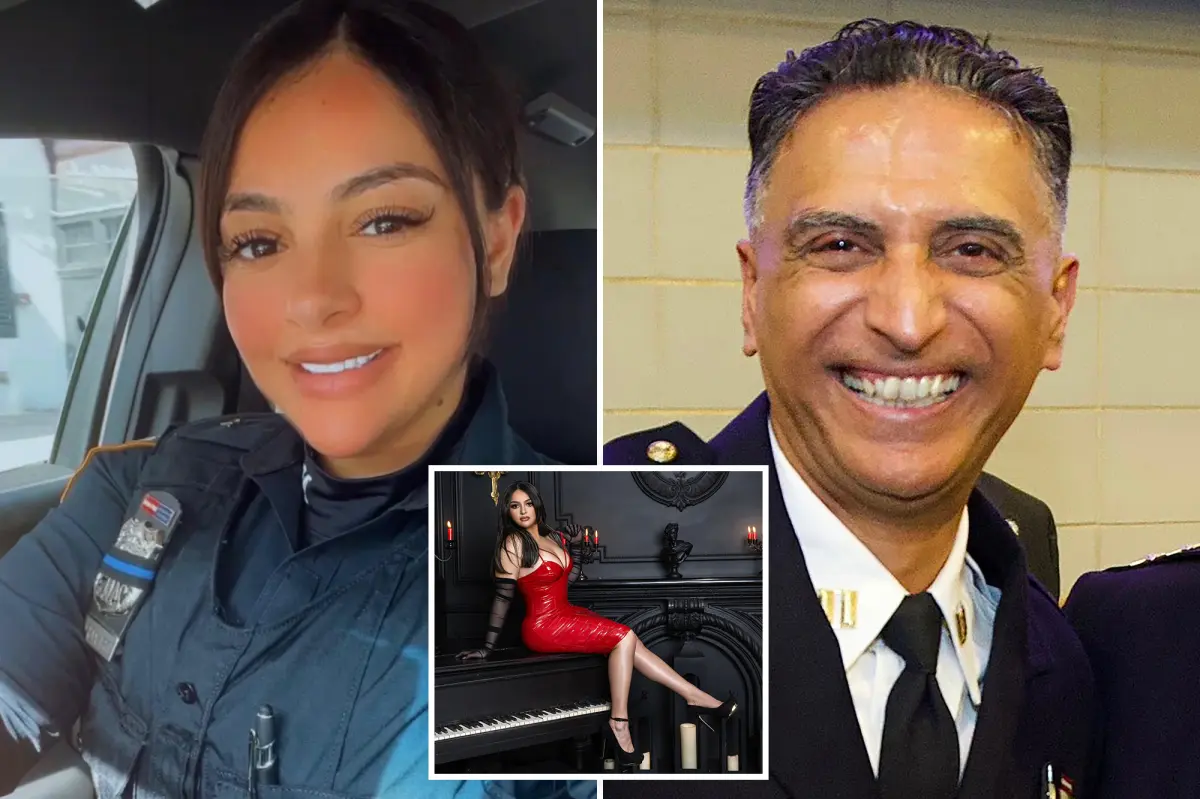
It is hard to imagine the kind of courage it takes for a police officer to walk into a precinct every day, put on a uniform, and pretend that everything is normal while the very person in charge of that precinct is allegedly using his power to pursue her, humiliate her, and turn her professional life into a nightmare. Maria Delacruz, a 33-year-old NYPD officer and mother of an 8-year-old son, says that is exactly what happened to her. In a lawsuit filed this week in Manhattan Supreme Court, Delacruz alleges that her former commander, Captain Amanjeet Sandhu, subjected her to months of relentless sexual harassment, created a toxic and sexually charged environment inside Transit District 1 on the Upper West Side, and then used his influence to push her out when she finally tried to escape. According to the complaint, Sandhu allegedly declared his love for her, said he wanted to be her lover rather than her supervisor, and made crude, invasive comments about her body almost constantly. Delacruz says she was terrified to report it at first because she did not know who to trust. “I didn’t feel like there was anyone I could go to,” she told The Post in an exclusive interview. That sentiment alone speaks volumes, not just about her case, but about the broader culture of fear and retaliation that many women say still exists inside the NYPD. The lawsuit paints a devastating picture of a commander who allegedly turned his command into something resembling a perverted frat house, with jealous coworkers, whispered rumors, and a chain of command that seemed more interested in protecting the accused than the victim.
By the time Sandhu took over Transit District 1 in January 2023, Delacruz had been serving as an officer for years, likely expecting to continue her career without such a nightmare. But within just months, the captain reportedly began assigning her to be his personal driver, a move that isolated her and gave him constant access. According to the lawsuit, by March of that year the pattern was firmly in place, and throughout 2023 Sandhu increasingly directed sexually explicit comments toward her. He commented on her breasts, buttocks, face, eyes, and body, allegedly referring to her as a Latina with large buttocks and making remarks about her “booty.” He told her, “If I was your man, I would slap that ass all the time.” When she stood up to leave his office, he would make comments like, “That ass is huge!” He reportedly suggested she remove her bulletproof vest, then stared at her breasts and bit his lip creepily while she spoke. He told her about dreams in which he was having sex with her. Delacruz was repulsed, and she did not stay silent in the moment. She told him, “What the f–k? Stop,” but the alleged behavior only continued. Eventually, she spent entire tours in his office or riding with him in his departmental vehicle, not because she wanted to, but because he was her superior officer and she was trapped in a system that gave her no clear way out. The lawsuit describes a kind of slow, grinding psychological abuse, with constant sexualization at every turn, a tactic that many abusers use to wear down their victims and make them feel powerless.
The abuse reportedly escalated into even more alarming territory. On one occasion, Delacruz opened the door to Sandhu’s office and found him with his pants halfway down, wearing white underwear and a tank top, with the outline of his penis visible through the fabric. Instead of being embarrassed, he allegedly told her to come inside. On another occasion, Sandhu instructed her to accompany him on a drive and attempted to kiss her against her wishes. Delacruz pulled away and pushed him back, saying, “No, you are married. Are you crazy?” Undeterred, he told her he wanted her to regard him as a lover and indicated that he would leave his wife to be with her. Then, at the 2023 Patrol Borough Midtown South Christmas party at the Glen Island Harbour Club in New Rochelle, he reportedly grabbed her left arm and pulled her toward him, saying, “You’re coming with me tonight.” He insisted they should leave together and sleep together. She refused, saying she was going home with her friend, but he continued gripping her arm painfully. By the summer of 2024, the situation had metastasized into something even darker. Sexual rumors about Delacruz and Sandhu were swirling, and the workplace had become openly hostile. In one especially humiliating incident, Delacruz was half-naked in the women’s locker room when another female officer accused her of “f–ing the captain.” The rumor mill had turned her into the story, and she was being treated as a willing participant in a relationship she never had. She insisted she never had a sexual relationship with Sandhu, but the damage was already done. Some coworkers brought complaints about the alleged relationship to Deputy Chief Steven Mauriello at the Manhattan Transit Bureau, but instead of focusing on the commander’s behavior, the focus seemed to shift to Delacruz.
When Delacruz confronted Mauriello in his office on July 17, 2024, she asked directly: “Why are you going around saying I’m sleeping with Sandhu?” His response, as alleged in the lawsuit, was chilling: “I’m not the only one saying that. Everyone here thinks that.” Rather than protecting her, the chain of command apparently wanted to manage the situation quietly. The Internal Affairs Bureau interviewed Delacruz over the locker room incident, and she planned to tell them about the harassment. But Mauriello allegedly pressured her to keep that part out, promising that if she only talked about the locker room fight, he would make sure she got transferred anywhere she wanted. She did what so many women in her position have done: she agreed. She took the transfer and did not tell IAB about the sexual harassment at that time. But the alleged harassment did not stop after she left. In September 2024, after her transfer, Sandhu reportedly sent her a disappearing WhatsApp message featuring a pornographic video. The video depicted a dark-haired woman positioned over a naked man with an erect penis, which she manually stimulated. Delacruz responded with shock and disgust, texting, “What the f–k?” But the messages kept coming. He wrote, “I think I should buy you a dildo. How many dildos do you own?” He asked how frequently she had sex, how many times she got “f–ked,” and how often she masturbated. She objected repeatedly, saying, “Enough. Stop asking those questions. That’s my personal business.” In late 2024, he allegedly sent her a photo of a woman wearing a thong with her breasts exposed and legs open. Throughout this entire ordeal, the lawsuit says, Delacruz found herself without meaningful protection, and instead of being able to trust the people who were supposed to keep her safe, she was pressured to leave her own precinct.
This case does not exist in a vacuum. It is the latest in a troubling series of sexual harassment and abuse allegations involving the NYPD. Retired Lieutenant Quathisha Epps alleged in 2024 that former NYPD Chief of Department Jeffrey Maddrey paid her a shocking amount of overtime for sex, a scandal first exposed by The Post. The Department of Justice opened an investigation after the report, but no charges have been filed, and Maddrey maintained that the relationship was consensual and denied any quid pro quo. Then, in 2025, NYPD Inspector Jeremy Scheublin was fired after being arrested on multiple felony charges, including attempted rape of a female subordinate. Scheublin pleaded not guilty, but the female officer filed a lawsuit alleging that he told her, “I want to make biracial babies with you,” while attacking her in his stationhouse office in Fordham Heights in The Bronx. These cases share a common pattern: powerful men using their authority to target women who depend on them for their careers, and systems that are slow to intervene, quick to blame the victim, and often more concerned with preserving institutional reputation than with doing justice. The lawsuit against Sandhu, Mauriello, Police Commissioner, and others seeks unspecified damages, and a spokesperson for the NYPD said the department has not yet been served with the lawsuit and will respond when they receive it. That is a standard response, but for women who have lived through this kind of trauma, it often feels like just another delay in a long history of silence.
What makes this story so human is not just the shocking details, but the quiet tragedy of what Delacruz went through. She was a mother, a colleague, a dedicated officer, and she found herself trapped in a system where the man who was supposed to be her leader instead became her predator. She suffered through unwanted advances, humiliating comments, violent attempts to control her, and a culture of gossip and jealousy that made her feel like the accused rather than the accuser. Now she has been transferred to Manhattan North Patrol borough in Harlem, and she is speaking out, not for revenge, but to protect other women. “I want to make sure that girls are not getting sexually harassed and feel safe to speak up,” she said. “I would like to be that supervisor that someone could come to and actually feel comfortable enough to tell me what’s going on.” There is something profoundly hopeful in that statement, a refusal to let her own suffering turn her bitter or silent. She wants to be the person she desperately needed when she was trapped in that office with a commander who made her skin crawl. Her story is a reminder that sexual harassment is never just about crude comments or unwanted touch; it is about power, control, and the quiet destruction of a person’s sense of safety and dignity. It is also a reminder that real change only happens when survivors are willing to speak out, and when the rest of us are willing to listen, believe them, and demand accountability. Delacruz has done her part. Now it is up to the courts, the NYPD, and the culture of American policing to decide whether her courage will mean anything at all.