


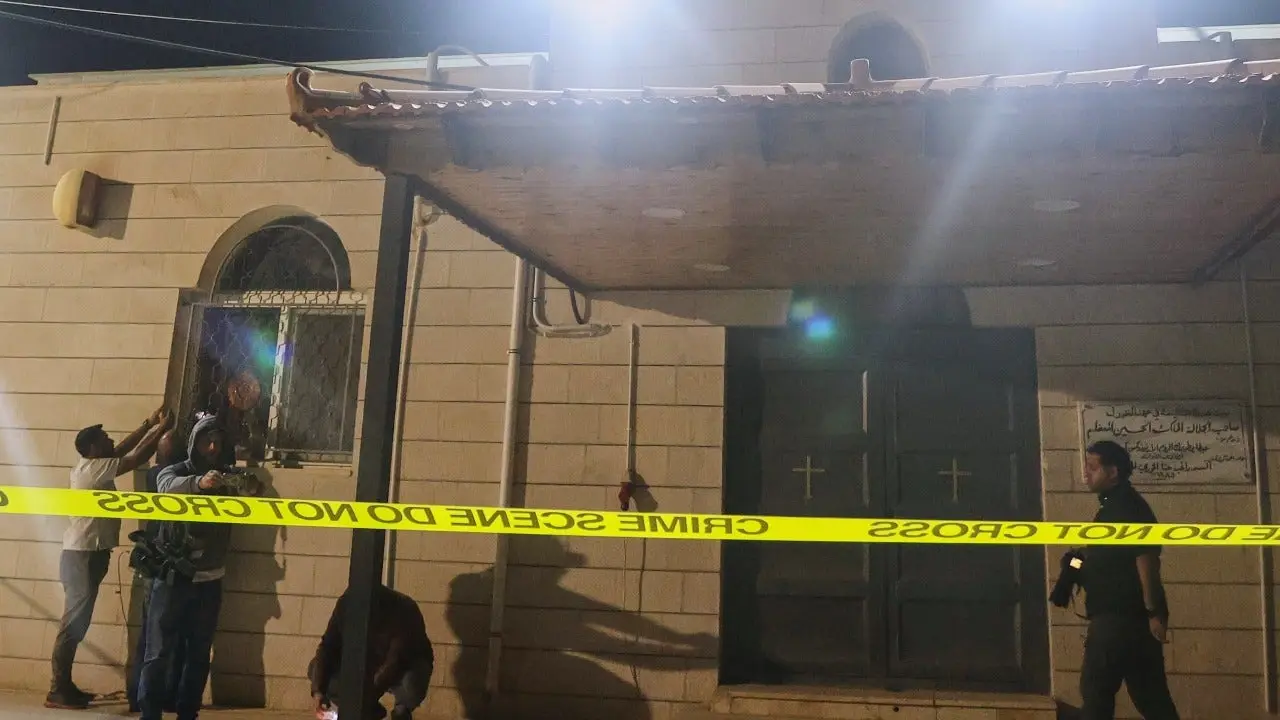
There are moments in human life that are supposed to be sacred, protected by the gentlest instincts of community and faith. A funeral is one of those moments—a time when friends and family gather not to celebrate victory or debate politics, but to honor a life that has ended, to hold one another in grief, and to find meaning in the presence of a higher power. On Friday, that sacred space was violently shattered. A group of gunmen stormed a Greek Orthodox church in Karak, Jordan, during a funeral service, opening fire on mourners who had come to pay their respects. When the shooting stopped, nine people were dead and more than two dozen were wounded. The attack took place in a city about 55 miles south of the capital, Amman, in a region known for its rich history and, significantly, for its sizable Christian minority. For the families who arrived at that church expecting to grieve, the day became an unimaginable nightmare. Instead of receiving condolences, they became victims of a brutal act of terror. The images that emerged from the scene—broken glass, pools of blood, the still bodies of the fallen covered with blankets outside the church—were not from a war zone, but from a house of worship, a place where the bereaved had sought refuge in their faith.
The human toll of the attack continued to unfold in the hours and days that followed. Jordanian Health Minister Ibrahim al-Budour said Saturday that one of the critically injured remained hospitalized at Prince Ali Military Hospital in unstable condition, a reminder that the trauma of the attack was not over. Each ambulance, each hospital room, each anxious family waiting for news carried its own quiet drama of fear and hope. Meanwhile, government spokesperson Mohammad Momani offered a preliminary explanation for the violence, saying the attackers subscribed to what he called “extremist takfiri ideology.” That term, likely unfamiliar to many outside the region, refers to a brutal worldview that brands anyone who does not adhere to a specific, radical interpretation of Islam as an apostate or a nonbeliever. In the hands of terrorist organizations such as ISIS, takfiri beliefs have been used to justify the killing of Muslims, Christians, and Jews alike—murder committed not for political gain alone, but in a twisted belief that the victims were spiritually illegitimate. The fact that attackers would enter a Christian church during a funeral and slaughter mourners is a stark illustration of this ideology’s cold logic: to them, human life means nothing if the person does not share their narrow and hateful creed. For the Christian community in Karak, and for Christians throughout the Middle East, this attack was another terrifying reminder that their faith, with its ancient roots in the region, can make them a target simply for being who they are.
In the aftermath of the shooting, Jordanian authorities were careful to frame the attack not as a Christian-versus-Muslim conflict, but as an assault on the nation’s unity and shared identity. Momani emphasized that Christians are “part of Jordan’s national fabric,” a phrase that carries deep meaning in a country where religious minorities have historically coexisted with the Muslim majority. Karak itself is home to a sizable Christian population, and the Greek Orthodox church at the center of the tragedy is not an isolated landmark but a familiar and beloved part of the local community. For generations, Christians in Jordan have lived as neighbors, colleagues, and friends alongside their Muslim compatriots, sharing in the country’s holidays, sorrows, and daily routines. The funeral that was interrupted was likely such a community event—people of different backgrounds mourning together, only to be targeted by outsiders who wanted to rip that fabric apart. The attack was designed to provoke division, to make Christians feel unsafe in their own homes and to make Muslims question whether their Christian neighbors could be trusted. Yet in the hours after the massacre, the response from Jordanian officials, from the king down to ordinary citizens, was one of solidarity and unity. Rather than retreating into fear, the nation seemed to lean into the very values the attackers sought to destroy: compassion, shared grief, and a collective refusal to be defined by terror.
The testimony of witnesses brought the horror of the moment into sharp focus. Dorgham Halasa, who was present at the scene, told the Associated Press that intense gunfire erupted inside the church about fifteen minutes after the funeral service began. People began running, he said—a simple, devastating description of the panic that must have seized the mourners as they realized that bullets were flying through their sacred space. Halasa said he did not see the gunmen himself, but others he spoke with reported seeing at least four of them. Jordanian authorities, as of Saturday, had not confirmed the exact number of attackers, leaving an unsettling uncertainty. Footage shown on Jordanian state television added to the chilling picture: two gunmen armed with what appeared to be pistols approached the church and opened fire, before a third man carrying what looked like a semiautomatic rifle joined them, and all three rushed toward the building. The fact that the attack was carried out in broad daylight, at a funeral, with such brazen coordination, suggests a level of planning that is hard to accept. For the survivors, the psychological scars will last far longer than their physical wounds. Many will relive the screams, the breaking glass, the crowds of people scrambling for safety, for the rest of their lives. And for the families of those who died, the consolation of a funeral—the very ritual that was meant to aid their grieving—has been stolen, replaced by a trauma that may make even the act of attending church feel dangerous.
The political and official response to the attack was swift and decisive, reflecting both the gravity of the moment and the determination of Jordan’s leadership to project strength. King Abdullah II said Jordan would “confront the terrorist act that targeted Karak with the harshest penalties.” His words were not merely administrative; they were a promise to the families of the victims that their loved ones would not be forgotten and a warning to any would-be terrorist that the state would not hesitate to respond with force. “Whoever imagines that the bullets of treachery can divide the ranks of Jordanians will fail in his endeavor before our steadfastness and unity,” the king added, along with a message of deep condolences to the families of the martyrs and wishes for the recovery of the wounded. The language of unity and steadfastness is important in a country that has long served as a relative oasis of calm in a turbulent region. Jordan has faced terrorism before, and it has consistently survived by turning those attacks into moments of national solidarity. The announcement of three days of national mourning, according to the state-run Petra News Agency, was a visible sign of respect for the victims and a gesture that honored their lives beyond simple statistics. But even as the king spoke and the nation mourned, questions remained unanswered. Did the gunmen have ties to a specific terrorist organization? Who were they, and how were they able to plan and execute such an attack? As of Saturday, Jordanian authorities had not announced any arrests, leaving a cloud of uncertainty over the investigation. For the families of the victims, justice may feel distant, but the government’s promise of severe punishment offers at least a sliver of hope that the dead will not have died in vain.
This tragedy in Karak is part of a larger, troubling pattern that has unfolded across the Middle East and beyond: the systematic targeting of Christians simply for their faith. Bishop Robert Barron has spoken powerfully about this reality, insisting that the war on Christians is real and that the world can no longer stay silent. For too long, attacks on Christian communities in places like Iraq, Syria, Egypt, and now Jordan have been treated either as regional conflicts or as isolated incidents, but they are, in fact, part of a global crisis of religious persecution. When a gunman enters a church and kills mourners at a funeral, he is not just attacking a building or a group of individuals; he is attacking an entire faith, a way of life, and the very idea that people of different beliefs can live together in peace. Yet in the midst of this darkness, there is also a story of resilience. The people of Karak did not respond to the attack by arming themselves against their neighbors. The nation did not collapse into sectarian chaos. Instead, Jordanians of all backgrounds came together in grief, determined to show that the bullets of treachery could not, in the end, divide them. For the Christian community in Jordan, the road ahead will be difficult. They will grieve their dead, tend to the wounded, and struggle to find a sense of safety in a place that has always been their home. But they will also draw on their deep roots in the land, their faith, and the support of the wider Jordanian community. The funeral that was so brutally interrupted was, in the end, a testament to the enduring power of hope—the hope that even in the face of terror, people will continue to gather, to mourn, and to believe that love is stronger than hate. It is that hope, stubborn and unbreakable, that the attackers failed to destroy.