

1. The Stage is Set: A Michigan Night of Political Combat
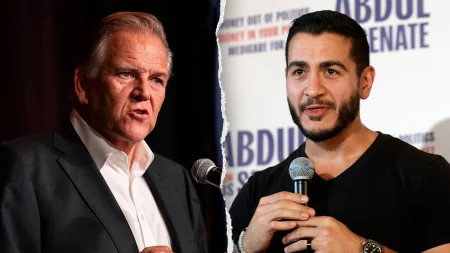
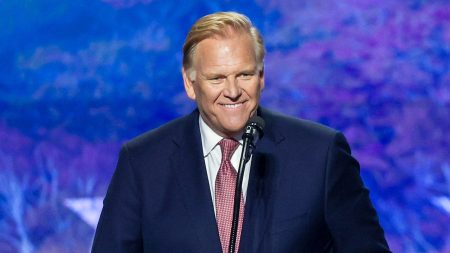
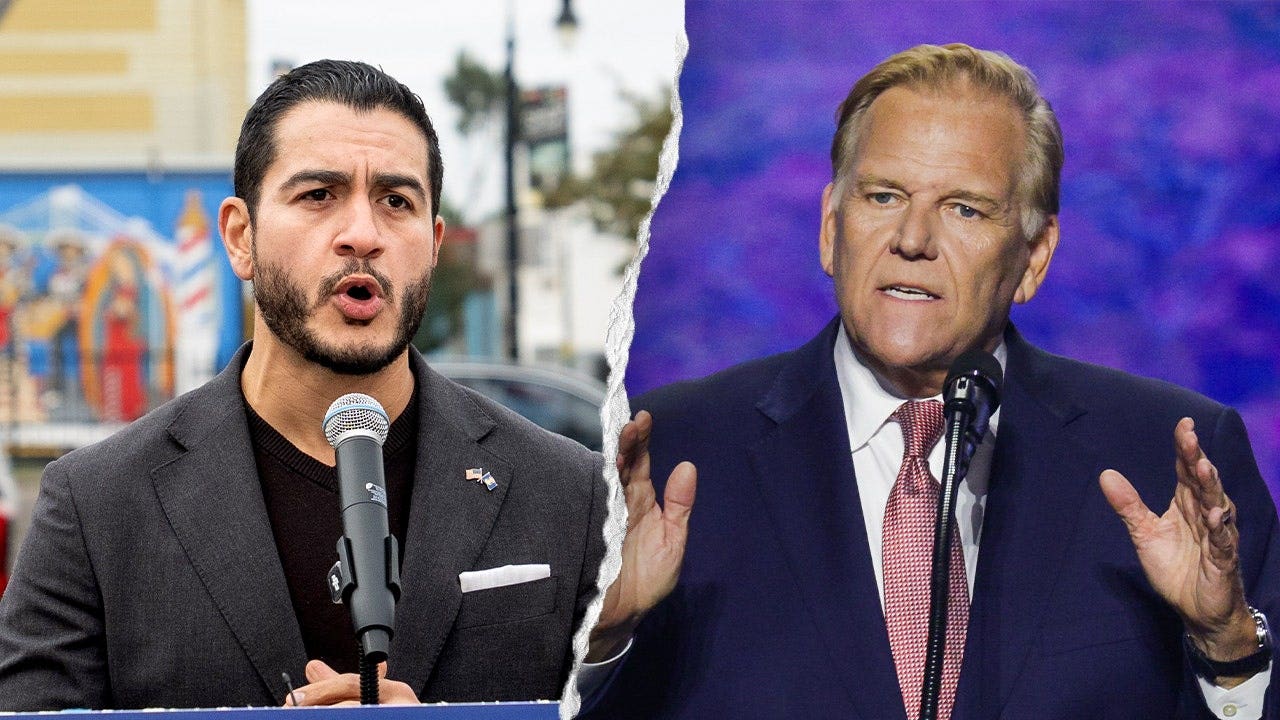
The air inside the debate hall was thick with tension, the kind that makes you forget you are watching a campaign event and feel instead like a spectator at a heavyweight title fight. The stage lights were unforgiving, the cameras merciless, and the two men standing at their podiums embodied not just opposing parties, but two completely contradicting visions of American identity. On one side stood Abdul El-Sayed, a physician, a former Detroit public health director, and an openly progressive Democrat whose immigrant-driven story had catapulted him into one of the most crucial Senate races in the country. On the other stood Mike Rogers, a former FBI agent and Republican congressman, whose political brand was built on national security, law enforcement, and a deep suspicion of ideological radicalism. The official topic of the evening was law enforcement funding—a sensitive issue in a state still wrestling with the legacy of urban unrest and the brutal national debate over police budgets. But neither candidate was content to stay within the dry confines of policy. Within moments, the conversation detonated into a firestorm of historical accusation, religious identity, and visceral personal attack, transforming a standard political debate into a scene that felt more like an interrogation room than a public forum. The audience, a mixture of partisans and undecided voters, leaned forward, sensing a collision. For El-Sayed, this was a chance to solidify his standing as a serious contender; for Rogers, it was an opportunity to paint his opponent as fundamentally unfit for national office. As the moderator probed the specifics of public safety budgets, the conversation twisted unexpectedly, veering away from the streets of Detroit and leading instead to the banks of the Nile, to a period long before the election cycle, and to an organization that has haunted American political discourse for decades.
2. The Accusation: Unearthing a Decade-Old Letter
Rogers’ response was systematic and deliberate, the methodical approach of a prosecutor laying out a case. He didn’t just answer the question about defunding the police; he pivoted ruthlessly, linking El-Sayed’s domestic stance to an international conspiracy. The senator referenced a letter that El-Sayed reportedly signed back in 2012, a missive unearthed by the Washington Free Beacon. In that letter, El-Sayed apparently called upon the then-president of Egypt, Mohamed Morsi—a prominent figure in the Muslim Brotherhood—to purge and defund his nation’s police force. Rogers dropped this bombshell with theatrical gravitas, stumbling over the terminology as he spat out, “He asked the Muslim Brotherhood, excuse me, head Morsi in Egypt, to defund the police there, too. I mean, it’s unbelievable.” The implication was unmistakable: El-Sayed’s views on law enforcement were not merely progressive domestic policy, but a direct line to a foreign extremist ideology. The attack was designed as a knockout blow, painting the Democratic candidate as someone whose loyalties lay not with the American Constitution, but with a shadowy international network banned in numerous countries. It was a grotesque oversimplification of complex geopolitics, but in the heat of a televised debate, nuance is the first casualty. Rogers, a man who spent his career hunting spies and intercepting communications, knew the power of a well-timed accusation. He leaned on the history, emphasizing the radical nature of such a request, and suggested that El-Sayed’s advocacy for police reform at home mirrored a dangerous preference for dismantling security forces abroad. The charge was not about budget lines or community policing; it was about character, about patriotism, about the very soul of the candidate. By invoking the Muslim Brotherhood, Rogers tapped into a deep well of public anxiety and prejudice, framing his opponent as an existential threat to the American way of life.
3. The Defense: Heart, Constitution, and a Plea for Honor
El-Sayed did not retreat. His response was armored in the language of the American founding, a passionate defense of his own identity and his nation’s principles. “To bring into question my commitment to the Constitution is really beneath you,” he fired back, his voice trembling with a cocktail of rage and hurt. He stood taller, his gaze locked on Rogers, and spoke of his pride in being an American, referencing the iconic framing of John F. Kennedy. He recounted his own service, mentioning his time as a public official, an oath he had taken to uphold the very document Rogers was accusing him of betraying. He argued that the Constitution guarantees all citizens the right to pray as they choose, and that questioning that loyalty based on his ethnicity or faith was profoundly shameful. He turned the accusation on its head, insisting that the only shamefulness in the room was Rogers’ willingness to smear him based on guilt by association. It was a deeply human moment, stripped of political calcification. El-Sayed’s voice cracked slightly as he dismissed the personal attack, not as a tactical move, but as a genuine insult to his life’s work. He explicitly rejected the narrative being woven around his family, dismissing it as nonsensical while defending the ordinary, hardworking American life of his mother—a nurse in Missouri, a woman whose story had nothing to do with geopolitical extremism. His defense was a plea to be seen as an individual, not a symbol; to be judged on his American merits rather than the accidents of his ancestry. He insisted that lowering the debate to such conspiratorial thinking violated the standards of the office he sought. In that moment, El-Sayed wasn’t just fighting for votes; he was fighting for his personal honor, and for the right to be recognized as a legitimate actor on the political stage rather than a cunning operative of a foreign power.
4. The Family Tree: A Painful, Personal Digression
The battle for El-Sayed was not confined to the stage; it reached into the deeply private realm of family history. The Wednesday night clash was merely the latest, most public eruption of a scandal that had simmered since social media posts from El-Sayed’s half-sister resurfaced. Those posts alleged that the candidate’s mother had been involved in Muslim Brotherhood activism during the 1970s. The allegations painted a portrait of a family steeped in radical politics, a narrative Rogers and his allies were eager to amplify. Yet El-Sayed’s response humanized the painful complexity of blended and fractured families. He spoke directly to the point of his upbringing, clarifying that he was not raised by his biological mother, and thus could not be held accountable for her past—if the allegations even held a shred of truth. He begged the audience to consider the absurd logic: that a nurse living in Missouri, caring for the sick in quiet obscurity, would somehow be the center of an international Islamist conspiracy. He questioned why his parentage should matter at all in a modern democracy, arguing that individual merit and personal dedication to one’s country should trump the accidents of birth. The allegation, lacking hard evidence, served its purpose as a GOP attack vector. It tapped into a nativist tendency to view certain immigrants and their descendants with permanent suspicion, regardless of their integration or achievement. For El-Sayed, the personal attack felt like a violation of the sanctity of family. He articulated the deep betrayal of watching strangers dissect his mother’s life, his father’s absence, and his own childhood trauma. He urged Rogers to focus on the issues that truly impacted Michigan families—jobs, healthcare, education—rather than dredging up half-century-old skeletons. The emotional weight of the segment was palpable, painting El-Sayed as a survivor of a difficult childhood who had overcome obstacles to become a celebrated physician, only to be dragged back to the margins by a political opponent willing to exploit his deepest insecurities.
5. The Escalation: Ideology Over Identity
Rogers, however, was far from finished. He pivoted to a macro-level argument, dismissing El-Sayed’s emotional rebuttal as a diversion into victimhood. “I know you want to make this about you being a victim,” Rogers said, his tone shifting from prosecutor to philosopher. He broadened the scope, moving beyond the specific family ties to attack the ideology itself. He referenced the Muslim Brotherhood as an entity banned in multiple Muslim countries, listing numbers that buzzed in the audience’s ears: banned in five nations, banned in another six. Rogers framed this not as a personal prejudice, but as a national security concern, warning that American law enforcement bodies are deeply troubled by this ideology because it allegedly provides funding for overseas operations. For Rogers, this was the crux: El-Sayed was a vector for a dangerous philosophy that threatened the stability of the world and the safety of American cities. He refused to accept El-Sayed’s protestations, painting him as a cunning apologist whose denials were part of a deceptive campaign to appear moderate. The contrast was stark: one man speaking from the heart about the Constitution and personal honor, the other speaking from a playbook of geopolitical fear. Rogers seemed to relish the opportunity to frame the election as a clear-cut battle between patriotic law and order and a questionable, internationalist progressivism. This tactic was a deliberate escalation, elevating a local Senate race into a referendum on global ideologies. Wrapping himself in the authority of his FBI past, Rogers implied he had special knowledge of dangers that the naive El-Sayed could not comprehend. He shifted the goalposts: even if El-Sayed had no direct ties, the mere association with a set of ideas Rogers deemed dangerous was enough to disqualify him. The rhetoric was engineered to appeal to a base that fears the erosion of traditional values and the creeping influence of foreign cultures, casting his opponent as a Trojan horse.
6. The Aftermath: The Human Cost of Political Warfare
As the debate wound down, the air in the room had shifted. The sharp words had settled, but the residue of the accusations lingered heavy in the space between the two men. The factual reality, as measured by all available evidence, suggested that El-Sayed had no verifiable, direct affiliation with the Muslim Brotherhood. Yet the insinuation had achieved its goal, clouding the issue and leaving a lingering doubt in the minds of some viewers while reinforcing deep distrust in others. For El-Sayed, the night was a test of resilience, a trial by fire that forced him to defend not just his policy positions but his very essence. For Rogers, it was a high-stakes gamble that might solidify his base but could also alienate moderate voters who view such personal attacks as un-American. The broader human narrative was one of two men in a brutal contest—one fighting for the right to be seen as a loyal American despite his heritage, the other fighting for a vision of a homeland under perpetual siege from external forces. The debate was a microcosm of the larger political climate, defined by identity, fear, and the weaponization of personal history. As the cameras stopped rolling and the candidates shook hands in a perfunctory gesture of decorum, the real work of convincing the electorate began. The Michigan voters departed with a stark choice, having witnessed a clash not just of policies but of worlds. El-Sayed’s voice echoed with the passion of an outsider seeking acceptance; Rogers’ carried the authority of a guardian. The night underscored the polarization gripping the nation, where a single letter sent over a decade ago can resurface to define a campaign. For El-Sayed, the path forward relies on the electorate’s capacity for nuance and empathy, hoping they see the doctor and father behind the ideological smokescreen. For Rogers, the path is to keep the focus on existential threats. In the end, the debate disclosed more about the state of American political discourse than about the candidates’ actual plans for Michigan. It revealed a system where personal pain is ammunition, where family trees are dissected for political gain, and where the search for truth is often lost in the thunder of accusation—leaving behind fractured trust and a lingering question of how a nation so united in its founding principles has become so divided in its interpretation of them.