


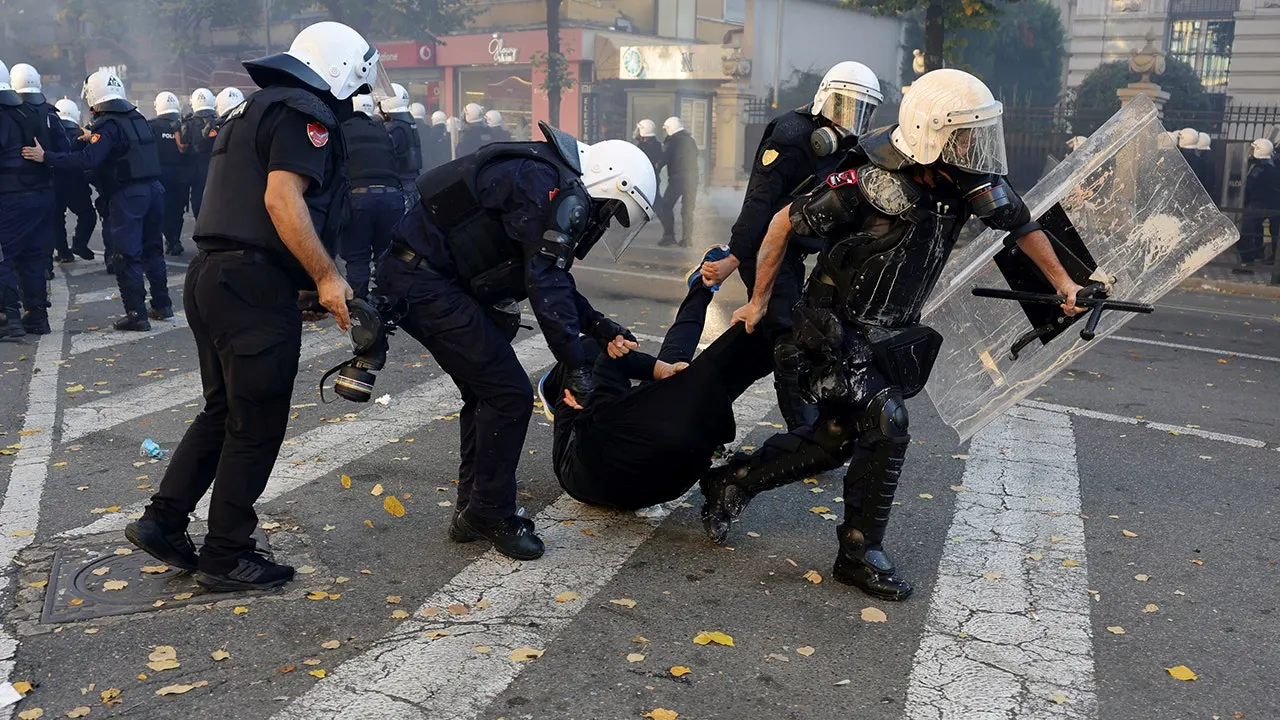
In the heart of Tirana, the air thickened with smoke and tension as a third consecutive day of unrest enveloped Albania’s capital. What began as a simmering discontent had boiled over into a full-throated clash between police and citizens, the echoes of shattering rocks and the hiss of water cannons replacing the usual hum of a Thursday afternoon. Rioters, their faces masked against the tear gas, hurled projectiles at a cordon of law enforcement outside the Education Ministry, while officers retaliated with the cold spray of water and the sting of chemical irritants. The scene was one of raw, chaotic defiance—a visual metaphor for a nation teetering between hope for a European future and the deep frustration of a people who feel left behind. This was not a spontaneous eruption but the culmination of years of anger, and at its center stood Prime Minister Edi Rama, a towering figure in Albanian politics, resolute and unyielding. “As for calls for my resignation,” he declared, his voice carrying a mix of defiance and weary conviction, “governments are changed through democratic elections. We had elections last year, not a revolution.” That statement, captured by Reuters, encapsulated his position—a man who sees himself as the legitimate steward of a nation’s destiny, refusing to bow to the chaos unfolding beyond the windows of his office.
The roots of this upheaval run deep, stretching back through Rama’s 13 years in power—a tenure marked by significant strides toward European integration but also by a growing chorus of accusations that have tarnished his government’s credibility. To the protesters, the clashes are not merely about a single policy or a moment of outrage; they are a reckoning for a system they believe has failed them. The statistics are stark: poverty persists in rural hinterlands, unemployment remains stubbornly high among the young, public services are strained to the breaking point, and a mass exodus of Albania’s brightest and most ambitious citizens continues unabated, as they seek better opportunities in the wealthier nations of the European Union. For ordinary Albanians, the promise of a prosperous, transparent state seems to have been traded for a reality where political elites allegedly enrich themselves while the middle class struggles to make ends meet. The protests, then, are a visceral expression of this betrayal—a demand for accountability in a country where many feel that the fruits of progress have been hoarded by a privileged few. The city’s streets became a stage for this deep-seated grievance, as students, workers, and families joined together, their voices rising above the din of police sirens, each banner and chant a plea for a different kind of leadership.
At the heart of this movement is a colorful and defiant symbol: the “flamingo.” Adopted as a mascot of resistance, the pink bird now adorns signs and flags carried by protesters who have united under the banner of the Flamingo Movement. Their demands are simple yet profound—the resignation of Prime Minister Rama over accusations of widespread corruption, favoritism, and misuse of public funds. The movement’s emergence marks a new chapter in Albanian civic activism, blending youthful energy with a broader anti-government sentiment that transcends partisan lines. Among the protesters are student groups with their own set of grievances: the soaring costs of higher education, a lack of financial support for those from poorer backgrounds, dilapidated university facilities, and a job market that offers little security or prospect for advancement after graduation. They tell stories of overcrowded lecture halls, textbooks priced beyond reach, and the painful choice between staying in a struggling homeland or leaving for a life elsewhere. But the protest canvas is even broader, encompassing opposition to a controversial development project linked to Jared Kushner, the son-in-law of former President Donald Trump. This project, a luxury resort planned on pristine coastal land, has become a lightning rod for anti-corruption concerns, symbolizing for many the unchecked influence of money and politics that they believe defines Rama’s administration. The fusion of student demands with a wider civic struggle has created a potent force, one that the government can no longer brush aside as the fleeting tantrum of a vocal minority.
The international dimension adds another layer of complexity to this domestic crisis. Agim Nesho, a former Albanian ambassador to the United States, spoke to Fox News Digital with a stark warning: “The message from the streets is clear: Albanians have had enough. Public patience with Edi Rama’s socialist government has come to an end.” His words echo a sentiment that has been brewing for years, a fatigue with a government that, in his view, has allowed the political elite to prosper while ordinary citizens languish. Nesho pointed to the mounting accusations of corruption, the misuse of public funds, and the political favoritism that have become hallmarks of Rama’s tenure. He described a country where the wheels have come off the socialist machine, where the once-vaunted progress has been marred by a deep-seated rot. Meanwhile, the European Union, a beacon of hope for many Albanians, weighed in with a note of caution. Late Wednesday, an EU delegation expressed concern over “the violent escalation at the protest in Tirana,” calling for a proportionate response from the authorities. The statement was a delicate balancing act—acknowledging the legitimacy of peaceful protest while condemning the outbreaks of violence. For the EU, Albania is a crucial partner, a would-be member state that has made significant strides under Rama’s leadership, but its credibility hangs in the balance as it watches a leader it helped cultivate face the wrath of his own people.
Prime Minister Rama, however, remains unmoved in his conviction that he is on the right side of history. Seated in his office, surrounded by the trappings of power he has held for over a decade, he presents himself as a man of reason in a storm of irrationality. “My responsibility is to listen, address legitimate concerns and keep Albania moving forward,” he told Reuters, framing his refusal to resign as a duty to the nation rather than a stubborn attachment to power. “The alternative would be a betrayal of the Albanians who gave me a strong mandate to complete negotiations on European Union membership.” That mandate, won just last year, was a vote of confidence in his vision of an Albania integrated into the EU, with accession hoped for as early as 2028. Rama, who has staked his political legacy on this goal, cannot afford to be seen as capitulating to mob rule. He has offered a willingness to discuss the cost of education, a nod to the students’ demands, but he draws a hard line: “Attacking institutions, destroying public property and threatening public safety have nothing to do with the legitimate demands of students.” His tone is firm, almost paternalistic, as he seeks to separate the constructive from the destructive. He insists that corruption is being tackled “as never before,” citing the EU’s recent acknowledgment of Albania’s efforts, and he casts the protests as the work of forces—both domestic and foreign—that are threatened by his country’s progress. “Perhaps some forces, at home and abroad, do not want Albania to succeed as a forerunner for EU membership. But I will not allow violence to derail Albania’s European future.” In his eyes, the protesters are not the vanguard of a just cause but the unwitting pawns in a larger game of destabilization.
As the sun sets on the third day of violence, the future of Albania hangs in a precarious balance. The clashes have left a scar on the national psyche: 89 people injured, including 61 police officers—a stark tally that speaks of the depth of the confrontation. The streets may be quieter now, but the underlying anger is far from extinguished. The Flamingo Movement has no intention of fading away, and its leaders speak of sustained action until their demands are met. For Rama, the path forward is clear: he will not resign, and he will continue to pursue his European dream, even as the ground beneath him trembles. Yet the cost of such stubbornness may be high. The protests have already drawn international scrutiny, with the EU’s warning serving as a reminder that Albania’s accession depends not only on institutional reforms but also on the perception of a stable, democratic society. The people of Albania, caught between longing for a better future and the weary reality of the present, must now grapple with a choice: to trust the leader who brought them to the threshold of Europe, or to believe that only through his departure can the nation truly find its way. The coming days will test not just the resilience of the government, but the very fabric of Albanian democracy. In the midst of the chaos, one thing is certain—this is a defining moment, a crucible in which the nation’s identity and destiny are being forged, whether in the fires of revolution or under the steady hand of a determined but embattled prime minister. The world watches, and Albania waits, its future unwritten, its people’s hearts torn between hope and despair.