


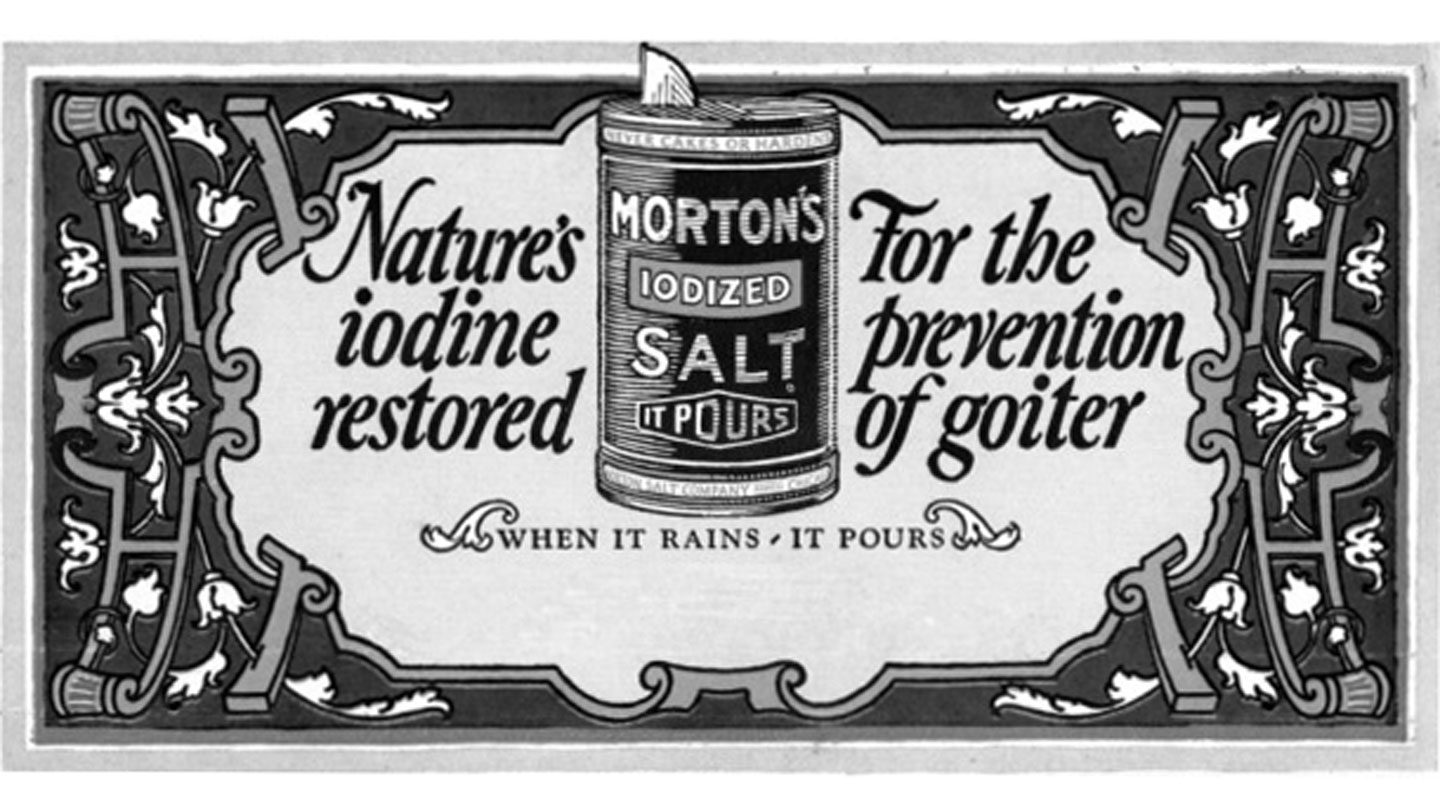
Walk down the seasoning aisle at the grocery store today, and it’s easy to feel like the humblest salt in the lineup is the last one you’d notice. Pink Himalayan salt, flaky sea salt, coarse kosher salt, smoked salt, black lava salt—each one promises a story, a texture, a table presence of its own. Beneath all that glitter, however, sits an ordinary blue-and-white canister of iodized table salt, and its story is arguably far more important than all the rest combined. Iodine is a tiny nutrient with an enormous job: it’s a necessary building block for thyroid hormones, the chemical messengers that regulate everything from metabolism to growth. Most crucially, those hormones are needed for the developing brain, especially in fetuses and young infants. A century ago, iodine deficiency was one of the most visible public-health tragedies in the United States. Entire regions of the country, including the Northwest, the Great Lakes states and Appalachia, were called the “goiter belt” because so many people had swollen thyroid glands bulging from their necks. In one northern Michigan county, a physician examining young men for the World War I draft in 1918 found that 30 percent of nearly 600 men had goiters, some large enough to be disqualifying. A 1922 Michigan Department of Health study found goiters in nearly half of schoolchildren across four counties. The problem was finally attacked in 1924, when the Michigan State Medical Society recommended adding iodine to table salt and the Morton Salt Company began distributing it nationally. By the 1950s, the goiter belt had almost disappeared. It was one of the quietest, most successful public health interventions in American history—and one of the easiest to forget.
But the memory is fading, and so is America’s iodine supply. Researchers reported in the Journal of Nutrition in 2025 that, between 2017 and 2018, an estimated 24 percent of women and 30 percent of men aged 14 and older were not getting enough iodine—about double the percentages from 2001 and 2002. The study also found that nearly half of pregnant women were falling short. The CDC’s 2026 Nutrition Report went further, saying that women of reproductive age as a population are now on the cusp of mild iodine deficiency. These are not theoretical concerns. Long-term iodine insufficiency prevents the thyroid from making enough hormones, and the consequences of that can ripple across generations. As Elizabeth Pearce, an endocrinologist at Boston University, puts it, even mild deficiency during pregnancy may be associated with measurably lower IQ in children. The most vulnerable time is the first trimester, when a developing embryo depends entirely on its mother’s supply for everything it needs—including the thyroid hormone needed to build the brain. Monica Serrano-Gonzalez, a pediatric endocrinologist at Hasbro Children’s Hospital and Brown University, calls iodine deficiency “the leading cause worldwide of preventable developmental delay.” Yet people, she says, “have kind of forgotten this is a risk.” We don’t see goiters in our neighborhoods anymore, so we no longer associate a missing nutrient with a child’s future. That unspoken loss is harder to see than a swollen neck, but it is just as real.
How exactly did the country backslide? The answer is not one thing but a slow drift in diet and choices that has dismantled the old safety net. The U.S. never mandated salt iodization. Instead, it relied on a voluntary arrangement between health authorities and manufacturers, and for decades that arrangement was enough because most people used ordinary iodized table salt at home. Today, only about 53 percent of table salt sold in American grocery stores is iodized, according to one analysis. Fancy, noniodized varieties have pushed it aside, and much of our daily salt actually comes from prepared, processed and packaged foods—which manufacturers generally make with noniodized salt. Even milk, once a fairly reliable source of iodine because dairy farms use iodine-supplemented feed and iodine-based udder sanitizers, varies dramatically in iodine content depending on farming practices. People who avoid dairy, follow plant-based diets, prefer kosher or sea salt, or simply cook outside the old patterns can all end up with too little iodine without ever realizing it. There is also a painful irony in the health advice we hear so often: we are told to cut salt, and many of us respond by using less table salt, but a great deal of the sodium in modern diets comes from processed foods that offer no iodine at all. In a food culture built on convenience and culinary experimentation, the voluntary system that worked in the 1920s no longer reaches everyone. It’s a failure not of effort but of infrastructure: the invisible nutrient has simply been left out of the modern meal.
Fixing this doesn’t require dramatic sacrifice, and it certainly doesn’t mean embracing heavy salt. The recommended dietary allowance for iodine is 150 micrograms per day for most adults, 220 micrograms for pregnancy and 290 micrograms for those who are breastfeeding. To make that concrete, a 2023 federal report estimated that one teaspoon of iodized salt contains roughly 300 micrograms of added iodine. That means a small amount of iodized salt used in home cooking can make a meaningful difference. Of course, the American Heart Association recommends limiting sodium to 2,300 milligrams per day, and a teaspoon of salt contains 2,400 milligrams, so balance still matters. The key is to make the salt you use count. For pregnant and breastfeeding women, and for women planning to become pregnant, the American Thyroid Association and the American Academy of Pediatrics recommend a daily supplement containing 150 micrograms of iodine, because the stakes for the developing fetus are highest. For everyone else, experts suggest reaching for iodized salt rather than fancy noniodized varieties for regular cooking and seasoning. “Look for salt that’s iodized,” Pearce advises. For people on low-salt diets, Serrano-Gonzalez offers a helpful distinction: the goal is to cut out packaged and prepared foods full of hidden sodium, not necessarily to banish all salt from the kitchen. “We do want to have moderation with salt intake, but we need a little bit,” she says. That’s a more nuanced message than the simple “avoid salt” mantra, but it’s the one that protects both heart health and brain health.
The stakes become even more vivid when we look beyond the United States. Globally, iodine deficiency remains a major public health threat, and the contrast in policies is striking: 126 countries mandate salt iodization, while only 21 have voluntary policies—including the U.S. A painful natural experiment in Ethiopia shows exactly what can happen when iodine supplies are disrupted. Ethiopia began iodizing salt in the 1990s, and by 1995 about 80 percent of households were using iodized salt. But the country’s supply came from Eritrea, and when the two nations went to war in 1998, the border closed and the iodized salt stopped flowing. By 2005, Ethiopia was severely iodine deficient; in some groups, up to 40 percent of schoolchildren and 36 percent of women of reproductive age had goiters. The government eventually restored mandatory iodization in 2012, and household coverage climbed to 85 percent by 2015. But the children born and raised during that interruption paid a terrible price. In rural areas, where soils naturally held very little iodine, child mortality in the first two years of life reached 25 to 30 percent, compared with about 10 percent in other areas, according to a study in Nature Food in September. Those who survived and reached secondary school scored lower on national exams. The researchers accounted for the conflict’s broader effects, and the link to iodine nutrition was clear. This is what a broken salt supply chain does. It doesn’t just change thyroid function; it changes lives, survival rates and futures.
America is not Ethiopia, and we are not on the brink of a famine-like crisis. Yet the warning signs—declining iodine intake, rising deficiency among pregnant women, the shrinking share of iodized salt on store shelves—are real. We have solved this problem before, and we can solve it again, but only if we remember that it exists. The lesson isn’t to fear salt or to start obsessively tracking micrograms. It’s to make a small, almost automatic choice for iodized salt when we cook and season at home, and to support public health measures that keep iodine nutrition visible. It’s also a reminder that the consequences of nutritional deficiencies often hide in plain sight: not only goiters, but children who score a few points lower on IQ tests, adults with sluggish energy, pregnancies that don’t get the support they need. The colorful salts lining the shelf are not the enemy; they are fine for finishing a dish or adding a special touch. But the salt that deserves a permanent place in our kitchens is the plain, inexpensive, iodized kind. A century ago, it transformed the health of a nation. It can still do that today, if we don’t let its victory become invisible. The next time you reach for seasoning, remember the goiter belt, the Ethiopian schoolchildren, and the tiny canister that helped change American history. Sometimes the most ordinary thing on the shelf is quietly extraordinary.