



On paper, the interview with Casey Harrell looks like any other. A journalist asks questions; he answers. He talks about his background as a climate activist, his Southern roots, and his young daughter, who once loved to dress up as a cheetah and roar through the house. “My daughter was incredibly cute in her cheetah outfit,” Harrell says. The transcript alone would tell a simple story of a conversation. But hiding between the lines is a far more extraordinary story: the story of where Harrell’s words actually come from. Nearly six years ago, in his early forties, Harrell began losing the ability to speak. By the time of the interview, he was communicating through an experimental brain implant capable of decoding his intended words directly from his thoughts. The device, called a brain-computer interface, is still experimental. But it has transformed his life. And it could soon transform many others. Rapid advances in computing power and artificial intelligence, lessons learned from patient experience, and major investments from neurotechnology companies are turning a long-imagined possibility into real progress. For years, scientists were not certain whether they could ever decode speech from brain activity; now a growing body of research points clearly to yes. Harrell’s new voice may not remain singular for long. The ordinary-looking interview, with its neat lines of written answers, is actually a glimpse of a future in which silence caused by paralysis or disease no longer has to mean the end of conversation.
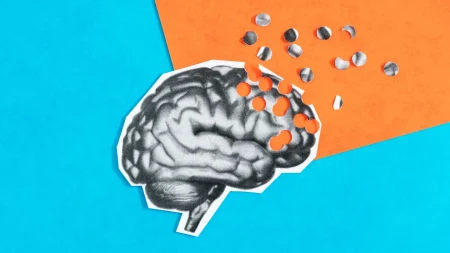
Harrell lives with amyotrophic lateral sclerosis, or ALS, a progressive neurodegenerative disease that affects roughly thirty-five thousand people in the United States. ALS destroys the nerve cells in the brain and spinal cord that control muscles, gradually cutting the connections between mind and body. For Harrell, this meant losing the use of his arms and legs and, eventually, the muscles of his throat and mouth that made speech possible. He was diagnosed in 2020, and the loss of speech came shortly afterward. He has described the experience as a slow-motion car crash: a gradual, agonizing process during which fewer and fewer people could understand him. “My voice is the most important thing I have lost in this whole disease,” he says. Through a family member, he learned about a clinical trial at the University of California, Davis, designed to restore speech with a brain-computer interface. In 2023, surgeons implanted four small grids of electrodes on the left side of his brain, directly over the speech motor cortex, the region that orchestrates the intricate movements needed to form words. When Harrell tries to speak, his brain generates electrical signals. The electrodes detect those patterns and send them to a computer, where machine-learning algorithms translate them into phonemes, the basic building blocks of words, and then assemble those phonemes into sentences. Harrell calls the elaborate setup “the Matrix.” Every morning after getting out of bed, he plugs into it. He now uses the system for ten to fourteen hours a day, making him, as he puts it, “the world’s biggest power user of the brain-to-computer interface known to man.” By a recent count, he has used the device to communicate nearly two million words. The science is still early, but for Harrell it has given back the most human ability of all: the chance to be understood.
Decades of fundamental research led to this breakthrough. In the 1950s, scientists first placed electrodes into brains to record electrical activity, and modern neuroscience began asking how the brain computes, how it allows us to move, and whether those electrical messages could be translated into action outside the head. Animal studies paved the way, including experiments in which rhesus monkeys used their thoughts to control a robotic arm. In 2004, the BrainGate trial showed that a paralyzed man could move a computer cursor with his mind alone. Speech itself was a much harder problem. Talking feels effortless, but just saying hello involves more than one hundred muscles: the diaphragm fills the lungs, air pushes through relaxed vocal cords, the tongue and jaw shape sounds, and sound waves finally ripple from the mouth. All of it begins with tiny pulses of electricity in the brain. For a person whose muscles no longer receive those commands, an implant can bypass the broken pathway and read the intention directly. Harrell’s first test came after he recovered from surgery, when researchers asked him to try to say a random sentence from a small vocabulary: “What good is that?” As Harrell’s brain sent the command, the words appeared on a screen. Everyone paused. Some of the researchers began to cry. Harrell and his family were emotional. David Brandman, the UC Davis neurosurgeon and neuroscientist who had worked toward this moment for much of his career, says seeing the immediate impact on Harrell and his family was incredible. The second day was even more personal. With a larger vocabulary, Harrell began by joking, “Is this thing on?” Then he said something that seemed to be a mistake: “I’m looking for a cheetah.” Leigh Hochberg, a neuroscientist watching remotely, was sure the decoder had failed. Then Harrell’s four-year-old daughter bounded into the room wearing a cheetah costume. The technology had not only restored words; it had restored an unplanned, spontaneous moment between a father and his child.
Harrell now uses his brain-computer interface in surprisingly ordinary ways. He sends emails and Slack messages, plays Wordle with his wife and daughter, and works on a new climate consultancy. The system has connected him to the world in ways that would have seemed impossible just a few years ago. But it is still a research device, with real limitations. It is not portable: wires emerge from a port on the top of his head, so he can use it only at home. It is also slow by the standards of natural conversation. During an interview, when the conversation turned to a neighborhood in Washington, D.C., where both people had once lived, Harrell was asked if he remembered his old address. The answer came about two minutes later. He compares using the interface to catching a train: if people are patient enough to wait for his sentence corrections, he can still be part of the conversation. His system works brain-to-text, and then, if he chooses, a computerized voice can speak the words aloud. The real “holy grail,” he says, is a brain-to-voice system that translates thoughts directly into natural, real-time speech. But the emotional stakes are already clear. Losing speech, as speech and language pathologist Jessica Pietrowski puts it, is often more devastating than losing mobility, because speech is how people maintain their identity in relationships. Harrell says his voice is the ability to parent his daughter, to connect with his wife, to share a wry joke with friends. Losing those small exchanges, he says, is the most devastating part of the disease. Having any path back to them, even an imperfect one, is transformative.
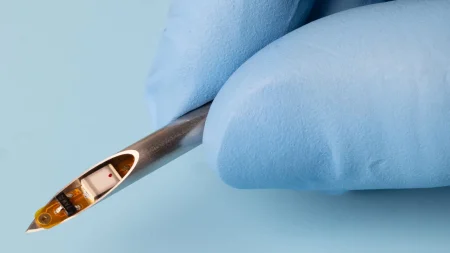
Researchers are already working on the next generation of devices. Last year, scientists reported a new algorithm that could turn Harrell’s brain signals directly into sounds with a delay of just ten milliseconds, very close to real-time conversation, although only about half of the sounds were intelligible to listeners. Other teams are pursuing fully implantable systems that would free users from wires and carts. Matthew Willsey, a neurosurgeon and biomedical engineer at the University of Michigan, recently implanted a dime-sized device made by the neurotechnology company Paradromics into the brain of a sixty-eight-year-old woman who had lost the ability to speak understandably. The device collects signals from her speech motor cortex and sends them wirelessly to a transceiver implanted in her chest, then to an external receiver and computer that turns her thoughts into spoken words. Because it is portable, it offers a glimpse of a future in which users can communicate away from home. The woman used the system to call her grandchildren on the telephone and to tell Willsey, “I want to thank you for all you have done for me.” Scientists also want to decode more than words. Pitch, timing, sarcasm, and concern are carried in the voice, and all are produced by muscles, so they can theoretically be read from the brain. Researchers are even exploring gestures, using brain signals to control the words and movements of digital avatars, so that a paralyzed person might nod, shrug, or smile as they speak. There is enormous optimism. Brandman imagines a day, perhaps five years away, when he can tell a newly diagnosed ALS patient that he does not have a cure but does have a device that can help her communicate. Yet significant hurdles remain. The systems are invasive, expensive, and far from universally available. Brain changes caused by disease could make neural signals unreliable over time. As one neuroscientist says, these are real challenges, and the field is working on them, but they are not solved yet. For people who have already lost their voices, though, the progress cannot come quickly enough.
For Casey Harrell, the future is already personal. His disease keeps him mostly at home, but his mind is no longer locked inside his body. He can share his thoughts with the world, with his wife, and with his daughter. He knows the system is far from perfect, but he also knows what it has given back. “The ability to scream when you are running and want to get out some stress, the ability to say sweet nothings into your partner’s ear,” he says. “These are the things that life is all about, and when you are robbed of those times, you want them back at all costs. And this is why this is good enough for now.” His vision for the future is simple and powerful: he wants to be one of many, not one of one. He wants a world in which people who have lost speech can reach for a device the way they might reach for a wheelchair or a hearing aid. The transcript of the interview may not show it, but every answer Harrell gave was a small miracle of engineering, patience, and hope. The real story between the lines is about connection: a father answering his daughter in a cheetah costume, a husband whispering to his wife, a man telling the world what he thinks and feels. Speech is fundamental to who we are, and restoring it, even imperfectly, is one of the most human achievements of modern science. Harrell’s voice, decoded from thought, is not just a technological milestone. It is a reminder that communication is what makes us who we are, and that no disease can truly take it away as long as the mind still reaches for words. For the first time in years, Casey Harrell has his voice back.