


Imagine a single typo in your genetic code, a tiny variation shared by millions of people, that quietly raises the odds of one of the most feared diseases of aging. That is the reality of APOE4, the strongest common genetic risk factor for Alzheimer’s disease. Scientists have known about this connection for decades, but exactly how the gene variant does its damage has remained frustratingly unclear. Now, a study published September 24 in Cell offers a compelling new answer. The gene variant appears to encourage scar tissue to form in the vital blood vessels that carry blood to and from the brain. This scarring, the researchers suggest, may interfere with the brain’s ability to clear away amyloid-beta, the protein that clumps into the sticky plaques considered one of the first biological signs of Alzheimer’s. The finding doesn’t solve the entire puzzle, but it gives researchers a fresh place to look and a new way to think about a disease that has defied easy explanation. It also reinforces a growing sense that Alzheimer’s may not begin in neurons alone. The brain is not just a collection of nerve cells; it is also a dense network of tiny blood vessels, delicate tubes that deliver oxygen and nutrients and carry away waste. When those vessels become damaged, the whole brain suffers. For years, many researchers assumed that blood vessel damage in Alzheimer’s was simply a consequence of the disease, a sad but secondary effect of the destruction happening around it. Blanchard and his colleagues wanted to ask whether the opposite might be true: Could blood vessel problems be part of the cause, not just the aftermath? Their new study suggests that for APOE4 carriers, at least, the answer may be yes.
To understand why this matters, it helps to know a little about what APOE actually does. APOE is a gene that makes a protein responsible for carrying fats and cholesterol through the bloodstream. It comes in a few common flavors, or alleles: APOE2, APOE3, and APOE4. APOE4 is the one that raises Alzheimer’s risk, and it is not rare. As neuroscientist Joel Blanchard of the Icahn School of Medicine at Mount Sinai puts it, if you had a room of ten people with Alzheimer’s disease, about six of them would carry the APOE4 allele. Yet here is the mystery that has puzzled researchers for years: many people who carry APOE4 never develop Alzheimer’s at all. They live into their eighties and nineties with their memories largely intact. So what is the gene variant actually doing to make the brain more vulnerable? A clue came from a group of people who seemed unusually resilient to that risk. In 2024, researchers examined more than 3,500 people, including some who carried two copies of APOE4 but had not developed Alzheimer’s. Genetic analysis showed that these resilient individuals had a mutation in their DNA that meant their blood vessels had far lower levels of a protein called fibronectin. Fibronectin is a kind of cellular superglue, a protein that helps wounds heal by providing a scaffold for new tissue. But in the brain, too much of this superglue may be a bad thing. The researchers suggested that excess fibronectin could make it harder for the brain to clear amyloid-beta, allowing the protein to build up into the plaques that are a hallmark of Alzheimer’s. That idea was intriguing, but it was only a clue. Blanchard and his colleagues decided to follow it.
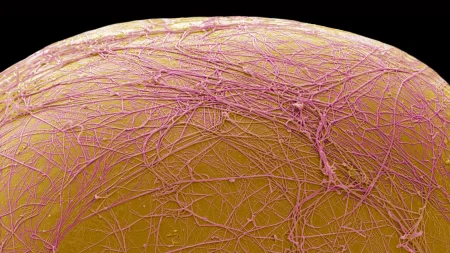
Blanchard and his team wanted to look more closely at the blood vessels themselves. The prevailing thought in the field, Blanchard says, has been that Alzheimer’s disease becomes so bad that the brain’s blood vessels break down as a result. But he and his colleagues wanted to ask the opposite question: Is it the other way around? Could damage to blood vessels actually be helping to drive the disease? To find out, they built an atlas that mapped gene expression across the human brain’s vasculature at a cellular level. Gene expression is the process by which DNA is read and converted into proteins, and mapping it cell by cell is like taking a detailed census of who is doing what in the brain’s circulatory system. The team stitched together data from three existing brainwide maps, creating an atlas that represented 66,000 cells from 220 people. Then they compared people who carried two copies of APOE4 with people who carried less harmful versions of the gene. The differences were striking. APOE4 carriers had fewer pericytes, starfish-shaped cells that wrap around blood vessels and keep them stable. They also had higher numbers of myofibroblasts, cells that normally form during tissue injury and pump out fibronectin. This matched the earlier clue from resilient APOE4 carriers: too much fibronectin, too little support. But a map is only a snapshot. It could show differences, but it couldn’t show whether the missing pericytes were actually transforming into myofibroblasts. To see the process in action, the researchers turned to 3D models of human brain tissue grown from stem cells. In models carrying two copies of APOE4, pericytes began to change. They took on the characteristics of scar-producing myofibroblasts. This transformation offered a possible explanation for the earlier clue: myofibroblasts produce large amounts of fibronectin. And when the researchers prevented cells in their models from producing fibronectin, amyloid accumulation dropped. The link was direct and visible.
The next question was what flips the switch. The researchers found a likely culprit: TGF-beta, an immune signaling molecule that helps regulate inflammation and tissue repair. In the APOE4 models, signaling through TGF-beta helped drive pericytes toward the scar-producing state. When the researchers blocked that signaling, in cell models and in aged mice, the proportion of blood vessels wrapped by pericytes was restored. That is a promising lead, but it comes with a warning. Abdel Ali Belaidi, a neuroscientist at the Florey Institute of Neuroscience and Mental Health in Parkville, Australia, called the TGF-beta data particularly interesting, because inhibiting the protein reversed some of APOE4’s effects on pericytes. But he also noted that TGF-beta performs many jobs throughout the body. It helps control inflammation, supports wound healing, and influences immune responses in ways that are essential for health. A drug that blocks TGF-beta broadly could cause serious side effects. So while this study identifies a possible target, it also highlights how delicate the biology is. The hope is that researchers can find a way to interfere with the harmful effects of TGF-beta in the brain’s blood vessels without disrupting its other roles. That is a tall order, but it is exactly the kind of problem that the new atlas and 3D models were designed to help solve. The study gives scientists a much clearer picture of the sequence of events: APOE4 leads to increased TGF-beta signaling, which pushes pericytes to become scar-producing myofibroblasts, which pump out fibronectin, which makes it harder for the brain to clear amyloid-beta. Each step is a potential place to intervene.
Even with these findings, APOE4’s link to Alzheimer’s is far from fully explained. Blood vessel damage is only one of the many ways the gene variant has been connected to the disease. Other studies have shown that APOE4 alters inflammation in the brain and interacts with tau, another protein that forms tangles inside neurons. Amyloid plaques and tau tangles are both hallmarks of Alzheimer’s, and they seem to work together in ways that are still not completely understood. How exactly APOE4 influences all of these processes, and how they lock together to drive dementia, remains a greater mystery than any single study can solve. Blanchard put it simply: “As a field, we’re all progressing toward an answer.” This study is a step, not a finish line. It gives researchers a new framework for thinking about Alzheimer’s as a disease that may begin in the blood vessels, not just in neurons. It also reinforces the idea that some people are genetically protected, and that protection can teach us how to build treatments. The resilient APOE4 carriers with low fibronectin are proof that the damage is not inevitable. If scientists can mimic the effects of their protective mutation, they might be able to help everyone, regardless of which version of APOE they carry. The study also reminds us that Alzheimer’s is not a single chain of events but a web of interacting processes, and that understanding the web is the only way to find the most effective points to intervene.
For anyone who carries APOE4, or who has watched a loved one struggle with Alzheimer’s, this research is personal. It can be frightening to learn that a gene you carry raises your risk, especially when the disease has touched your family. But this study offers a more hopeful message: genes are not destiny. Many people with APOE4 never develop Alzheimer’s, and the discovery of protective mutations shows that the body has natural ways to resist the damage. The more we understand those defenses, the closer we get to therapies that could strengthen them. The new work is still early, and it will take years to turn these insights into drugs. But every study like this one brings scientists closer to the day when Alzheimer’s can be prevented, or at least slowed, before it steals memories. In the meantime, the message from researchers is one of cautious optimism. They are not just studying a disease; they are studying resilience. And resilience, it turns out, may be the best teacher of all. The tiny blood vessels in our brains are easy to ignore, but they are essential to everything we are. Keeping them healthy, the new research suggests, might be one of the keys to keeping our minds intact. It is a reminder that even the smallest parts of our biology can hold the biggest answers.