


The same species that proudly pins race numbers to its chest, swims the English Channel, and dives a hundred meters down on a single breath is also the species whose closest relatives—chimpanzees, gorillas, and orangutans—can do none of those things. It’s a strange and wonderful gap in nature, and for decades scientists have argued about how we got there. Most have insisted the answer lies on land: early humans, they say, evolved their remarkable endurance by chasing antelope across the hot African savanna, mile after exhausting mile, until the animals simply collapsed. That “persistence hunting” story has become something of a classic, taught in textbooks and featured in documentaries. But in a paper published September 17 in the journal PaleoAnthropology, two researchers propose that we should look toward the water as well. The idea, nicknamed “dive first, run later,” suggests that our ancestors first built up stamina by diving for food in lakes and coastal waters, and only later carried that hard-won endurance onto the grassy plains. The hypothesis doesn’t toss out the land-based story—it complicates it, weaving together two very different worlds into a richer, messier, and far more interesting account of how humans became champions of long-distance movement.
There is a long history here, and it is not without scars. In 1960, researchers proposed what became known as the aquatic ape or waterside hypothesis, suggesting that our ancestors took to the water and evolved long legs, naked skin, and other traits from swimming for their meals. The idea caught the public’s imagination and filled popular books, but it never really passed scientific muster. As more fossils emerged, pointing strongly toward a terrestrial existence, the scientific community turned its back on any watery story, and the hypothesis was treated almost as a joke—a cautionary tale about ideas that run ahead of evidence. That memory still lingers. University of Connecticut paleoanthropologist Christian Tryon admits his first reaction to the new paper was doubt: “I could not work out [at first] if this was groundbreaking or dumb.” And he notes that the field has been reluctant for good reason. “There’s been this reluctance to really think about anything sort of water-related as important in human evolution,” he says. Yet the new work is not coming from fringe enthusiasts. Evolutionary anthropologist Josephine Joordens, a self-described “water person” who originally trained as a marine biologist, had long suspected that coastal life mattered in human evolution because water edges offer easy access to both marine and land resources. She joined forces with Erika Schagatay, a physiologist and champion freediver at Mid-Sweden University, to create a more careful, evidence-based argument than anything that came before.
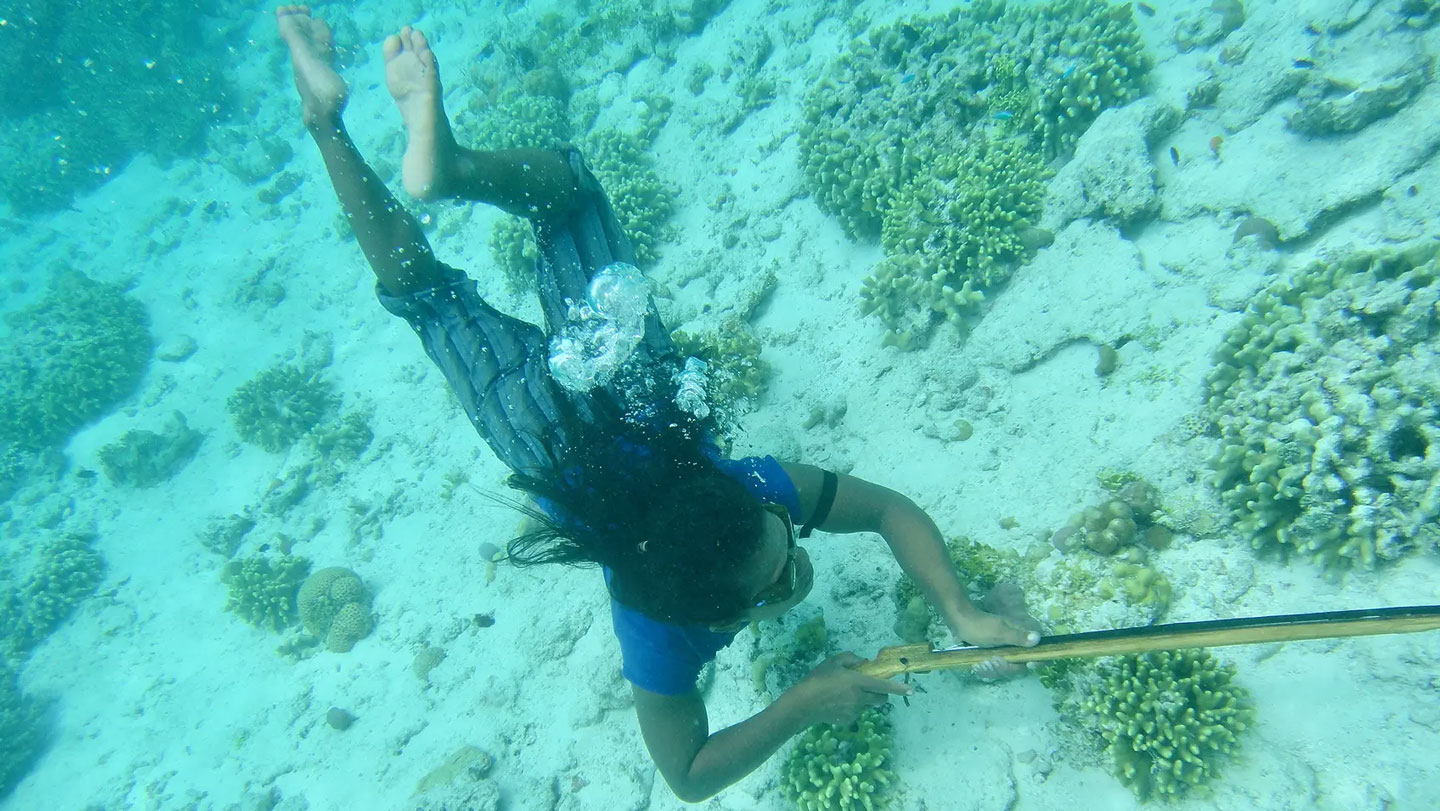
The heart of the hypothesis lies in the modern world, specifically in communities that still live by the sea and forage underwater. Schagatay has spent decades watching freediving groups like the Ama in Japan and the Sama-Bajau in Southeast Asia. These remarkable people spend four to six hours each day diving several meters below the surface, over and over again, to catch fish, pry mussels off rocks, and gather other food. Their bodies have responded to this lifestyle in measurable ways: they have larger spleens than their non-diving neighbors, a trait that acts like a biological scuba tank by releasing extra oxygen-rich red blood cells into the bloodstream during a dive. They also show enhanced respiratory and cardiovascular capacity, and they become expert at pacing their breathing, controlling their heart rate, and extending their breath-holds so they can work underwater without tiring. Schagatay and Joordens argue that these same abilities—oxygen efficiency, breath control, cardiovascular stamina—are exactly the building blocks our distant ancestors would have needed before they could become great endurance runners. The pair proposes that some Homo species, roughly two to three million years ago, spent generations diving in shallow waters for food. Over time, natural selection favored bodies that could tolerate low oxygen, manage repeated physical stress, and recover quickly. Those traits, they suggest, were then passed on to other populations that stayed mostly on land, giving them a physiological head start for running marathons of the ancient world. They even point to physical features that fit the diving lifestyle: heavy, dense bones that help a diver sink and stay underwater, and noses that face downward, which may have helped keep water out during repeated plunges.
It would be easy to dismiss this as the aquatic ape hypothesis wearing a new coat, but the researchers and some of their colleagues are careful to say it is not. “Occasional aquatic foraging is quite a different proposal” from the old idea of a mostly aquatic existence, says Christopher Ruff, a biological anthropologist at Johns Hopkins School of Medicine. The earlier theory imagined our ancestors living in the water like mermaids, swimming through much of their daily lives, and that simply does not square with the fossil record. The new idea is much more limited: a seasonal practice, a coastal tradition, a way of getting extra calories from rivers, lakes, and shorelines while still living mostly on land. Ruff says this version should be taken seriously. Leslea Hlusko, a paleobiologist at the Centro Nacional de Investigación sobre la Evolución Humana in Burgos, Spain, agrees. She says the study “shows there is a lot of evidence” that forage diving could have been an early evolutionary driver. There is something intuitively appealing about the scenario too. Imagine a group of early humans living near a lake: the water is full of protein-rich shellfish and fish, the shoreline is safe and easy to navigate, and the food does not run away as quickly as a gazelle. The people who figured out how to dive and hold their breath would have had access to a reliable source of nutrition, and over many generations those skills would have reshaped their bodies.
But not everyone is convinced, and the critiques are sharp. Daniel Lieberman, a paleoanthropologist at Harvard University and a leading voice on endurance running, argues that diving actually works against the idea that it prepared humans for running. Diving slows the heart rate down—it is part of the “dive reflex” shared by many mammals—while running speeds the heart up. The physiological demands are almost opposites, he says, so it is far from clear that one would naturally lead to the other. He also challenges the idea that heavy bones evolved to help divers stay underwater. Heavy bones could just as easily have developed because people were doing heavy physical work on land, carrying loads, or walking long distances. And the downward-pointing human nose, another proposed diving adaptation, does not convince him either, since many diving mammals, from seals to dolphins, have forward-facing nostrils. More likely, he says, the shape of the human nose evolved for other reasons, like moisturizing the air we breathe or adapting to dry climates. Archaeologist Eugène Morin of Trent University in Canada adds an economic objection: diving is costly, and the calorie returns are often low. Catching a few fish and shellfish burns a lot of energy and takes a lot of time, and if other food resources are available on land, early humans would probably have chosen those instead. In his view, the savanna hunting story remains more practical and more plausible, at least for most of our evolutionary history.
Even with those criticisms, the conversation itself may be the most valuable part of the paper. Pascal Gagneux, a biological anthropologist at the University of California, San Diego, notes that the old simple story of apes walking out of the forest and onto the savanna “clearly does not cut it anymore.” Coastal routes around Africa, lakeshores, and river valleys, he argues, must have played a huge role in human evolution, whether or not diving was central. Our ancestors were not creatures of one habitat; they were adaptable, opportunistic, and willing to explore new edges between water and land. Joordens and Schagatay know they are stepping into a minefield. The history of water-related ideas in paleoanthropology is scattered with burned reputations and mockery, and they admit they felt a little nervous. But, as Joordens puts it, “we are both in our early 60s and we both have beautiful careers, so we thought ‘whatever happens, happens.’” That mix of confidence and curiosity seems fitting for a field that is still trying to understand what makes humans human. Tryon, after wrestling with his first impression, found the paper worth reading. “If nothing else,” he says, “it gets people thinking and it gets people looking.” And that may be exactly what science needs: not a settled answer, but a reason to wonder again at the strange, winding path that led us to become the only animals on Earth who run twenty-six miles for fun and dive to the bottom of the ocean on a single breath.