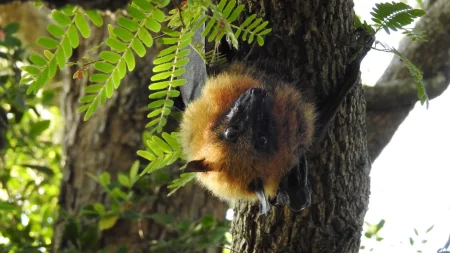



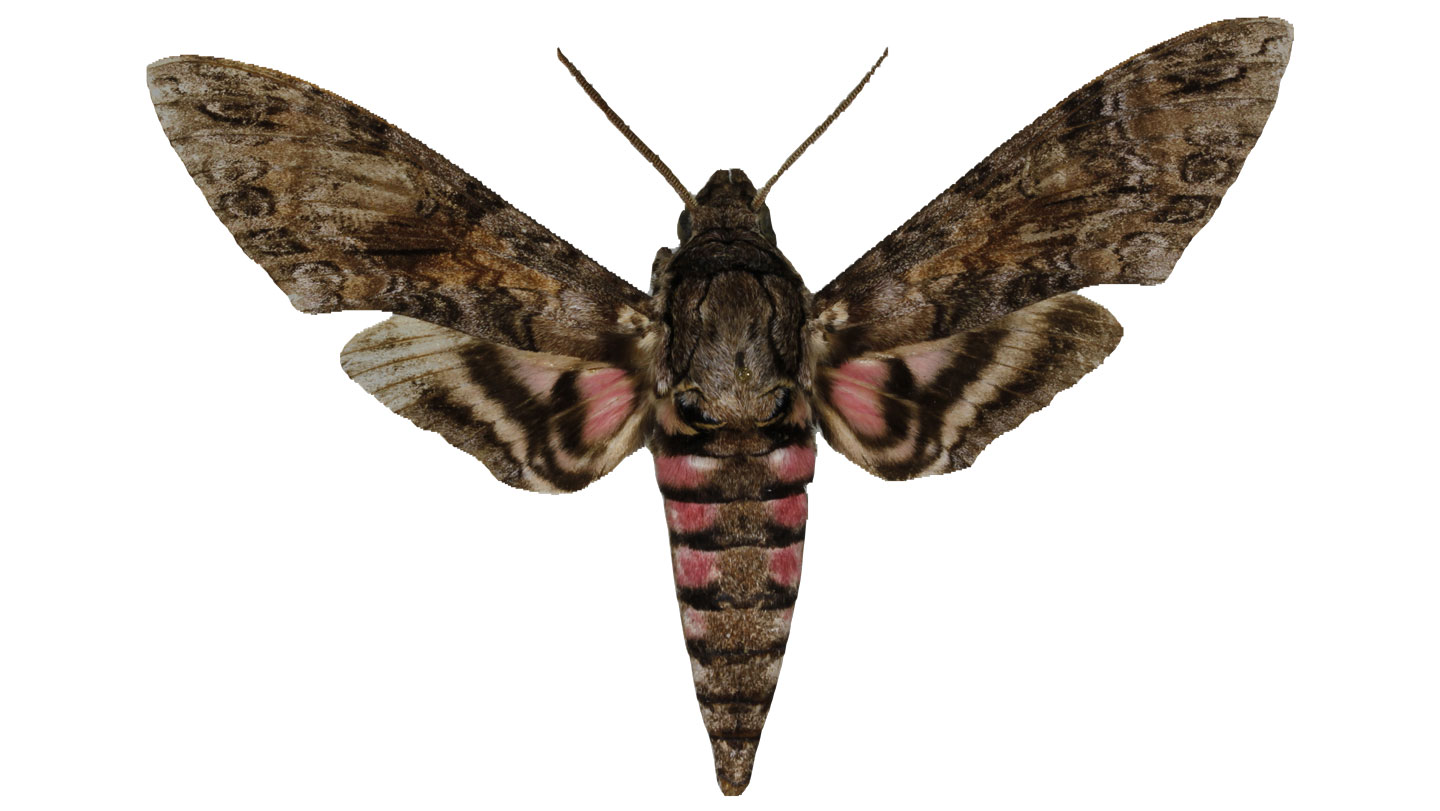
In the silent, moonlit arena of the night sky, a life-or-death duel plays out with astonishing sophistication just beyond our senses. When a bat launches its attack, locking onto its prey with rapid-fire sonar pulses, some hawkmoths refuse to be easy targets. Instead of fleeing, these moths turn their own hindquarters into a weapon, rubbing specialized scales on their genitalia against rough patches on their abdomens. This rapid scraping action, akin to running a fingernail along a comb, unleashes a concentrated burst of high-frequency ultrasound. These sound waves act as an acoustic shield, effectively scrambling the bat’s sonar system and breaking its lock on the moth, allowing the would-be victim to slip away into the darkness.
This remarkable defense mechanism is not a rare, isolated quirk of nature. In fact, new research reveals that it has evolved independently up to seven separate times across different hawkmoth lineages, a powerful demonstration of convergent evolution. The relentless predatory pressure from bats has repeatedly driven these otherwise defenseless insects to arrive at the same clever solution: using their own bodies as ultrasonic weapons. A study published on November 4 in the journal Proceedings of the Royal Society B shows that when a bat gets too close, some hawkmoths turn the tables. Rather than being passive prey as they flit through the night, they actively fight back with a sonic defense born of evolutionary necessity, showcasing nature’s incredible ability to find creative answers to life’s most persistent challenges.
To understand how this defense works on a granular level, scientists have spent years meticulously analyzing the anatomy and acoustics of these insects. The research team, including sensory ecologist Jesse Barber and entomologist Akito Kawahara, combined high-fidelity audio recordings of moths responding to simulated bat attacks with high-resolution microscopic images of museum specimens. In their latest study, they tested a staggering 143 species of hawkmoths, those torpedo-shaped speedsters often seen hovering at flowers. Their analysis revealed that 77 of these species produce ultrasound, but they do so in three remarkably different ways. In every instance, the sound originates from a patch of enlarged, football-shaped scales located on the male moth’s genital valves—structures typically used to clasp a female during mating. However, the crucial anatomical differences lie in what these specialized scales are scraped against.
The three distinct strategies are a marvel of anatomical engineering. Some species rub their genital scales against a row of similar scales near the rear of their abdomen, like two combs being dragged together. Others press their scales against stiff, spine-like bristles jutting out from the abdomen’s edge, creating a distinct rasping sound. Most intriguingly, a third group uses a previously unidentified feature: they scrape their scales over a field of microscopic, bumpy ridges on the underside of their bodies. These minute protuberances, only visible under powerful microscopes, are now recognized as a key component of the hawkmoth’s sonic arsenal. This finding highlights how even the smallest, most overlooked details of an insect’s anatomy can play a pivotal role in its survival, and how the intense evolutionary arms race with bats has led to an incredible diversity of form and function, even down to the microscopic level.
The mechanical differences in these sound-producing techniques are not just anatomical trivia; they correspond directly to the distinct acoustic properties of each type of ultrasound. The moths that scrape their scales against spines or the newly discovered microscopic bumps produce longer, more continuous sounds. This sustained noise is thought to be highly effective at jamming the bat’s sonar, filling the air with a wall of sound that makes it nearly impossible for the predator to resolve the moth’s location. In contrast, moths that rub scales against other scales generate irregular, pulsed bursts of sound. These discontinuous clicks may function differently, likely serving to startle the attacking bat at close range or to mimic the high-frequency warning calls of other, foul-tasting insects, effectively bluffing the predator into releasing its grip.
The evolutionary history of these defenses is as complex as the anatomy itself. Through phylogenetic analysis, the researchers concluded that this genitalia-based ultrasound production arose independently at least four times, and potentially as many as seven, over the last 5 to 30 million years. Each time, a different lineage of hawkmoths, faced with the same selective pressure from echolocating bats, independently evolved a separate solution to produce the very same type of protective sound. This is a textbook example of convergent evolution, where the same environmental force sculpts similar adaptations through distinct genetic and developmental pathways. The finding suggests that the nightly aerial battles fought over our heads are far more varied in their acoustic complexity than scientists ever imagined, a hidden world of ultrasonic skirmishes where moths are not just passive victims but active participants in their own survival.
Crucially, this evolutionary arms race has not been a one-way street. While some hawkmoths evolved powerful sonic defenses, other lineages that shifted their activity patterns to the twilight or daytime hours, when bats are less active or absent, subsequently lost their intricate sound-producing machinery. This loss demonstrates the immense cost and intensity of bat predation. It highlights that these defenses are not permanent, but are dynamically evolved and lost in response to the ever-present threat. As Marc Holderied, a bioacoustics expert, aptly remarked, these hawkmoths clearly have “more tricks up their sleeve” than previously imagined. The constant, generational pressure from bats has not only shaped the moths’ defensive strategies but has been a major, persistent driver of insect evolution overall, proving that even the most intimate and seemingly vulnerable parts of a creature’s body can become powerful tools for survival in the unending struggle of the natural world.