

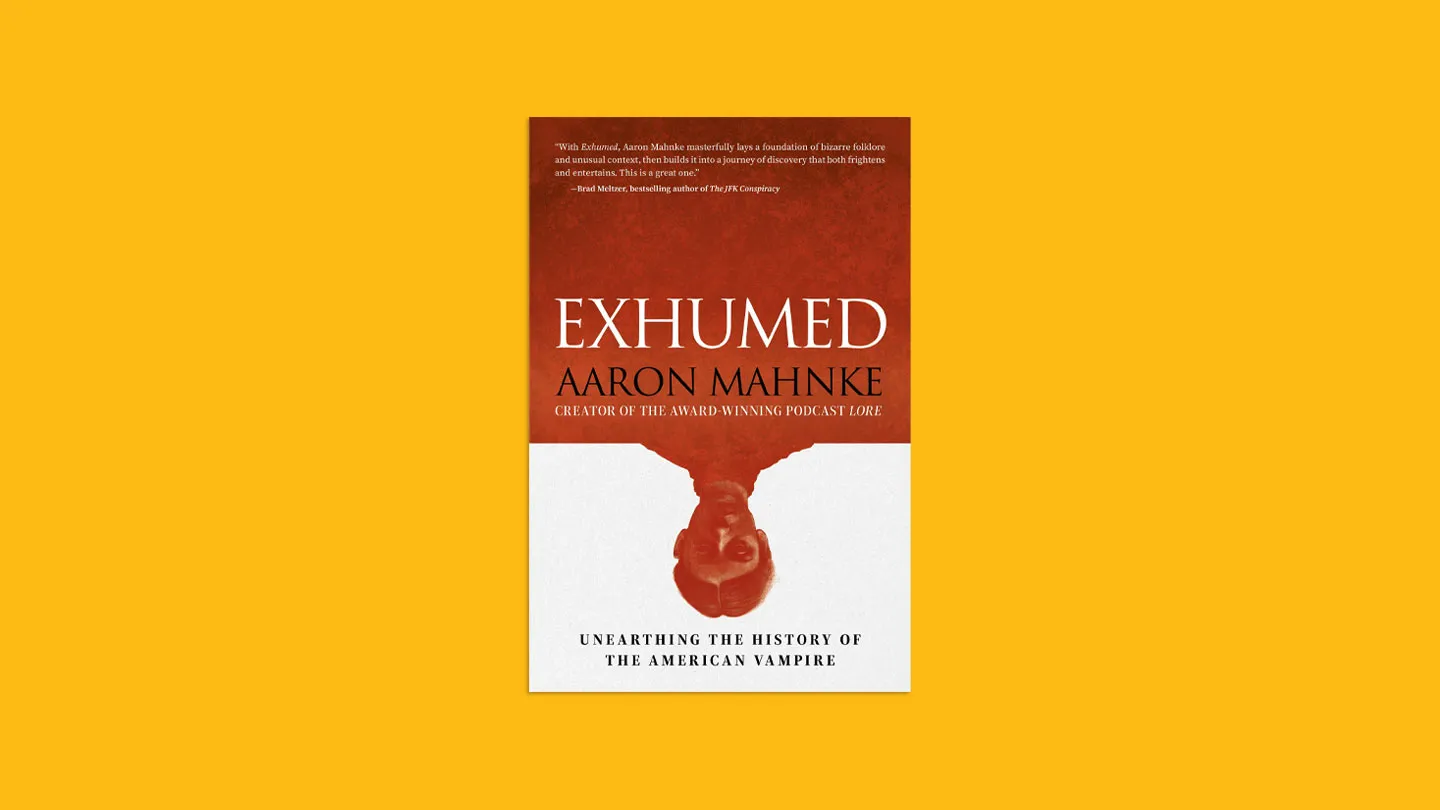
October is my favorite month. I love everything about it: the slow, gorgeous shift of leaves from green to amber and crimson, the first sharp bite of morning air, the way the world seems to settle into a quieter, more mysterious rhythm. And every year, as the days shorten, I feel that familiar hunger for stories that make the hair on my arms stand up. This spooky season, that hunger was fully satisfied by Exhumed, a new book by historian Aaron Mahnke, published by Running Press at $30.00. It’s the kind of book that feels made for October, but it’s much more than a collection of creepy tales. Mahnke draws on rich, science-based history and folklore to explore how the fear of the unknown has shaped human culture across the centuries, and he makes a compelling case that those old fears are still alive in us today. What surprised me most, though, is how fresh and accessible he makes it all feel. He weaves in references to Taylor Swift, Twilight, and other modern pop culture phenomena, which breathes new life into stories that might otherwise feel dusty and remote. Thanks to Mahnke’s gripping prose, I felt like I had been dropped right into the middle of the action, standing in cold graveyards and candlelit rooms, watching terrified people try to make sense of a world they didn’t understand. It was honestly hard to lay the book down.
Exhumed kicks off with a story that is both tragic and deeply strange: the tale of America’s first “vampire.” Walk with me for a moment back in time to Exeter, Rhode Island, in 1892. Tuberculosis is sweeping through the community, killing scores of people. The Brown family is hit especially hard. Mary Brown, the matriarch, dies of the disease, and so do two of her daughters, Mary Olive and Mercy Lena. Then Edwin, a son, falls ill with the same terrifying symptoms. In a desperate attempt to save him, the town begins to suspect that one of the dead women isn’t truly dead, but is instead an undead vampire feeding on Edwin from the grave. So the townspeople do something that feels unthinkable to us today: they exhume the bodies. Mercy, who had been buried during the dead of winter, is surprisingly well-preserved. Her hair and nails appear to have grown longer, and when her skin is pierced, dark blood dribbles out. For the frightened community, this is all the evidence they need. Mercy must be a vampire. They burn her heart and make a medicinal concoction, but it doesn’t save poor Edwin. He dies anyway. What makes the story even more haunting is a small, ironic detail: the true cause of tuberculosis, a bacterium, had actually been discovered a full decade before Mercy’s body was dug up. But news didn’t travel fast in those days, and deeply entrenched beliefs are hard to change, even when hard evidence is right in front of people. These events, Mahnke notes, helped inspire Bram Stoker’s Dracula, published just five years later. It’s a chilling reminder that our most enduring monsters are often born from real grief and fear.
What I appreciate most about Exhumed is that it doesn’t just parade these historical oddities in front of us for shock value. Mahnke uses them to explore a profound truth about human nature: when we can’t explain something, we will do almost anything to fill the gap. Fear has led people to do some extremely odd things by today’s standards. They’ve burned hearts to kill “vampires,” set booby-traps in graves to prevent the dead from rising, and even drunk the blood of freshly hanged men in an attempt to “cure” epilepsy. At one point in history, eating mummies, a practice known as “mumia,” was considered a cure-all for just about every ailment. Leonardo da Vinci himself believed that the human body contained “vital spirits,” and that when someone died, there were leftover spirits for the living to make use of. It’s easy to look back at these beliefs and laugh, or to feel superior to those poor, superstitious people. But Mahnke gently implores us to withhold judgment. After all, storytelling is one of the main ways humans make sense of the world. “All of us, both then and now, are simply making the best of what we have, trying to find a way to improve our lives,” he writes. That line really stayed with me. It reframes the whole book. These weren’t ignorant fools; they were people doing exactly what we all do when we’re confronted with the unknown: reaching for patterns, inventing explanations, and looking for a way to feel safe. The only difference is that we have modern science on our side. But deep down, we still carry the same fears and the same urge to tell stories about them.
One of the most delightful parts of Exhumed is when Mahnke shows how these historical beliefs have left their fingerprints all over our modern world, often in ways we don’t even notice. Take the tomato, for example. In seventeenth-century Europe, it was known as the “poison apple.” Many people became sick after eating tomatoes, and some even died. For two centuries, society wrongly blamed the fruit itself. The real culprit turned out to be something much sneakier: the acidity of the tomato juice was leaching lead out of the pewter dishes people ate from, causing lead poisoning. The poor tomato was innocent all along, but it took two hundred years for science to clear its name. Or consider the red, white, and blue poles that still spin outside barbershops today. Most of us walk past them without thinking twice, but those stripes are a relic of a time when barbers didn’t just cut hair—they performed bloodletting. That’s right, the barber was also your local surgeon. The red stripes stand for blood, the blue for veins, and the white for the rags used to clean up the mess. The ball on top is said to represent the bowl that caught the blood, and the pole itself represents the wand that patients squeezed during the procedure. So if you were feeling sick in 1705, you didn’t make an appointment with a doctor. You headed to the local barber with the spinning pole outside. I love details like these because they make history feel tangible. Every ordinary object has a hidden story, and Mahnke has a gift for pulling those stories out and dusting them off.
What really sets Exhumed apart, though, is the way Mahnke connects these ancient fears to the pop culture we consume today. He cites Taylor Swift and Twilight in his analysis, and at first, that might seem like an odd pairing with centuries-old folklore. But he makes it work brilliantly. Vampires, after all, never really went away. They just changed their clothes. In the nineteenth century, they were gaunt, undead monsters rising from New England graves. In the twenty-first century, they’re brooding teenagers, glittering in the sunlight and falling in love with mortal girls. The surface details shift, but the underlying fears remain the same: fear of death, fear of disease, fear of the outsider, fear of our own bodies betraying us. Mahnke shows that these stories are not just entertainment. They are ways for us to process our anxieties in a safe, symbolic form. When we watch a horror movie or read a ghost story, we’re doing exactly what our ancestors did when they burned a vampire’s heart or sprinkled salt across a threshold. We’re trying to name our fears, give them a face, and in doing so, take away a little bit of their power. This is what makes the book feel so relevant, even though it’s steeped in history. It’s also why I found it so hard to put down. Mahnke doesn’t just tell you what happened; he makes you feel the fear and uncertainty of the people who lived through it. And because his prose is so vivid, the past doesn’t feel like a distant, foreign country. It feels uncomfortably close to home.
By the time I finished Exhumed, I had a whole new appreciation for the season, and for the origins of the stories that make it so thrilling. This book is the perfect companion for spooky season, but it’s also much more than that. It’s a thoughtful, compassionate meditation on what it means to be human in a world full of mysteries. Mahnke never mocks the people whose beliefs he explores. Instead, he invites us to step into their shoes, smell the cold earth of the exhumed grave, hear the whispered fears of a community in crisis, and understand that they were just trying to survive, just as we are. He reminds us that science is powerful, but so are stories. And while we might roll our eyes at mummy dust and vampire hearts, we are not so different in our own convictions. We still cling to our own versions of explanations, some of them more evidence-based than others, because the unknown is still frightening. We still find comfort in narratives that offer order in chaos, however imperfect. Exhumed doesn’t try to solve the mystery of our fears; it simply holds them up to the light and lets us see them clearly. It’s an absorbing, humanizing read that I would recommend to anyone who loves history, anyone who loves a good scare, and anyone who wants to understand why we tell the stories we do. If you’re looking for a book to curl up with as the nights grow longer, this is the one. You can buy Exhumed from Bookshop.org, and I should mention that Science News is a Bookshop.org affiliate, so purchases made through links in the article help support their work. But whether you buy it there or borrow it from a library, just read it. October is waiting, and Mahnke will make sure you never look at a barber pole the same way again.