


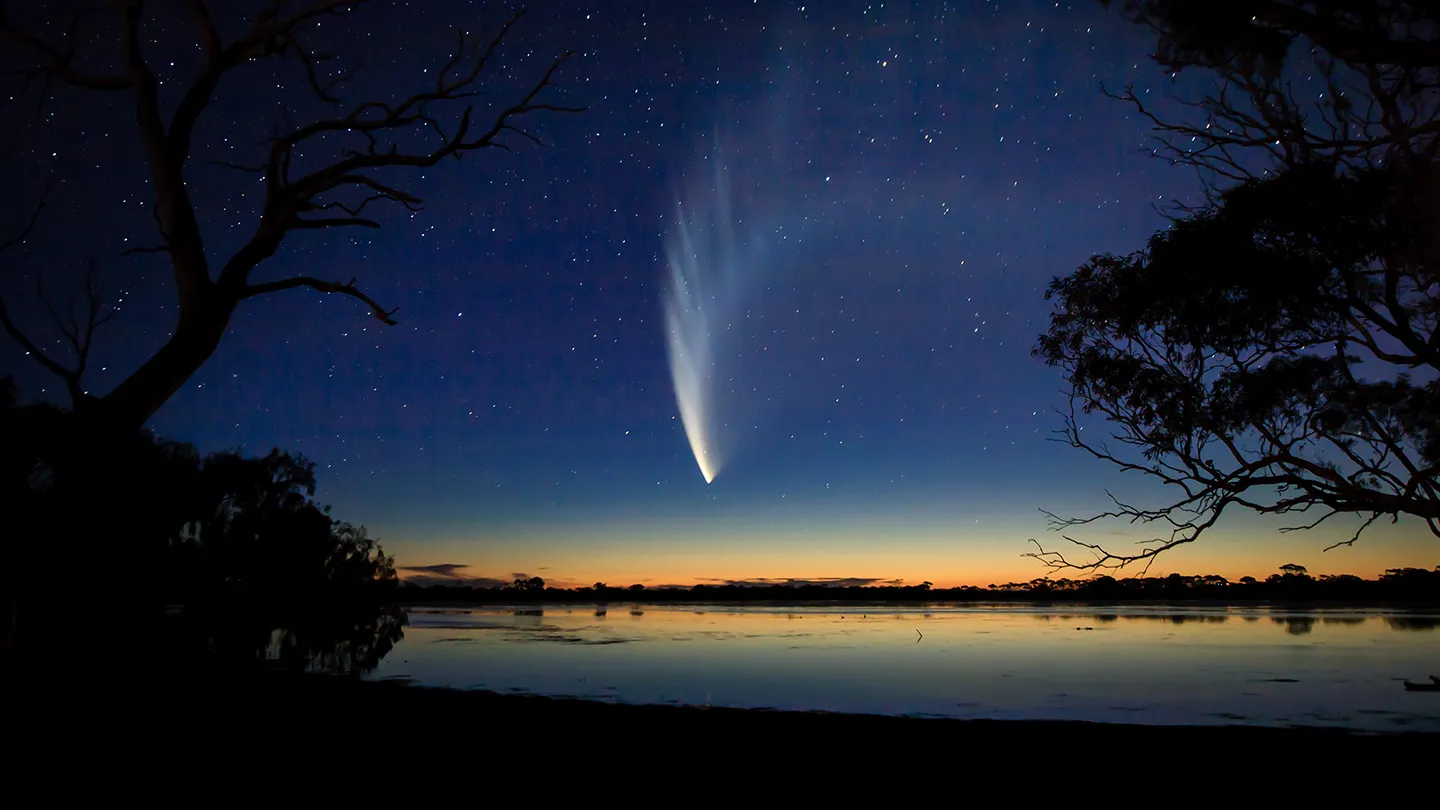
Every living thing on Earth can trace its ancestry back, at some point, to a handful of simple chemicals. But where did those chemicals come from? For a long time, one of the most popular answers was written in the stars—or, more precisely, in the icy wanderers of our solar system. Comets are essentially dirty snowballs, leftovers from the formation of the planets, and they are known to be rich in carbon- and nitrogen-containing compounds. Those are exactly the kind of raw materials that, under the right conditions, can transform into sugars, amino acids, and other building blocks of life. So it has always made sense to imagine a comet crashing into the young Earth and sprinkling these ingredients across the surface like seeds onto fertile ground. The idea is poetic, elegant, and deeply appealing: life’s origin wasn’t just a lucky accident in some warm pond; it was written into the universe from the very beginning. But a new study is challenging that charming narrative. In research published October 28 in Scientific Reports, a team of scientists re-created the violent arrival of comets using computer simulations and concluded that most comets would have been traveling too fast and at too steep an angle to Earth for prebiotic compounds to survive the impact. The findings directly undercut the long-standing idea that comets seeded Earth with the chemicals necessary for life. They don’t eliminate comets from the story entirely, but they make that version of events look far less likely. As Richard Anslow, a planetary scientist at the U.K. Met Office in Exeter and the lead author of the study, puts it, “Even though we see that comets contain all of these molecules in really high concentrations, it’s not straightforward to go from there to saying we’re going to have all of these available for prebiotic chemistry on the surface of the Earth.” A comet can be a treasure chest, in other words, and still fail to open.
To understand why these findings matter, it helps to appreciate why comets were such attractive candidates in the first place. Comets preserve material from the very earliest days of the solar system, including simple molecules like water ice, ammonia, methanol, carbon monoxide, and hydrogen cyanide. In the right environment, those molecules can react together to form biologically important compounds, including sugars and the nucleotide building blocks of DNA and RNA. For decades, scientists reasoned that if comets were constantly hitting early Earth during its first billion years—a period of heavy bombardment, after all—then at least some of that carbon- and nitrogen-rich material must have ended up on our planet’s surface. It seemed almost inevitable, a recipe handed down from the cosmos. But as our understanding of both comets and the early solar system improves, it becomes more important to revisit old assumptions. Nicolle Zellner, a physicist at Albion College in Michigan who was not involved in the new study, says this kind of reassessment is not a sign of weakness in science; it’s a sign of health. Ideas that once seemed like certainties often turn out to be oversimplified when tested against better data and sharper models. And the new study is a perfect example of why old ideas deserve a second look. A comet crashing into Earth is not like a leaf drifting onto a pond. It’s a supersonic, scorching, bone-jarring collision. The speed of entry, the angle of approach, the thickness of the atmosphere, the force of impact—all of these factors determine whether delicate organic molecules make it through alive or are shattered beyond recognition.
The research team used hydrogen cyanide as its scientific guinea pig, and for good reason. Hydrogen cyanide is a simple molecule—one carbon atom, one nitrogen atom, one hydrogen—but it has a remarkably strong bond between carbon and nitrogen. That bond gives the molecule unusual stability, and it also means hydrogen cyanide carries the kind of chemical energy that can be released to power the later reactions needed to build more complex organic structures. In the world of prebiotic chemistry, hydrogen cyanide is considered a heavyweight champion. If any molecule could survive a punishing journey through Earth’s atmosphere and a violent impact, this one could. The researchers reasoned that if even hydrogen cyanide tends to be destroyed, then more fragile and more complex molecules—the kinds of compounds that would go on to form membranes, proteins, and genetic material—would stand almost no chance. As Anslow explains, hydrogen cyanide is “probably one of the more robust molecules to surviving impacts. So if things look bad for hydrogen cyanide, then we think it’s going to be much harder for other, more complicated molecules that are more likely to be broken down during these impacts.” In their simulations, the researchers modeled a comet’s journey through Earth’s atmosphere and its collision with the planet’s surface. They used the modern atmosphere as a baseline, which is conservative, because early Earth’s atmosphere was almost certainly much denser. A thicker atmosphere creates more friction, more heat, and more destructive stress. In other words, the simulations were already generous to the comet hypothesis—and the results still looked grim.
The results, when they came in, were striking. Over the course of more than a billion years, the simulations suggested, there would have been only one impact, on average, capable of delivering a meaningful amount of hydrogen cyanide to Earth’s surface. Let that sink in. Not one every few hundred million years. One, total, in more than a billion years. And even that single impact would depend on an exceptionally narrow set of conditions. The comet had to be larger than 100 meters across, so its outer layers could protect the inner material from the worst of the heat. It had to be moving relatively slowly. It also had to approach at an oblique angle, essentially slicing through the atmosphere rather than plunging straight down like a dart. A slow, sideways strike gives the molecules a chance to survive the initial entry. But even then, the comet would still have to land in the right place. If it crashed into the ocean, any surviving hydrogen cyanide would be diluted almost immediately by an enormous volume of water. It would never reach the concentration needed to trigger the next series of chemical reactions. To be useful, the comet would need to hit solid land, where the molecules could remain concentrated enough to interact and build more complex structures. The odds of all these factors aligning so perfectly are staggeringly low. It’s not impossible, but it strains the idea that comets were reliable suppliers of life’s building blocks. A single lucky accident, however spectacular, is not the same thing as a cosmic delivery system.
Interestingly, the simulations also pointed to a different possible destination: Mars. Because Mars is smaller and has a thinner atmosphere than Earth, comets approaching it would experience less heating and less force upon entry. That means organic molecules would have a better chance of surviving the journey. In the story of life in the inner solar system, it may have been Mars that received cometary gifts more successfully than Earth. But that still leaves the question of where Earth’s carbon-bearing chemicals came from. The study doesn’t offer a definitive answer, but it does suggest several alternatives worth exploring. Gordon Osinski, a planetary geologist at Western University in London, Canada, who was not involved in the research, points to carbon-rich asteroids called carbonaceous chondrites. These primitive space rocks are also full of organic material, and their structure may allow those compounds to survive impact more readily than cometary material does. Another possibility is that the building blocks of life were forged right here on Earth, in places like volcanoes and hydrothermal vents, where simple gases react in the presence of heated water and catalytic minerals to form more complex molecules. None of these alternatives has been proven yet, but they are all credible, and they deserve more attention in light of the new findings. Osinski suspects the study “definitely will make people think twice about comets being the originator for the delivery of organics.” He hopes other scientists will try to reproduce the results and then run similar simulations for carbonaceous chondrites as well. That kind of persistence is how science moves forward—not by protecting old stories, but by testing them until they either hold up or give way to something better.
The study is not the final word on the subject. It focuses on one molecule, relies on models that will continue to improve, and necessarily makes simplifying assumptions about a process that is still not fully understood. But that’s precisely where its strength lies. It invites us to look beyond our favorite origin story and consider other possibilities, however messy or complicated they may be. The origin of life may not have been a grand cosmic event involving a comet and a spectacular collision. It may have been something quieter, stranger, and more local—a warm volcanic pool, a deep-sea vent, a patch of mineral-rich clay where chemistry slowly became biology. What this research shows is that the universe does not always cooperate with our expectations. The difference between a planet that becomes alive and one that stays barren could depend on something as subtle as an angle of approach, the size of an impact crater, or whether a molecule ends up in the ocean or on solid ground. That fragility makes Earth’s existence feel even more extraordinary, and it makes the search for life’s origins even more compelling. We may never find a single moment when life began, but every time a cherished idea is re-examined, we get a little closer to an honest understanding of our place in the cosmos. Sometimes the truth is less romantic than the myth. But it is no less astonishing.