



In a recent reflection as Editor in Chief of Scientific American, Nancy Shute turns her attention to something at once intimate and immense: the sound of a human voice. In a world saturated with screens, algorithms, and automated replies, Shute invites readers to pause and consider how much meaning travels through the fragile, expressive instrument of speech. Her editorial threads together seemingly disparate stories—how the voice uplifts and informs, how a rare neurological disorder has found new rays of hope, and how artificial intelligence is quietly challenging the very foundations of mathematical discovery. But beneath these diverse topics lies a unifying truth: that science is not an abstract machine of facts and formulas, but a profoundly human endeavor, carried forward by people who speak, suffer, wonder, and dream. Shute’s writing is a reminder that the best science journalism does not simply relay data; it listens to the cadences of lived experience and translates them into understanding. She opens a space where readers can feel the warmth of a conversation, the tremor of a diagnosis, and the quiet excitement of a breakthrough, all while confronting the powerful ethical questions that arise when our own creations begin to think alongside us. It is an invitation to celebrate the voice, not just as a biological phenomenon or a communication tool, but as an emblem of our shared humanity in an age that often threatens to dehumanize knowledge. Through her words, we remember that every study, every statistic, every scientific triumph begins and ends with people talking to each other, caring for each other, and daring to ask what comes next.
The power of the human voice, Shute argues, is something we often take for granted until we lose it or witness it falter. The voice carries more than words; it carries timbre, rhythm, pauses, laughter, and tears. It is the ship of emotion across the ocean of meaning. In the editorial, she highlights research demonstrating that infants respond to the melody of their mother’s speech long before they understand a single word, and that listeners can identify joy, anger, sadness, or fear with remarkable accuracy purely from vocal tones, even in unfamiliar languages. The voice can soothe a frightened child, galvanize a crowd, comfort a grieving friend, or warn of impending danger. It is our most versatile instrument, and yet it is also one of the most vulnerable. Shute reflects on how scientists are now exploring the voice as a window into health: subtle changes in pitch, rhythm, and breath can signal neurological decline, depression, respiratory infections, or even the early stages of conditions like Parkinson’s disease. Machine learning models are being trained to detect these acoustic clues, promising earlier diagnosis and more personalized care. But Shute also cautions against reducing the voice to a digital data set. A person may be more than their speech patterns, and a diagnosis is more than a probability. The human voice, she reminds us, is never just information; it is connection. It is the way a grandmother tells a family story, the way a teacher sparks curiosity, the way a doctor sits beside a patient and says, “I hear you.” In celebrating the voice, Shute calls for a science that elevates not only the message but the messenger—honoring the people who speak and those who take the time to truly listen.
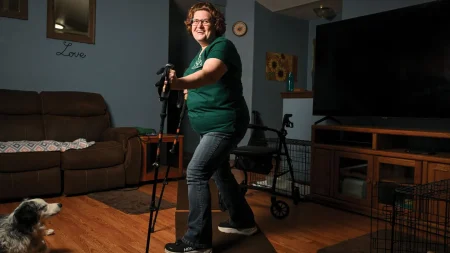
From the melody of ordinary speech, Shute turns to a condition that steals the voice, the movement, and ultimately, the agency of those it afflicts: stiff person syndrome. This rare neurological disorder, characterized by progressive muscle rigidity and severe spasms, is named with an irony that no one affected would miss—there is nothing “stiff” about the experience of locked limbs, arched backs, and sudden falls. The illness is caused by the body’s own immune system mistakenly attacking proteins involved in the inhibitory signaling of the central nervous system, leaving the brain unable to calm overactive muscles. For years, patients faced a cruel combination of excruciating symptoms and widespread misunderstanding, dismissed as anxious or faking. But as Shute notes, the tide is turning. New research into immunomodulatory therapies, targeted antibodies, and gene-adjacent treatments has begun to offer genuine hope. In particular, treatments that deplete the harmful B cells or block the autoimmune cascade have shown promise in stabilizing symptoms and allowing patients to reclaim their lives. Perhaps just as importantly, the condition has finally entered the public spotlight. When the renowned singer Celine Dion bravely disclosed her diagnosis, she gave stiff person syndrome a face, a voice, and a story. Her vulnerability shattered the silence that had hidden the disease in shadows, and her determination to return to the stage mirrored the resilience of countless others living with chronic illness. Shute’s portrayal humanizes the science, moving beyond clinical terminology to describe real people whose days are measured in small battles: standing from a chair, lifting a cup, singing one more note. She praises the researchers who refused to accept that nothing could be done, and she honors the patients who participate in trials, not for their own sake alone, but for the future generations they will never meet. Their courage, she suggests, is a kind of voice in itself—an unspoken declaration that suffering does not define a person, and that hope, however fragile, deserves room to grow.
If the human voice offers connection, and medical research offers hope, then the third thread of Shute’s editorial poses a more unsettling question: what happens when machines begin to speak in ways we no longer understand? The use of artificial intelligence in mathematics has ignited a heated controversy, one that is reshaping the oldest of sciences in real time. Mathematicians have always relied on intuition, creativity, and painstaking proof—the beautiful architecture of logical reasoning that turns guesswork into certainty. But AI, from theorem-proving software to large language models trained on billions of symbols, can now generate conjectures, outline proofs, and even discover patterns that elude human minds. Some celebrate this as liberation: AI can handle the woolly arithmetic, leaving humans free to dream, to connect, to ask the deeper questions. Others recoil in alarm. If a proof is so vast that no human can actually verify it, is it truly a proof? If a machine produces a beautiful theorem without explanation, have we advanced understanding or simply replaced it with a magic trick? Shute captures this tension with balance and empathy. She describes mathematicians who proudly use AI as collaborative partners, and others who warn of a crisis in rigor, where the very meaning of mathematical knowledge becomes unmoored from human reasoning. The controversy is not merely philosophical; it has practical consequences for education, peer review, funding, and the way we train the next generation. If a computer can solve a problem that once required a lifetime of genius, what is the point of learning to think in proofs? Yet Shute suggests that the panic may be premature. AI did not make poetry obsolete; it did not erase the human need to paint, to compose, to tell stories. In the same way, it will not erase the deep human longing to understand why—to see the elegant thread that ties a theorem to the fabric of mathematics. AI may become a new tool in the mathematician’s bag, not a replacement for the mathematician’s soul. But, she cautions, we must steer the transition with care, ensuring that the voices guiding scientific progress remain human, diverse, and accountable.
Taken together, these three stories—about the voice, about chronic illness, about AI in mathematics—paint a portrait of science at a crossroads. Shute draws them together with a masterful hand, showing that what connects them is a question of trust. We trust the human voice because it has evolved over millennia to convey not just facts but intent. We trust researchers and patients in the fight against stiff person syndrome because their vulnerability reminds us that medicine is a covenant between people, not a transaction of chemicals. And we are rightly wary of trusting AI without question, because trust is a human gift, earned through integrity, transparency, and shared reasoning. Science thrives when it is communicated not as a monologue of authority, but as a conversation among equals. Shute’s editorial is a plea for that conversation—a call for scientists to speak plainly, for journalists to listen deeply, and for readers to stay engaged even when the topics feel difficult or foreign. She acknowledges the impulse to shrink from complexity, to retreat into echo chambers where everything is comfortable and familiar. But the voice, she reminds us, is fundamentally an act of reaching out. It crosses distance. It breaks silence. It makes the abstract personal. In an era when misinformation can spread faster than the very research that corrects it, the role of editors, writers, and outlets like Scientific American becomes almost sacred: to distill, to clarify, to humanize, and to place each new discovery within the larger story of what it means to be alive, on a planet in constant motion, among people who are at once fragile and magnificent.
Ultimately, Nancy Shute’s reflection is a meditation on the art of listening. She asks us to lend our ears to the voices of patients, researchers, critics, and dreamers, even when—especially when—those voices are quiet or uncertain. She invites us to consider that the greatest breakthroughs in medicine, in mathematics, and in every field of inquiry are not solitary moments of revelation, but the cumulative results of thousands of people speaking up, questioning, sharing, and refusing to surrender. Stiff person syndrome may one day be cured; AI may one day prove theorems that mock the limits of human cognitive ability; the human voice itself may be replicated, sampled, and synthesized into perfection. But no algorithm will ever feel the cold fear of a diagnosis, the trembling joy of a child’s first word, the bittersweet pride of a proof completed after a decade of struggle. Those feelings belong to us, and they are what make science worthy of our devotion. Shute ends her editorial with a quiet call to action: let us be curious, let us be kind, and let us keep talking—to each other, across every divide, with honesty and hope. Our voices are imperfect, wavering, laden with emotion and memory. And that is precisely their power. They remind us that behind every fact is a person, and within every truth, a heartbeat. In a time of deep divisiveness, technological upheaval, and global challenges that dwarf any single nation or discipline, that is a message worth hearing—and a reason to listen, carefully, to the next voice that speaks.