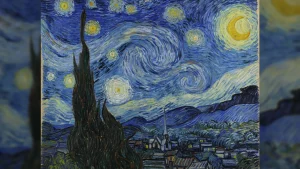


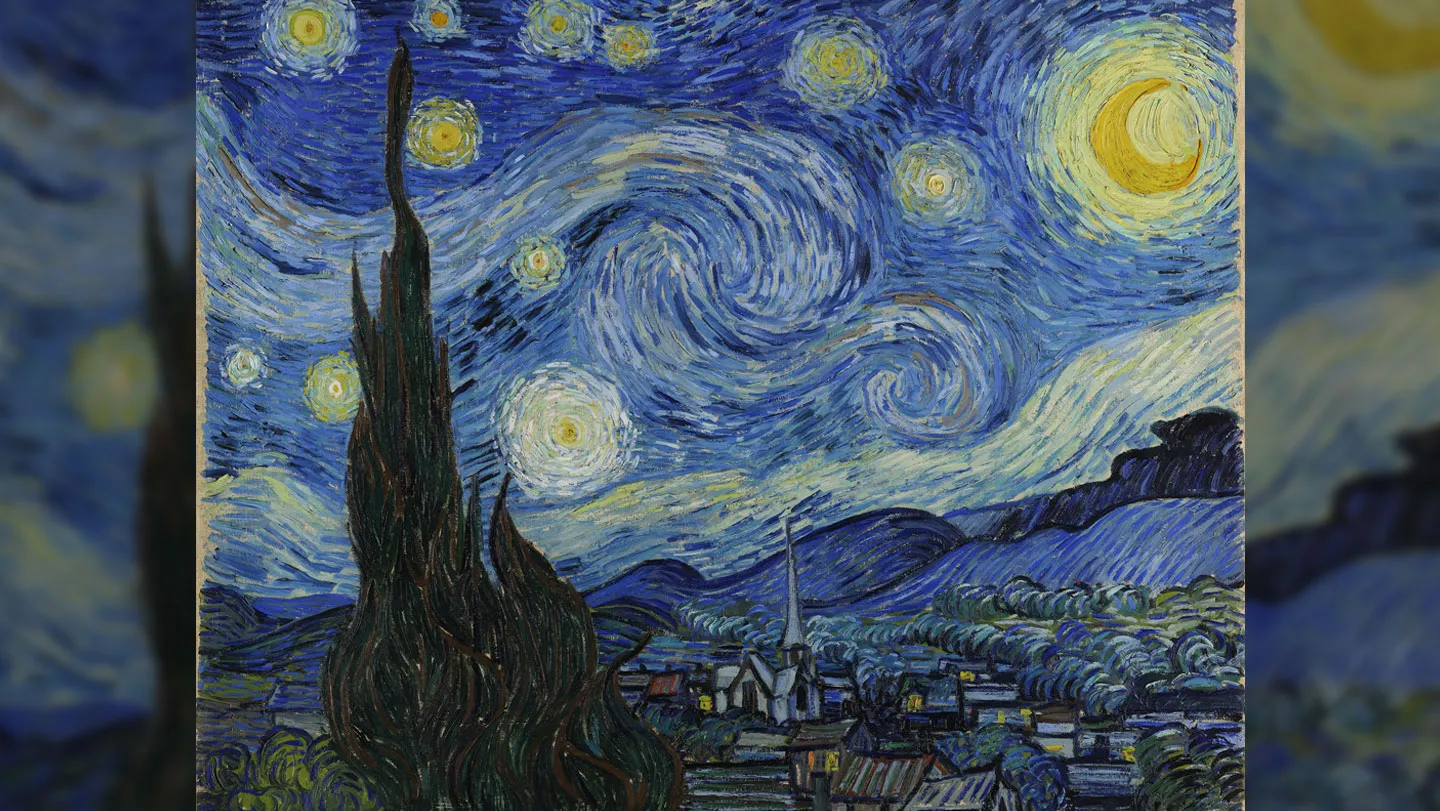
For more than a century, Vincent van Gogh’s The Starry Night has stood as one of the most beloved and mysterious works in all of art. With its swirling blue sky, blazing whorls of light, and a dark cypress tree reaching upward like a flame, the painting has always felt less like a literal record of a place and more like a vision from a dream—or perhaps from a mind in turmoil. Yet a new study by astronomer Elijah Jeong-hyun Kim and his colleagues suggests that the painting may be far more grounded in reality than anyone ever realized. According to their research, published in Scientific Reports, The Starry Night may have been based on a specific, verifiable moment in the night sky: the predawn hours of July 22, 1889, over the south of France. If the team is right, then one of the most imaginative paintings in Western art was not an escape from the world, but a deeply attentive response to it. Kim and his collaborators used a combination of astronomical simulations, statistical shape analysis, and even a visit to the site van Gogh painted to figure out which stars might have inspired the canvas. Their conclusion challenges the common assumption that The Starry Night was mostly invented in the artist’s head. As the team put it, “How could an invented sky fit the sky of a particular date this closely? Observation and imagination have commonly been treated as an either/or, yet ‘The Starry Night’ shows the two coexisting on one canvas.” The suggestion is not that van Gogh simply copied what he saw, but rather that the raw material for his art may have come from a real astronomical event, one that he then transformed into something extraordinary.
To understand why the finding matters, it helps to revisit what scholars thought they knew about the painting’s date. Art historians have traditionally dated The Starry Night to around mid-June 1889, largely because of a letter van Gogh wrote to his brother Theo on or about June 18. In that letter, van Gogh mentioned completing “a landscape with olive trees, and also a new study of a starry sky.” The timing seemed to fit: van Gogh had checked himself into the asylum at Saint-Rémy-de-Provence in early May, and The Starry Night is widely believed to represent the view from his east-facing bedroom window. A few weeks after that letter, van Gogh suffered a severe breakdown and did not paint for about six weeks. So historians naturally concluded that the painting must have been finished before that period of illness. That line of reasoning seemed solid, but it set the stage for a long-running puzzle among astronomers. In the 1980s, two different researchers tried to match the stars in the painting to the real sky over Saint-Rémy in mid-June 1889. One argued that the painting showed the constellation Aries on June 19. Another looked at weather records from Aix-en-Provence, about seventy kilometers away, and found clouds on that date, leading to the conclusion that The Starry Night was not a direct observation at all, but rather “a celestial composite, constructed to make an image of the morning sky.” For decades, that debate sat unresolved, caught between art historians who trusted van Gogh’s letter and astronomers who could not make the pieces fit.
Kim entered the discussion without the usual assumptions. Unlike previous researchers, he did not begin by accepting the June date. A telescope builder by profession, the founder of a company called SLLAB Inc. in Seoul, South Korea, Kim had spent years guiding telescopes through their first alignment with the night sky, which meant he had memorized the positions of constellations the way a musician memorizes scales. When he looked at The Starry Night, he was skeptical of the old Aries theory. The stars of Aries are faint, he noted, “hardly enough to inspire a painter.” Instead, he saw something different: the V-shaped pattern of the Hyades star cluster, which sits in the constellation Taurus and is anchored by the bright orange star Aldebaran. To test this idea, his team turned to a statistical technique called Procrustes shape analysis. The name sounds forbidding, but in essence the method compares two shapes and measures how closely they match after accounting for size, rotation, and position. Using this tool, they compared the stars in the painting to the stars of the Hyades and found a suspiciously close match. To make sure the method actually worked, they applied it to another van Gogh painting, Starry Night Over the Rhône, which unquestionably contains the Big Dipper. The degree of matching in both paintings was similar, which gave the team confidence that they were on the right track. They then used the moon and Venus to narrow down the date. On June 19, 1889, the moon was a waxing gibbous, nearly full and bright, but the moon in van Gogh’s painting is a sharp waning crescent, the kind of thin silver sliver seen just before dawn. That single detail alone made the traditional June date look highly unlikely. Using computer simulations that did not exist in the 1980s, Kim calculated the positions of the celestial bodies on every plausible date in 1889 down to the second. He also traveled to France in the summer of 2019 to stand in the landscape around Saint-Rémy and try to reconstruct the view van Gogh might have had from his window. When all the data came together, one date fit better than any other: July 22, 1889, just before dawn, when the waning crescent moon, Venus, and the Hyades cluster were arranged in a way that echoes the composition of the painting.
For Kim, the discovery was not just an intellectual triumph but a deeply personal one. He described the moment when he finally located the right spot and overlaid a drawing of the painting’s celestial elements on the real view: “I still cannot forget the moment we finally found the spot, overlaid the drawing on the view and saw it fit perfectly,” he said. “I was standing where Vincent had stood 130 years earlier. And the thrill I felt when I confirmed that the moon, the Hyades and Venus of July 22, 1889, fit exactly within the drawing’s field of view is still with me.” There is something moving about that image: a twenty-first-century astronomer, armed with software and ancient intuition, standing on the same patch of earth where a tormented painter once looked up and saw a sky that would eventually become part of humanity’s shared imagination. Kim’s enthusiasm is contagious, and his story is a beautiful reminder that science is not a cold, mechanical pursuit. It is driven by the same curiosity and wonder that inspired van Gogh to paint. The team’s work also suggests a new way of thinking about the artist: not as a solitary genius inventing worlds out of nothing, but as someone deeply attuned to the natural world, who saw something extraordinary in an ordinary dawn and chose to magnify it, distort it, and reimagine it. Whether or not every detail of the theory survives scrutiny, Kim’s research has already changed the conversation by suggesting that observation and imagination are not opposites. They are partners.
Of course, not everyone is convinced. Donald Olson, an astronomer at Texas State University in San Marcos, has spent years studying the connections between astronomy and art history, and he respects the new work even as he questions its conclusions. He points to a basic technical problem: Kim’s team relied on a narrow field of view, one that makes the Hyades cluster fill most of the canvas. But the same canvas also includes broad, round hills and cliffs at the bottom, which would require a much wider field of view to take in. In other words, the geometry of the painting may not be consistent with the geometry of a single, fixed window looking at a single patch of sky. Olson argues that the narrow field of view is “essential for their theory that the stars of the Hyades fill most of the canvas,” and that it is “inconsistent with the much wider field of view required to encompass ‘The Starry Night’s’ round hills and cliffs.” That casts doubt on the paper’s central claim, even if it does not completely dismantle it. Olson also offers a simple, almost elegant test for the Hyades theory. He suggests asking an amateur astronomer to look at The Starry Night and point out Aldebaran, the brightest star in the Hyades, which in the real sky sits at the bottom left corner of the V. In nature, Aldebaran stands out unmistakably. But in the painting, there are many other stars that appear far more prominent. If Kim’s theory is correct, Olson says, identifying Aldebaran should be easy. Kim and his colleagues do identify Aldebaran, placing it as one of the two stars to the left of the cypress tree. But Olson suspects that most experienced stargazers, even if they are told to look for the Hyades, will not agree with that identification. Instead, they will see the brighter, more dramatic stars in the painting as something other than a faithful astronomical map. Olson’s tone is gentle rather than dismissive. He says, “Not to douse Kim’s enthusiasm,” before raising his objections, and he freely acknowledges that van Gogh’s letter to Theo remains strong evidence for a mid-June date. The debate, in other words, is far from settled.
So what does all this mean for how we should see The Starry Night? Perhaps the most honest answer is that the painting now holds even more mystery than before. If Kim is right, van Gogh was looking at a real sky on a specific morning, one that included Venus, a waning crescent moon, and the gathered stars of the Hyades cluster, and he turned that fleeting moment into a canvas that has outlived his own troubled life by more than a century. If Olson is right, then the painting remains a more layered object, one that combines pieces of memories, moments, and emotions into a unified whole that never really existed in any single sky. Either way, the painting becomes richer. It is no longer simply a beautiful image; it is an invitation to ask questions about time, perception, and the strange alchemy by which the human mind takes in light from distant stars and transforms it into something that speaks to people across generations. The great irony is that van Gogh himself likely did not think of his work as either pure observation or pure invention. He wrote endlessly about trying to capture the essence of things, about the struggle between what his eyes saw and what his heart felt. A painting like The Starry Night exists in that struggle. It is a record of a real sky, filtered through a human consciousness that was both tormented and brilliant. And in the end, that may be the most perfect explanation of all: the painting is both science and dream, both fact and fantasy, both the sky above France in 1889 and the imagination of a man who refused to see it in ordinary ways. The new study gives us a date, a constellation, and a theory, but it cannot and should not explain away the wonder. It simply gives us another reason to look up, and to look again.