

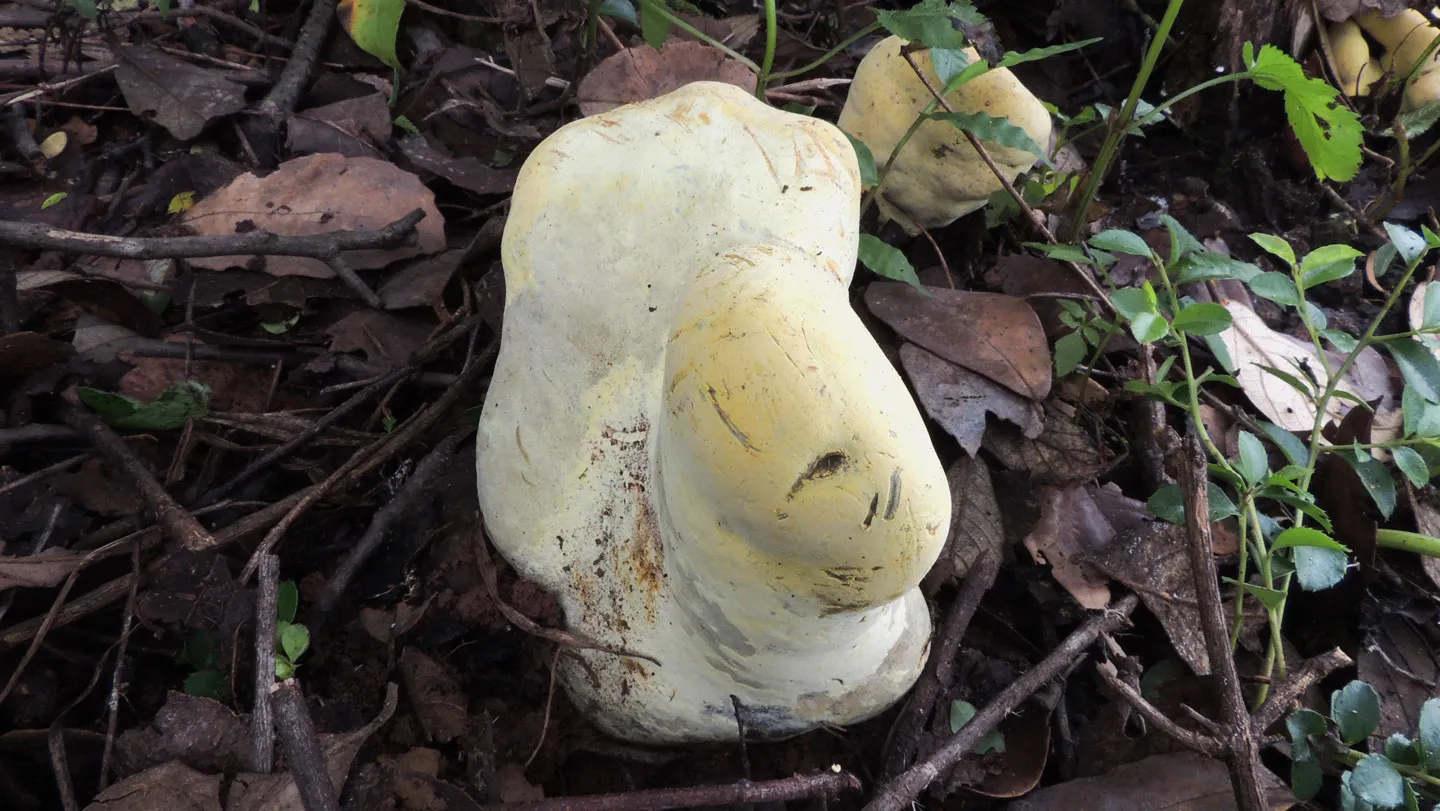
Deep in the lush, mist‑shrouded rainforests of southwestern China, something extraordinary was hiding in plain sight. For years, local farmers had walked past it, noticed it, wondered about it—perhaps even paused to admire its strange, almost alien beauty. But science had no name for it. That all changed in 2024, when researchers from the Kunming Institute of Botany arrived in Yunnan Province to survey fungal diversity. They were following a tip from farmers who had stumbled across an unusual fungus growing among decaying tree roots. The farmers, curious and practical in equal measure, snapped photos and sent them to the scientists. One of them had even done something braver than any trained mycologist would ever dare: they took a bite. “They wanted to confirm whether it was edible or not,” recalled Indunil Chinthani Senanayake, the mycologist who led the team. That simple, human act of curiosity—the age‑old instinct to taste something unknown and see if it nourishes or harms—had inadvertently set the stage for one of the most remarkable fungal discoveries in recent memory.
When Senanayake and her colleagues finally reached the site, they found something that made their scientific hearts race. Sprouting from rotting wood were strange, yellowish growths that looked like a cross between tentacles and spatulas, reaching ambitiously toward the forest canopy. These were unmistakably ascomycetes, or “sac fungi,” the vast group that includes morels, truffles, and molds. But there was a problem: sac fungi simply aren’t supposed to get this big. Most species in this lineage produce modest fruiting bodies—the spore‑bearing structures we recognize as mushrooms—that are small, delicate, and easily overlooked. Yet here were specimens towering at up to 50 centimeters tall, with some weighing a staggering 2.2 kilograms. For context, that’s roughly the size and weight of a pineapple, or a small watermelon, or a very enthusiastic cabbage. By every scientific estimate, these are the largest spore‑making fruiting bodies ever recorded among all sac fungi. The team carefully collected samples, carried them back to the laboratory, and began the painstaking process of figuring out exactly what they had stumbled upon.
The science of what makes this fungus so special begins with a crash course in fungal anatomy. Most people are familiar with the mushrooms that pop up on forest floors after rain—these are the “fruiting bodies” of fungi, temporary structures designed for a single purpose: to produce and release spores. The main body of the fungus, a vast network of threadlike cells called mycelium, lives hidden underground or inside rotting wood throughout the year. Sac fungi, scientifically known as ascomycetes, produce their spores inside microscopic, bladder‑like containers called asci. This distinguishes them from club fungi, or basidiomycetes, which make spores on the familiar bowling‑pin‑shaped structures we associate with culinary mushrooms like portobellos and shiitakes. The distinction matters because, among sac fungi, huge fruiting bodies are virtually unheard of. Truffles, which are also ascomycetes, can grow impressively large in their subterranean homes, and some species approach the bulk of D. rex. But Torda Varga, a mycologist at the Royal Botanic Gardens, Kew, who was not involved in the research, confirmed that D. rex appears to be the largest sac fungal fruiting body he is aware of. What struck Varga as even more remarkable, however, was the sheer audacity of the fungus’s invisibility. “A fungus with such an enormous fruiting body appears to have remained scientifically undocumented until now,” he said, noting that his own experience has mostly been within Europe, where such a find would have been impossible to overlook. It is a humbling reminder that even in an age of satellite imagery and genetic sequencing, the natural world still keeps secrets from us.
To understand where this giant belongs in the tree of life, the researchers turned to DNA analysis. They extracted genetic material from the samples and compared it against databases containing the genomes of thousands of other fungal species. The results were surprising. The closest known relatives of D. rex are species like the candlesnuff fungus and dead‑man’s‑fingers—odd, slow‑growing fungi that produce fruiting bodies only a few centimeters tall. The evolutionary distance between these tiny relatives and the colossal newcomer was vast enough to suggest that D. rex represents an entirely new family within the ascomycetes. This means it’s not just a new species; it’s a whole branch of the fungal family tree that scientists had never encountered before. The team christened it Dianjunus rex, a name steeped in meaning. The genus name, Dianjunus, honors the ancient Dian kingdom, a Bronze Age civilization that once flourished in the same region of Yunnan. The species epithet, rex, comes from Latin for “king”—a fitting title for a fungus that rules the record books. Every time the name is spoken, it carries echoes of both the deep human history of the land and the biological majesty of the organism itself.
The story of D. rex becomes even more poetic when you consider its evolutionary origins. Molecular clock analysis, which uses genetic mutations as a sort of molecular stopwatch, suggests that the Dianjunus lineage first emerged in the immediate aftermath of the Cretaceous–Paleogene extinction event—the cataclysmic asteroid impact roughly 65 million years ago that wiped out three‑quarters of all plant and animal species, including the non‑avian dinosaurs. This is a strikingly apt origin story for a fungus named after a king of a kingdom. In the cold, dark years that followed the impact, when sunlight was blocked by global clouds of debris and photosynthesis ground to a halt, the planet’s ecosystems collapsed in a cascade of extinctions. But life did not surrender entirely. In the gloom, a different kind of life thrived. As Senanayake explains, “During the dark, cold, post‑impact years after the mass extinction, fungi that decompose dead organic matter could keep functioning better than light‑dependent photosynthesizers.” The ancestors of D. rex were likely among these survivors, consuming the massive quantities of dead wood and plant matter left behind by a dying world. They were the cleanup crew of the apocalypse, the earnest recyclers that converted death into new life. Over tens of millions of years, this lineage evolved in obscurity, growing larger and stranger, until a group of curious farmers in Yunnan happened to notice it.
Looking ahead, there may be far more to uncover about this royal family of fungi. Varga has proposed a clever approach: searching environmental DNA, or eDNA, databases. These databases contain genetic fragments shed into soil, water, and air by organisms throughout their lives. Scientists around the world routinely collect these samples for everything from biodiversity surveys to forensic investigations, and the resulting data are stored and shared publicly. “Some of these sequences might belong to previously undocumented relatives of Dianjunus rex,” Varga said. If researchers can identify these hidden genetic signatures, they might be able to trace the distribution, ecology, and evolutionary history of D. rex’s family without ever needing to find a physical specimen. Such discoveries could reveal how widespread these giant fungi truly are, what environmental conditions they need to flourish, and how they have changed over the millions of years since the dinosaurs fell. For now, D. rex stands as a magnificent enigma—a pineapple‑sized king in a kingdom of the invisible, a living link to a time of devastation and renewal, and a powerful reminder that the natural world still has surprises capable of humbling the most seasoned scientists. In an era when we sometimes feel we have mapped and catalogued everything, the discovery of such a colossal, previously unknown fungus—found only because farmers took a chance, snapped a photo, and asked a question—invites us all to look a little closer at the world beneath our feet. Who knows what other kings are waiting to be found?