


The 2026 World Series has flipped from a tense, nail-biting affair into a full-blown Milwaukee takeover. After squeaking past the Tampa Bay Rays in Games 1 and 2, the Brewers arrived in Tampa Bay for Game 3 with something far more emphatic in mind. They did not just win; they demolished. A 10-1 rout, powered by a jaw-dropping eight-run fifth inning, gave Milwaukee a commanding 3-0 series lead and left the team standing one victory away from the first World Series championship in franchise history. For a franchise that has spent decades chasing October glory, the moment felt almost surreal. The game began as a taut, low-scoring duel, with both starting pitchers dealing and the outcome far from certain. But baseball has a way of turning quiet evenings into chaos, and the fifth inning turned this one into an all-time classic. The Brewers scratched across two runs in the third inning, then waited before unleashing a fifth-inning eruption that Tampa Bay simply could not survive. By the time the dust settled, the scoreboard read 10-1, the Rays were reeling, and the Brewers were on the brink of baseball immortality. It was not just a victory; it was a statement, delivered with a sledgehammer after two games that had required surgical precision.
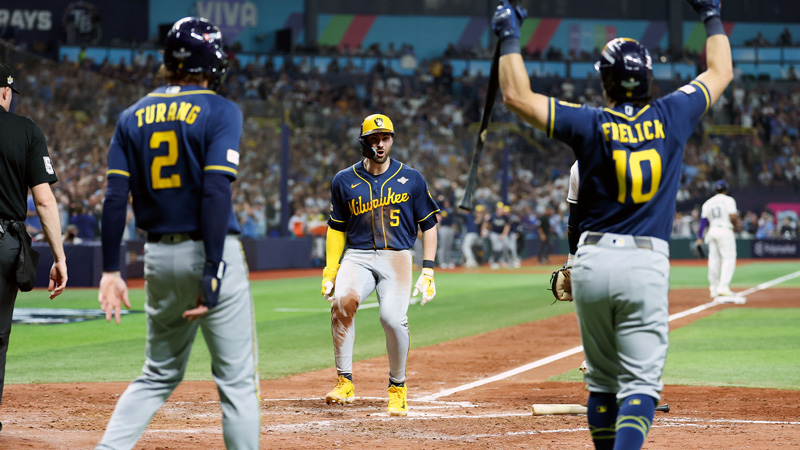
The turning point came in the top of the fifth inning, and it began with a manager’s gambit. Brewers skipper Pat Murphy challenged an inning-ending force out, gambling that a replay review would keep the frame alive. He won the challenge, and the floodgates opened. What followed was one of the most extraordinary innings in World Series history. Milwaukee proceeded to score eight runs, all of it after the overturned call gave them life. The rally was fueled by a remarkable stretch of consecutive hits, six in a row at one point, and the Brewers became the first team in postseason history to log seven consecutive hits in a single inning. Ironically, the historic outburst required no power at all; there was not a single home run in the inning. The eight-run frame tied the 1921 New York Giants and the 2001 Arizona Diamondbacks for the most runs scored in a World Series inning without a home run. For a game that had been so closely contested, the sudden explosion felt almost impossible. Rays fans watched in stunned silence as their team’s bullpen unraveled, and the Brewers’ dugout grew louder with every pitch. It was a rally born of patience, a successful challenge, and relentless contact hitting—exactly the kind of baseball that wins championships.
The rally was especially devastating because of how it unfolded against Tampa Bay’s bullpen. Rays reliever Cam Booser, who had entered the night without allowing a run over six innings this postseason, could not record a single out. He faced four consecutive hitters, gave up four consecutive hits, and was pulled before anyone could stop the bleeding. The damage extended beyond Booser alone, but the sequence encapsulated the nightmarish nature of the inning. With two outs, after Murphy’s challenge had breathed life into the rally, the Brewers showed a level of two-out discipline that has rarely been seen on this stage. They became the first team in MLB history to score eight runs with two outs in a World Series game. The only other team in playoff history to score as many runs with two outs in any postseason game was the Los Angeles Dodgers, who scored ten with two outs in the first inning of Game 3 of the 2020 National League Championship Series. This time, the Brewers matched that historic threshold on the grandest stage of all, and they did it without leaving the yard. It was an inning defined by bloop singles, line drives, broken-bat hits, and a few walks, all piling on until the Rays had no answer.
While the offense grabbed the headlines, the pitching performance from Milwaukee’s Robert Gasser was every bit as historic. Gasser surrendered just two baserunners all night—one hit and one walk—across six scoreless innings, and he faced the minimum number of batters through six-plus innings. That put him in rarefied air, becoming just the second pitcher in World Series history to accomplish that feat. The only other was Don Larsen, who threw a perfect game for the New York Yankees in Game 5 of the 1956 World Series. It is impossible to overstate how dominant Gasser was. He kept the Rays off balance, worked quickly, and never seemed to be in serious trouble. The Brewers’ bullpen followed his lead, and the Rays managed only three hits and one walk for the entire game—four baserunners total. Two of those hits belonged to Yandy Díaz, who was a lonely bright spot in the Tampa Bay lineup. Milwaukee’s pitching staff recorded 26 outs before surrendering a single run, meaning they were one out away from a shutout before the Rays finally scraped across a meaningless run in the ninth. For a team with World Series aspirations, that kind of pitching is the ultimate luxury, and it allowed the Brewers to relax, breathe, and play freely as the lead grew.
The individual offensive numbers were just as staggering. Jackson Chourio fueled the attack with four hits, all of them coming within the first five innings. That made him just the fourth player in World Series history to collect four hits that early in a game. More impressively, at 22 years and 229 days old, Chourio became the youngest player to have four hits in a World Series game since Joe Garagiola did it for the St. Louis Cardinals in Game 4 of the 1946 World Series. He was not alone. William Contreras and Brice Turang each added three hits, giving Milwaukee three players with at least three hits in the same World Series game—a luxury few teams ever experience. The entire lineup seemed locked in. Eight of Milwaukee’s nine starting position players recorded a hit, and eight different players drove in at least one run. The Brewers collected 16 hits total, yet they scored only in two innings: two runs in the third and eight in the fifth. That imbalance made the fifth-inning explosion all the more striking; for most of the night, the Rays were one bad inning away from disaster, and that bad inning arrived with a vengeance. The Brewers’ offensive depth was on full display, as hitters up and down the order contributed pressure at every turn.
For the Rays, the loss was a bitter pill. Tampa Bay starter Freddy Peralta had been superb all postseason, surrendering a combined two runs across his first three starts and four appearances, covering 16 ⅔ innings. But Game 3 was different. Peralta entered the fifth inning with two earned runs to his name, and by the time the inning was over, he had been charged with five earned runs. The line was uglier than the pitching had been early, but baseball is a game of outs and moments, and the moment slipped away. The Rays managed only three hits, with Díaz accounting for two of them, and they never mounted a serious threat after the Brewers’ eruption. Now, with their backs against the wall, Tampa Bay faces elimination. The Brewers, meanwhile, can taste champagne. They are three wins from a title that has eluded them since their founding, and after two close games and one historic rout, they head into the next contest with momentum, confidence, and a place in baseball history already secured. For fans in Milwaukee, this is everything they have dreamed about. For the players, it is one more win away from immortality. The numbers from Game 3 will be replayed and remembered for years, but what matters most is the simple, human joy of a team on the verge of making history.