



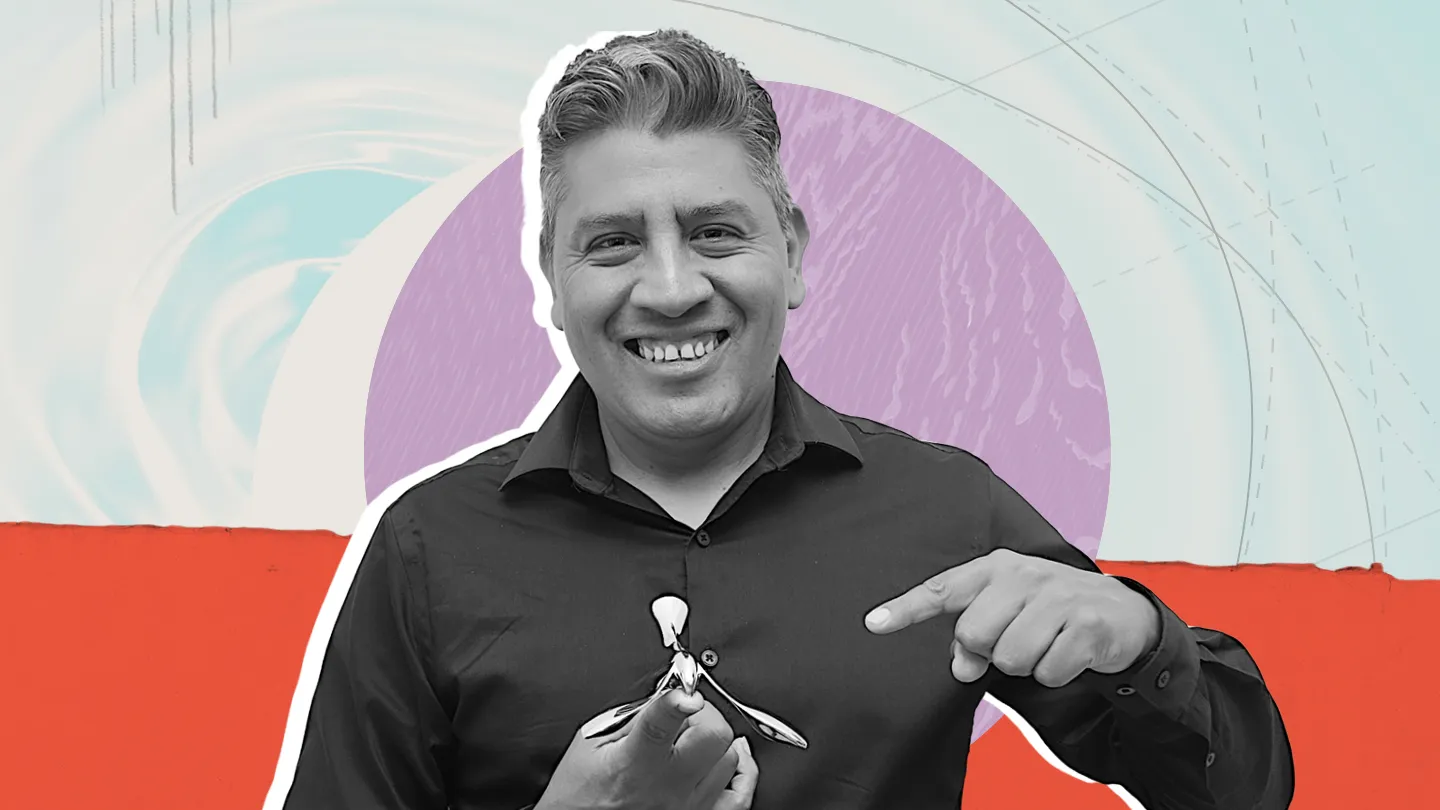
On a family trip to Atlanta, Víctor Ortega Jiménez wasn’t trying to capture the postcard image of flamingos—those elegant, long-legged birds with their flamboyant pink feathers and impossible posture. He was on holiday with his family, but his scientist’s eye was already at work. As the flamingos fed in their pond, dipping their heads below the surface, he noticed something that most visitors would have completely missed: beautiful, mysterious ripples spreading across the water. It wasn’t the birds themselves that caught his attention, but the patterns they left behind. He began taking pictures and videos, not to admire their color or grace, but to hold onto a question. What was causing those waves? Why did the flamingos’ feeding create such distinct, intriguing disturbances in the water? At the time, he had no idea that the answer would take him more than four years to uncover. “It took more than four years to answer that question,” says Ortega Jiménez, who now works at the University of California, Berkeley. “But I think the answer was fascinating.” That moment at the Atlanta pond became the starting point of a long journey into the hidden mechanics of nature—a journey that would ultimately reveal something not just about flamingos, but about how living creatures solve complex problems in ways that human engineers are only beginning to appreciate.
Ortega Jiménez is a biomechanist, someone who studies how the principles of physics and engineering shape the way animals move, feed, and survive. His work isn’t just about understanding animal anatomy or behavior for its own sake; it’s about discovering how nature has evolved elegant solutions to problems that we, too, face. From the way birds fly to the way insects jump, biomechanics reveals the hidden logic behind life’s movements. Flamingos, it turns out, are a perfect puzzle for someone like him. They feed in a way that seems almost awkward—their heads are upside down, their beaks are curved, and they spend hours wading and stirring the water. But beneath that apparent awkwardness is a brilliantly efficient system. After years of analyzing the videos he took in Atlanta and conducting additional experiments, Ortega Jiménez and his colleagues finally understood what the ripples were telling them. When flamingos retract their heads while feeding, they create swirling vortices in the water—small whirlpool-like currents that act as traps. By pulling their heads back at just the right moment, they concentrate the water and everything in it in a way that helps them scoop up algae and other tiny food particles. But the flamingos don’t stop there. They also stomp their feet in the water, almost as if they’re dancing, and this stomping amplifies the vortex, making it even stronger. The combination of head movements and footwork creates a kind of hydraulic machine that guides food toward their unusually shaped beaks, transforming a simple feeding ritual into a feat of fluid dynamics.
To fully appreciate what the flamingos are doing, it helps to understand how their bodies are adapted for this unusual lifestyle. A flamingo’s beak is not like a typical bird’s beak. It is lined with rows of tiny, comb-like structures called lamellae, which work like an internal sieve. When a flamingo feeds, it holds its head upside down and sweeps it through the water, pumping water through the beak with its tongue. The lamellae trap small organisms—algae, crustaceans, and other microscopic life—while allowing water, mud, and silt to pass back out. This is already a remarkable filtering system, but the story of the ripples adds another layer of complexity. The vortex created by the head retraction and the stomping feet doesn’t just stir up the water; it actively funnels food particles into the waiting beak. It’s a coordinated sequence: first, the bird disturbs the water to dislodge food from the bottom; then, it creates a swirling current that concentrates the food; finally, its specialized beak strains the meal from the water. The whole process is so precise that it can separate particles as small as a single cell. In a way, the flamingo is operating a living water-treatment plant, and it does so without ever clogging its filter, because the constant motion of the water clears away debris as it works. That self-cleaning capability is one of the most intriguing aspects of the system—and one that has real-world applications.
The potential applications of this discovery are significant, especially at a time when water pollution is one of the most urgent environmental challenges we face. Microplastics—tiny fragments of plastic that have broken down from larger pieces of waste—are now found in oceans, rivers, lakes, and even drinking water around the world. They are small enough to slip through many conventional water treatment filters, and they carry their own set of risks to wildlife and human health. Even more troubling are PFAS, often called “forever chemicals” because they don’t break down easily in the environment. These synthetic compounds have been used in everything from nonstick cookware to firefighting foam, and they have contaminated water supplies across the globe. Removing them is extremely difficult, in part because they can be present at concentrations so tiny that they are measured in parts per trillion. Ortega Jiménez believes that the flamingo’s feeding mechanism offers a blueprint for a new kind of filter—one that could remove extremely small particles from water without constantly getting clogged. By mimicking the vortex-based, self-cleaning design of the flamingo’s beak and feeding movements, engineers might one day develop water treatment systems that are more efficient, more sustainable, and better equipped to handle contaminants like microplastics and PFAS. It’s a striking example of biomimicry: looking to nature’s millions of years of evolutionary problem-solving to address human challenges. “Nature is always full of secrets,” Ortega Jiménez says. “And I think that’s the riddle that keeps me going, trying to understand nature. That’s my way to see science: by observation and trying to be inspired and trying to solve a problem.”
His approach is a reminder that scientific breakthroughs don’t always begin in a high-tech laboratory. Sometimes they start with a person on a family trip, noticing something that seems too ordinary to matter. The history of science is full of these moments—an apple falling from a tree, the shape of a leaf, the ripple in a pond. Observation, Ortega Jiménez suggests, is the foundation of discovery. “That’s my way to see science,” he says. “By observation and trying to be inspired.” This philosophy has deep roots in the field of biomimicry, where scientists and engineers look to nature for design inspiration. Velcro, for example, was invented after its creator noticed how burrs stuck to his dog’s fur. Bullet trains in Japan were redesigned to be quieter and more efficient after an engineer studied the beak of a kingfisher. Wind turbines have been improved by examining the bumps on humpback whale fins. In each case, the key was not simply copying nature, but understanding the underlying principles—the “secret” that nature had already worked out. Flamingos have been feeding this way for millions of years, perfectly adapted to their environment, their beaks and behaviors refined by evolution into a masterpiece of efficiency. For Ortega Jiménez, the ripples at the Atlanta pond were not a distraction from his vacation but an invitation. They led him into a mystery that demanded patience, creativity, and a willingness to follow curiosity wherever it went. And the answer, when it finally came, was not just a satisfying resolution to his own question. It was a glimpse of how much we still have to learn from the living world around us.
In the end, the story of the flamingos is really a story about attention. It is about a scientist who refused to let a beautiful mystery slip away, even when the answer took years to find. It is also a story about the connections between all living things and the quiet intelligence embedded in the natural world. Flamingos don’t know that their feeding habits might one day help clean up human pollution. They are simply doing what they need to do to survive—and in doing so, they have stumbled upon a design so ingenious that we are only now beginning to understand it. The challenge, Ortega Jiménez suggests, is to remain open to these discoveries, to let ourselves be puzzled by what we see, and to trust that even the smallest observation can lead to something important. Next time you find yourself watching a bird on a pond, or noticing the pattern of ripples on water, you might pause and ask: What is happening here? What problem is this animal solving? What secret is nature keeping? For scientists like Ortega Jiménez, those questions are the beginning of a journey. And sometimes, a family trip to Atlanta turns out to be the first step toward an idea that could change the way we think about water, pollution, and the remarkable creatures with whom we share the planet. Nature, he reminds us, is always full of secrets. All we have to do is pay attention—and be willing to spend four years, if necessary, uncovering what those beautiful ripples mean.