


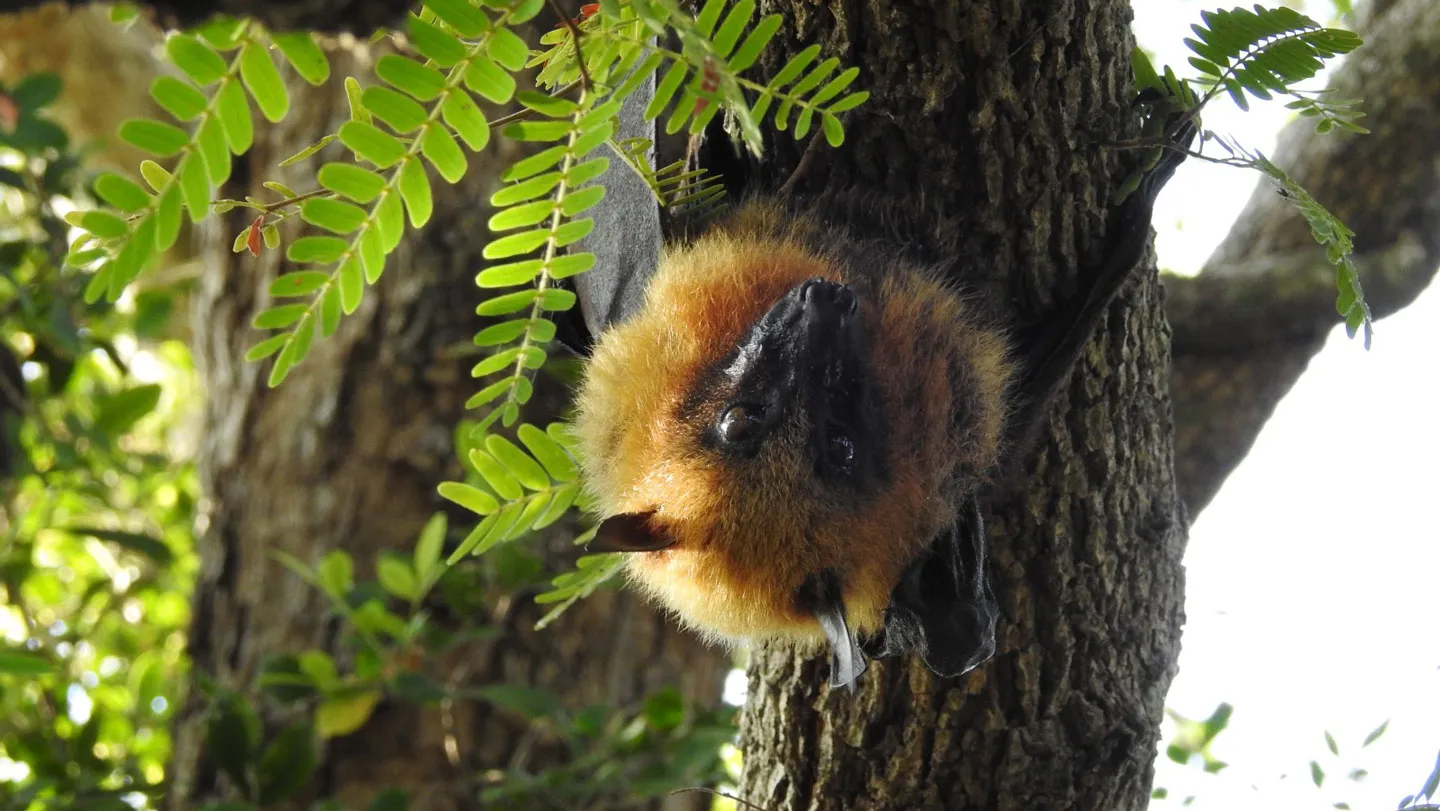
Picture a creature that seems to belong in a myth: a bat with a leathery wingspan stretching more than a meter and a half, gliding through the twilight like a living shadow. These are the fruit bats of Madagascar, some of which go by the evocative name “flying foxes.” With their fox-like faces and immense wings, they feel less like ordinary wildlife and more like something that flapped out of a fantasy novel. Yet a sobering discovery has emerged from the study of these remarkable animals: they are not the giants they once were. In fact, one species of flying fox in Madagascar appears to be shrinking. Researchers who have spent years studying the island’s bats now believe that human hunting pressure may be driving this transformation. It’s a story that links the past to the present, a museum’s dusty drawers to living populations in the forests, and the simple act of feeding a family to the slow, silent reshaping of an entire species.
The first hints of something unusual came not from the field, but from collections of specimens that had been carefully preserved over generations. Scientists at the Field Museum in Chicago, including flying vertebrate ecologist Emily Cornelius Ruhs and conservation biologist Steven Goodman, noticed something strange when they compared old specimens with bats that field researchers had been capturing in recent years. The older flying foxes seemed considerably larger. To find out whether their impression was accurate, the research team began to take meticulous measurements of skulls and teeth across a total of 121 specimens held in nine different museums. These specimens had been collected over more than 150 years, offering a rare window into how the animals have changed through time. What the measurements revealed was striking. Bats collected before the 1980s had skulls that were, on average, about 3.6 millimeters longer than those collected afterward—a difference of roughly 6 percent. That may not sound like much, but in evolutionary and ecological terms, it is a significant shift. Twelve separate features of bones and teeth were measured, and the pattern held. Something had happened in the space of a few decades to make Madagascar’s flying foxes physically smaller.
What could cause such a change? Climate change and habitat loss were possible explanations, but the timing of the shrinkage pointed in another direction. Around the 1980s, something important shifted in the way people hunted flying foxes. Before that time, bats were mostly hunted on a very small scale, providing food for individual families or small communities. But then commercialization began in earnest, and bats started appearing in markets and restaurants. The hunting pressure increased dramatically, and the biggest bats in the population may have been the ones most often targeted. As Ruhs put it, the largest animals offered hunters the “most bang for your buck.” From a purely practical standpoint, a bigger bat means more meat for the same effort. But from an evolutionary standpoint, the consequences are profound. When the largest individuals are selectively removed from a population, the smaller bats become the ones most likely to survive and reproduce. Over time, the genetic traits for large body size are gradually winnowed out, and the species itself begins to shrink. This is not the slow, natural evolution that unfolds over millennia; it is a rapid, human-driven transformation, visible within the span of a single human lifetime.
This shrinking is not just a curiosity. It may have serious consequences for the future of the species. Emma Stone, a conservation biologist at the University of Bath in England, notes that species are specifically adapted to their environments, and that adaptation usually takes place over thousands of years. When human pressures cause physical traits to change so quickly, bats may become less able to respond to environmental stresses, climate shifts, or disease outbreaks. Their bodies are intimately linked to their survival, and a smaller frame may alter everything from how far they can fly in search of food to how well they can compete for resources. At the same time, the overall population of Malagasy flying foxes has collapsed. There were an estimated 300,000 of these bats in the early 2000s, and researchers estimate that the number has fallen by two-thirds since then. Losing so many individuals while the survivors are physically shrinking is a double blow. It suggests a population already in trouble, and it raises concerns that the bats’ changing bodies could be a warning sign of broader species-wide vulnerabilities. These bats are not isolated curiosities; they play vital roles in their ecosystems, dispersing seeds and pollinating flowers as they move across the landscape. Their decline could ripple through the forests of Madagascar in ways that are not yet fully understood.
The research opens the door to important questions about what comes next. One promising path forward is the study of the bats’ genetics. Future work could reveal how modern populations are faring, whether they still carry enough genetic diversity to adapt to changing conditions, and how severe the impact of selective hunting has been on their evolutionary potential. Ruhs also notes that other fruit bat species in Madagascar are hunted and eaten, and investigating whether they are shrinking in similar ways could offer valuable context. If the pattern holds across species, it would strengthen the case that hunting pressure is the driving force and that conservation strategies need to address the size-selective nature of the harvest. But this is not a simple story of good versus evil. The people who hunt these bats are not villains. In many villages and cultures in Madagascar, bats are an important source of food. For generations, hunting was sustainable because it was small in scale and tied to local needs. The challenge now is to understand how to manage the harvest more carefully so that both people and bats can continue to survive. As Ruhs herself said, “These are important food sources for people. But I think there is something to be said for understanding how to manage [their harvesting] a little bit more. If this population isn’t doing so well, how do we overcome the needs of the people who live there while also protecting species?”
There is something deeply poignant about the image of these magnificent animals growing smaller, generation by generation, under the weight of human hunger and commerce. A creature that once seemed to belong to the realm of fantasy is being quietly edited by the realities of the modern world. The flying foxes of Madagascar are not simply statistics or specimens in a drawer; they are living, breathing members of a complex web of life, and they have stories written in their bones. Those bones tell a tale of survival under pressure, of adaptation pushed beyond its natural rhythm, and of a species caught between the needs of a growing human population and its own evolutionary heritage. If we pay attention, they also offer a chance to act before it is too late. With careful management, with research, and with a genuine commitment to balancing human needs and wildlife protection, there is still hope that these giants of the night can recover their former majesty. But that will require more than passive concern. It will require recognizing that every choice we make—about how we hunt, how we consume, and how we care for the places where both bats and people live—has the power to shape the future of the natural world. The bats are shrinking, but they are still here. The question now is whether we can find a way to keep them here, not just as smaller echoes of themselves, but as the thriving, awe-inspiring creatures they were meant to be.