


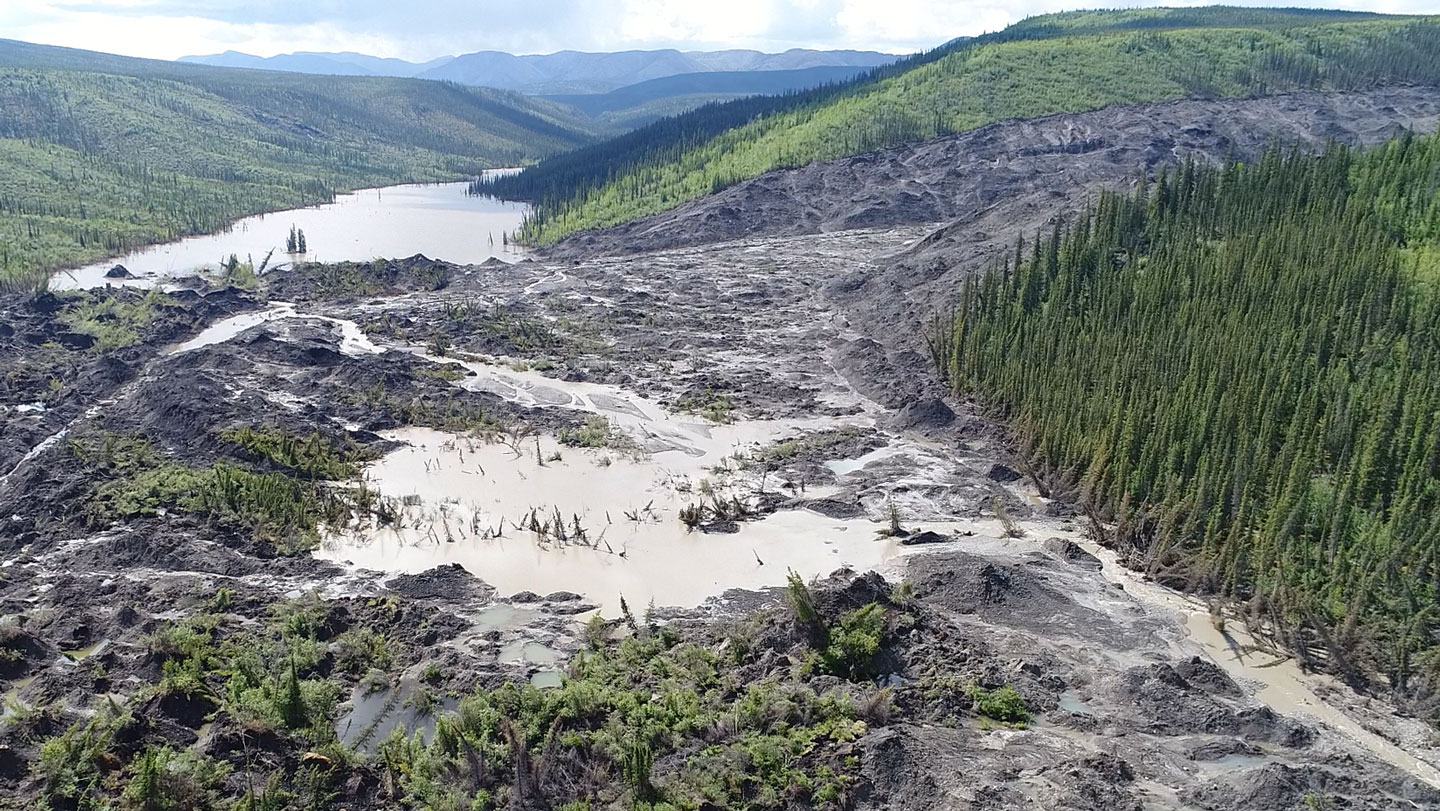
In 2018, in a remote corner of Canada’s Northwest Territories, the earth did something that scientists initially thought was impossible. A massive slab of ground—its volume roughly equivalent to seven Great Pyramids of Giza stacked together—suddenly broke away from a forested hillside and thundered downhill, leaving behind a raw, pale scar that stood out sharply against the surrounding green. The landslide itself was extraordinary because of its size, but what concerned researchers even more was the condition of the ground before it moved. The slope was underlain by permafrost, soil and rock that had remained frozen for years and in many places seemed locked in place, almost as if cemented. Frozen ground is not supposed to detach in one piece. It is normally too stable, too rigid, too stuck. Yet here, an enormous frozen slab had let go and traveled far downslope, and nothing in the existing playbook of landslides or permafrost thaw could fully explain why. A slide this big would have been attention-grabbing anywhere, but in an area where permafrost had appeared secure, it was deeply puzzling. Scientists knew that climate change was warming the Arctic and sub-Arctic, and they knew that thawing permafrost could sometimes cause hillsides to slump or settle. But those movements are usually slow processes, involving mud and water and gradual collapse. This was a sudden, catastrophic event, almost like the ground had snapped. The question was not just what moved, but why it moved so violently when it should have stayed frozen. Finding an answer would require years of detective work, a helicopter ride through valleys full of collapsing slopes, and a new way of thinking about what happens beneath the surface of frozen land.
Six years later, a team of researchers thinks it has the answer. In a paper published in the September 28 issue of Geophysical Research Letters, they described what they call permafrost detachment slides, a new category of catastrophic landslide that had not been recognized before. According to their analysis, these slides are set in motion not by a single dramatic trigger, but by a quiet chain reaction that can begin decades before the collapse. It starts, they suggest, with a wildfire. When a fire sweeps through a permafrost landscape, it burns away the insulating layer of moss, shrubs, and trees that keeps the frozen ground cold. That leaves the surface exposed to warmer summer air, allowing heat to penetrate deeper into the soil. Over time, this can weaken the permafrost and cause the ground to creep, opening cracks in the surface. Rainwater and snowmelt then seep into those cracks and travel downward until they hit the bottom of the permafrost. There, the water thaws the frozen base, gradually eating away at the last thing holding the slab to the earth. When enough of the base has thawed, the entire layer—still frozen on top—breaks free and slides downslope in a single, massive movement. The process is slow and invisible for years; the actual landslide is sudden and catastrophic. Dmitry Nicolsky, a geophysicist at the University of Alaska Fairbanks who was not involved in the study, said the findings challenge the usual assumptions about how frozen ground behaves. Large landslides don’t normally carry so much still-frozen material, and when movement does occur in thawing layers, it is usually slow, creeping, and easy to miss. But this study, Nicolsky said, shows how incomplete our understanding of the underground world is. “We don’t know how it will move—it might go slowly or it might go catastrophically.”
The research began with an unexpected sight from a helicopter. In 2019, Joseph Young, then a permafrost geologist at the University of Alberta in Edmonton, was flying to a field site in the Northwest Territories to help with a colleague’s project. As the helicopter crossed the valleys, he looked down and noticed that whole hillsides were collapsing. Slopes that should have been stable, especially in an area where the permafrost was not expected to thaw very much, were riddled with landslides. “The slopes were just collapsing with landslides everywhere,” Young remembered later. The scale was breathtaking, but the first glimpse from above raised more questions than it answered. Once on the ground, Young and his colleagues found something even stranger. In most thawing permafrost landslides, the process is driven by surface melting: the top layer warms, turns into a soggy slurry of mud and water, and flows downhill. The scene here was different. Instead of muddy flows, the ground was littered with enormous blocks of still-frozen soil, some of them moved hundreds of meters from where they had originally rested. It looked as though the frozen ground had not melted at all. It had broken loose as a solid mass and traveled across the valley, like a cargo sled sliding on ice. “Traditionally with permafrost, it melts from the top down, and that releases this slurry of muddy material,” Young said. But this was not that. It was frozen ground moving as a unit, over a huge distance, and it did not fit the standard picture of how permafrost failure happens. That strange observation was the first real clue that a different mechanism was at work—something hidden below the surface, something slow and patient, setting the stage for a sudden release.
To make sense of the phenomenon, Young and his collaborators decided to focus on the two largest slides they could find in the region. The first, which occurred in 2018, displaced an estimated 18 million cubic meters of earth. That is enough material to cover thousands of football fields several feet deep, and the slide was so massive that it dammed the Redstone River, altering the local landscape and changing the flow of water. The second slide, from 2017, had moved about 4.5 million cubic meters of material—still enormous, but less than a third of the size of the 2018 event. Both landslides had left behind distinct scars, and both had something in common that would become the key to the mystery. When the researchers mapped the failure surfaces, they found that the slides had occurred along flat, relatively smooth planes about 20 meters below the surface, right at the base of the permafrost layer. In other words, the break had not happened at the surface but deep underground, along the boundary between frozen and unfrozen ground. Satellite observations added another critical clue. Over the years before the landslides, the ground at both sites had not been perfectly still. It had been moving, slowly but steadily, shifting a few meters each year. That slow movement suggested that the slopes had been losing strength long before they finally gave way. The combination of deep slippage and slow surface creep told the researchers that these were not ordinary slope failures. They were detachment slides—the frozen layer separating from the ground below and then racing downhill as a coherent mass. The question was what had caused that deep boundary to become so weak.
What could cause a permafrost layer to detach in this way? Young and his colleagues suspected that two forces were working together: climate warming and wildfire. To test the idea, they set up temperature sensors at sites in the region, measuring ground temperatures from 2020 to 2022. They deliberately chose locations that had either remained covered by undisturbed forest or had been burned by wildfire about 25 years earlier. These measurements allowed them to see how the ground was affected by the loss of covering vegetation. They then used those data to build computer simulations, modeling how the ground would have changed in the decades after a fire. The simulations revealed a clear sequence of events. After a forest fire, the exposed ground begins to warm much more rapidly during summer. The heat weakens the upper part of the permafrost, causing it to deform and creep. As it creeps, cracks form along the surface. Those cracks create channels for water—rain, snowmelt, and perhaps groundwater from warmer layers—to travel deep into the frozen soil. Some of that water reaches the base of the permafrost, where the temperature is already close to the melting point. There, the water thaws the frozen layer from below, dissolving the bond that holds it to the rest of the earth. Eventually, the thawed base becomes slippery enough that the entire frozen layer slides away. The researchers believe this mechanism may explain far more than the two slides they studied in detail. Using satellite images, they identified more than 150 other landslides in the same region that may have been caused by the same process. Such detachment slides could occur anywhere where a relatively thin and warm permafrost layer sits on a slope—especially if a sudden warming event, like an extreme summer or a wildfire, gives the system the final push.
The discovery has implications that go far beyond one remote valley in northern Canada. Permafrost is thawing all over the world, from Alaska to Siberia, and the slide in the Northwest Territories is an unusually dramatic example of what that thaw can do. For Young, these landslides are more than just rocks and ice; they are stark, visible evidence of climate change. “This is a direct reality of a changing climate,” he said. What worries scientists like Nicolsky is how difficult it is to predict the next slide. The slow creep and the hidden thawing happen underground, away from satellites and human eyes. By the time a landslide is visible, the process may already be irreversible. The best hope is to learn to read the early signals—the gradual movement of the ground, the emergence of cracks, the long shadow of a wildfire from a quarter-century ago. The study is a reminder that the frozen places of the earth are not static. They are changing, sometimes quietly and sometimes catastrophically. And the ground that looks solid and permanent may already be preparing to move. In the end, the force that broke the Northwest Territories hillside was not some ancient earthquake or deep geological fault. It was heat—heat from a warming climate, stored in a landscape shaped by fire and water, slowly pulling apart what had been frozen for thousands of years. The slide took only moments, but the warning signs had been there for decades. Now scientists know what to look for, and they hope that next time, they will see it before the ground lets go.