


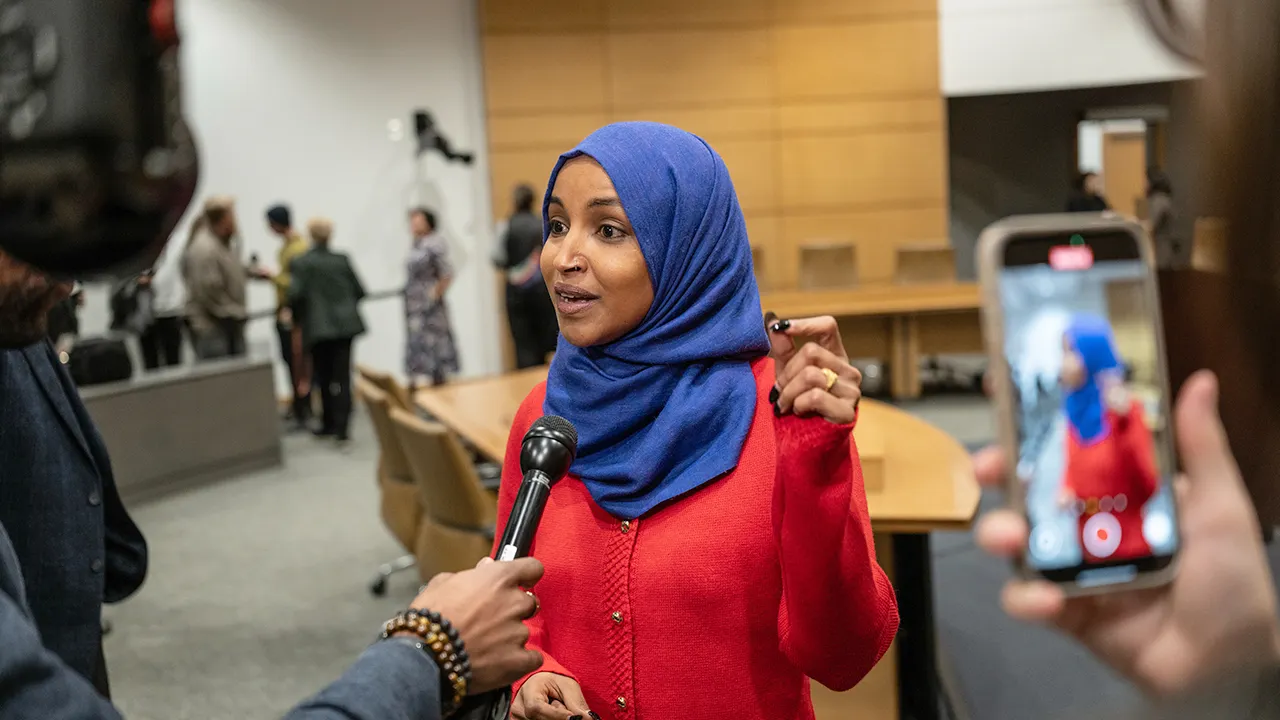
On a seemingly ordinary Monday, federal agents made their way to the Washington, D.C., home of Representative Ilhan Omar, carrying a judicially authorized search warrant that would immediately thrust the Minnesota Democrat back into a maelstrom of political and legal controversy. Homeland Security Investigations executed the search as part of an ongoing federal criminal examination of Omar’s immigration paperwork, a development that the Justice Department confirmed without offering details about the scope or direction of the probe. For Omar, a prominent progressive voice and one of the most recognizable members of “The Squad,” the raid felt less like a routine law enforcement action and more like the latest chapter in a decade-long campaign against her. Within hours, she took to social media with a defiant message, insisting she was fine and accusing the Trump administration of weaponizing federal law enforcement against political enemies. “For ten years, Trump has targeted me with baseless lies and smear campaigns. This is just the latest escalation in his campaign of political intimidation,” she wrote. “I will not be silenced.” But the images of federal agents at her home, combined with reports that her family members were being subpoenaed, created an atmosphere of uncertainty that no amount of confident denial could fully dispel. Tom Homan, the former acting ICE director, confirmed the existence of a criminal investigation involving Omar and told Fox News that he knew “things are going on.” The raid, though, did not happen in a vacuum; it was the visible surface of a much deeper and more sprawling inquiry into immigration records, family histories, and financial disclosures that has been building for years.
The subpoenas issued in connection with the investigation land close to home in the most literal sense. Federal investigators, according to The New York Times, have subpoenaed Omar’s sister, Sahra Noor, and at least one other person within her family circle as they look into possible fraud and false statements in immigration paperwork. Fox News has also learned that subpoenas have been sent to multiple family members. The use of grand jury subpoenas is a standard investigative tool, and by themselves such subpoenas do not mean the recipients are suspected of criminal wrongdoing. Still, the image of a sitting congresswoman’s relatives being drawn into a federal inquiry is jarring, especially for a family whose story has always been tied to the promise of America as a refuge. Omar came to the United States as a refugee from Somalia, spent years in a Kenyan refugee camp, and eventually built a political career that made her one of the first Somali-American legislators in the country. Her personal narrative has always been central to her appeal, a story of displacement, survival, and democratic participation. But that same narrative has also made her a target for conservative critics who have long questioned the details of how she obtained citizenship. The investigation into her family’s immigration history appears to be examining whether her late father, Nur Omar Mohamed, lied or omitted information on immigration forms before he became a naturalized citizen. It is a deeply personal line of inquiry, one that reaches into the origins of her American identity. For the family, the subpoenas are not just legal documents; they are reminders that even the most private corners of their lives are being scrutinized under the harsh light of federal authority. Omar has repeatedly denied any wrongdoing and has framed the investigation as an abuse of power, but the subpoenas suggest that investigators are looking for something substantial enough to compel testimony from the people closest to her.
The investigation has also revived questions about a small but conspicuous discrepancy in Omar’s biography: her birth year. According to emails reviewed by the New York Post, Omar’s congressional staff contacted the Minnesota Legislative Reference Library in May 2019, just a few months after she entered Congress, to request that her listed birth year be changed from 1981 to 1982. The library’s director wrote that staff members were informed of the error and asked to correct it, and that Omar’s team was working with Wikipedia, the Biographical Directory of the United States Congress, and other sources to align the record. But the original 1981 entry had apparently been drawn from other reference materials and was added without any supporting documentation such as a birth certificate. The discrepancy does not, by itself, establish that Omar falsified immigration records, nor has any report linked the biography change directly to Monday’s search. But in the unpredictable ecosystem of political scandal, a minor inconsistency can take on outsized importance. Aj Kern, who challenged Omar in the 2022 Democratic primary, has questioned whether Omar was still a minor when her father became a citizen, and has filed complaints and lawsuits demanding proof of her citizenship. A state judge dismissed the lawsuit for lack of jurisdiction, but the questions have lingered. Omar has consistently said that she became a citizen through her father’s naturalization in 2000, before she turned 18. “I became a citizen actually before I turned 18,” she told The Intercept in 2018. “My father became a citizen and so I got my citizenship through that process.” For any naturalized citizen, the story of how they came to belong to a nation is often told with a mix of pride and gratitude. But for Omar, that story is now being dissected piece by piece, with every date and detail examined for potential contradiction. In a life lived in the public eye, such small inconsistencies can become weapons, especially when the broader political climate is already charged with suspicion and animosity.
Adding another layer to the saga is the separate scrutiny of Omar’s financial disclosures, which has unfolded in parallel with the immigration investigation. Speaking on Fox News’ “America Reports,” U.S. Attorney for the District of Columbia Jeanine Pirro disclosed that her office was examining Omar’s financial filings. Those filings previously showed that the combined reported value of two businesses tied to Omar’s husband, Tim Mynett, had climbed from roughly $15,000 to $51,000 in 2023 to somewhere between $6 million and $30 million in 2024. The businesses in question are eStCru LLC, a California winery, and Rose Lake Capital LLC, a Washington-based venture capital firm. Omar later amended the filings in April, reducing the couple’s combined reported assets to between $18,004 and $95,000. Her office explained that the original disclosures failed to properly account for business liabilities. Financial disclosures of this kind list assets in broad ranges and do not establish an exact net worth, but the dramatic swing from relatively modest holdings to tens of millions and back again raised eyebrows and invited criticism. In September, the Office of Congressional Conduct voted 5-1 to recommend that the House Ethics Committee dismiss misconduct allegations related to the disclosures, finding no substantial reason to believe Omar reported false or incomplete information in violation of federal law or House rules. That review, however, is separate from the federal investigation that Pirro described, and it remains unclear whether the financial inquiry is connected to the search of Omar’s home. For the congresswoman, the repeated cycles of investigation, denial, and partial vindication have become a familiar rhythm, but the current moment feels different because multiple strands of scrutiny are converging at once. The personal and the political have become tangled in a way that makes it difficult to separate legal fact from partisan warfare.
The political reaction to Monday’s raid came quickly and predictably, hardening existing divisions rather than bridging them. President Donald Trump renewed his criticism in a statement shared by the White House on X, questioning the sudden change in Omar’s financial filings and demanding answers “NOW!” Vice President JD Vance, who had previously accused Omar of immigration fraud, said he had no advance knowledge of the search and insisted that the administration would follow the facts. “If there’s a real case there, we’re going to follow the facts,” Vance said. “If there’s not a real case there, then we won’t.” Democrats, meanwhile, expressed outrage over the raid, with some drawing parallels to past raids that generated criticism from the left and reminders from Republicans about their own reactions in earlier controversies. Omar’s husband, Tim Mynett, appeared at the scene during the HSI raid, adding another layer of personal drama to an already fraught situation. But beneath the political noise is a more sobering reality: a sitting member of Congress is the subject of an ongoing federal criminal investigation, and the outcome of that investigation could have lasting consequences not just for Omar’s career but for public confidence in the institutions tasked with applying the law evenly. The Justice Department’s confirmation that a judge authorized the warrant lends a formal weight to the proceedings, but it also leaves unanswered questions about what prompted the search and what investigators hope to find. For Omar, who has built her political identity partly on being a vocal critic of entrenched power, the spectacle of federal agents at her doorstep is both deeply personal and inherently political. She has cast herself as a target of a weaponized system, a narrative that resonates with many of her supporters while fueling the suspicions of her detractors.
At the center of it all is a woman whose life story embodies the complexities of the American experience. Omar arrived in the United States as a refugee, grew up in Minnesota, and rose through community organizing to win a seat in Congress, where she became a national symbol of progressive politics and a frequent target of conservative anger. Her journey has always been a testament to the possibilities of democratic citizenship, but it has also made her an object of intense scrutiny in a way that few of her colleagues can imagine. The investigation into her immigration paperwork, her family’s legal history, and her financial disclosures is still unfolding, and no charges have been filed. Grand jury subpoenas do not, on their own, prove wrongdoing, and prior federal inquiries into Omar’s immigration history have not resulted in charges. Still, the search of her home, the subpoenas to her relatives, and the questions about her birth year and her father’s naturalization have created an atmosphere of suspicion that is unlikely to dissipate soon. For Omar, the fight is not just about defending her legal innocence; it is about defending the integrity of her personal story against a coordinated effort to cast doubt on every chapter. For her supporters, the investigation is proof of a broken system that targets those who challenge the status quo. For her critics, it is long-overdue accountability. The truth, as is often the case, probably lies somewhere in between, hidden in the pages of immigration forms, financial reports, and old email requests to change a birth year. But until the investigation reaches its conclusion, the question of what happened, when it happened, and why it matters will continue to dominate the national conversation, leaving Omar, her family, and the American public to wait for answers that may not come quickly or easily.