

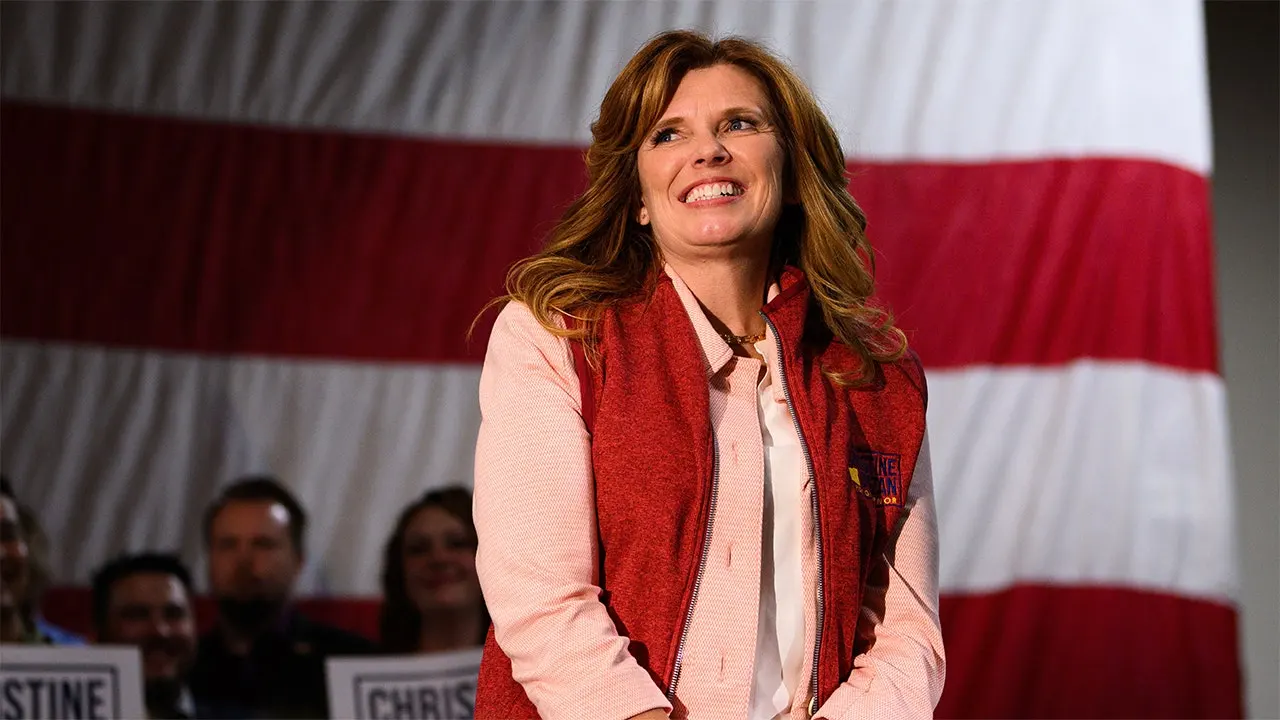
For more than four decades, the Oregon governor’s mansion might as well have had a “Democrats only” sign hanging over the front door. Republicans had watched election after election slip away, often by punishing margins, in a state that proudly wears its blue heart on its sleeve. Yet something is shifting in the Pacific Northwest, so quietly that even battle-hardened political operatives are doing a double take. The latest Fox News Power Rankings have nudged Oregon’s gubernatorial race from “Likely Democrat” to “Lean Democrat,” a small adjustment on paper that carries enormous weight in reality. It says that Democratic Gov. Tina Kotek is no longer the heavy favorite in her rematch against Republican Christine Drazan—and that a state that gave Kamala Harris a 14-point presidential win and sent Democrat Ron Wyden back to the Senate by 15 points may be ready to do something it hasn’t done in a generation: elect a Republican governor. The reasons aren’t complicated, but they’re deeply personal for the people living through them. Homelessness has become impossible to scroll past. Housing prices have pushed working families to the brink. Schools are buckling. Taxes feel heavier with every paycheck. And the cost of everything, from groceries to gas, makes Oregonians wonder if their state still loves them back. That weariness, that gnawing sense of being ignored by the people in charge, is exactly what Drazan is counting on. She can see it in the faces at town halls, hear it in the voice of the small-business owner who can’t afford to hire, and feel it in the cold grip of a voter who has never pulled the lever for a Republican in their life but is now considering it out of sheer desperation. “This is something historic we’re trying to pull off,” she said in a recent interview, with the tone of someone who believes deep down that history is ready to be written. Four years after coming within a whisker of breaking the streak, she’s back for another shot—and Oregon’s voters are taking a second look. It’s the kind of race that, just a year ago, almost no one would have believed was possible.
To understand why this race is so tight, you have to understand the path Drazan has traveled. In 2022, she was the Republican leader in the Oregon House, carrying her party’s banner into a governor’s race that most people assumed was unwinnable. She lost to Kotek by less than four points—a result that stung, but also proved something to the state’s political establishment: a Republican could compete in Oregon. After that defeat, Drazan didn’t disappear. She didn’t move to a different state or fade into a comfortable retirement. She stayed. She won a state House seat in 2024, went back to the legislature, and once again took up the role of minority leader. Then, last year, she was appointed to the state Senate. That’s not the behavior of a politician licking her wounds; it’s the behavior of a fighter who sees the long game. “It’s good to stay in the fight,” Drazan said, with a matter-of-factness that suggests she never considered any other option. “I think Oregonians… recognized that I didn’t leave, I didn’t move to a different state, I didn’t go hide. I got engaged again, went back into the legislature to serve my community. I think that that matters to people, that I am committed long-term to our state.” That commitment is unusual in an era when losing candidates often fade into obscurity or relocate to friendlier political climates. Drazan did the opposite, and in doing so she’s built a kind of trust that campaign ads can’t buy. Meanwhile, Kotek has had to govern under the weight of enormous expectations. Progressives wanted bold action on homelessness and climate; moderates wanted fiscal restraint; everyone wanted results. And the results have been slow to arrive, at least in the eyes of many Oregonians. Polls now show a margin-of-error race, which is a sobering reality for a Democratic incumbent in a blue state. “People are starting to get to know me a little bit more and my leadership,” Drazan said, “and they’re taking a closer look at whether or not Oregon is uniquely bad right now. It’s not a national issue, it’s here at home. We’re struggling right now locally. So, that’s making this race tight.”
The issues driving this race aren’t partisan abstractions—they’re the texture of daily life in Oregon. Walk down any major street in Portland and you’ll see tents in doorways, people in crisis, and a public that has grown exhausted by a problem that keeps worsening despite promises to fix it. Homelessness has become the defining moral and practical challenge of the state, and Kotek has shouldered the blame even as her administration insists that progress is being made. Housing is the other half of the nightmare: young families can’t afford to buy, renters are being priced out of neighborhoods their parents grew up in, and the American dream feels like a game rigged against the next generation. Schools, too, are a source of heartbreak. Parents see their kids struggling to catch up, teachers stretched thin, and a system that seems to have more time for policy debates than for reading, writing, and arithmetic. Add in a tax burden that feels heavier with every new bill, and the cost of living that chews through paychecks before the week is half over, and you’ve got a recipe for political revolt. It’s the kind of discontent that doesn’t care about party labels. In 2024, Oregonians still voted for Harris and Wyden, but those ballots were cast with gritted teeth by many residents who felt ignored by state leaders. Gubernatorial elections in Oregon have traditionally been closer than presidential ones, and this one is no exception. The difference this time is that Republicans have found a candidate who speaks to that discontent without offering the same tired scripts. Drazan doesn’t blame Washington, D.C., for Oregon’s troubles; she points the finger at a decade of single-party control in Salem and argues that one-party government has lost touch with the people it’s supposed to serve. “Oregon needs change,” she said plainly. “Oregon needs to be done with one approach to the world. Single-party control has not been good for us in my home state. And we need that balance. We need people to be at the table that have been ignored in the past to be able to turn our economy around, frankly, and turn our schools around and serve the people that are facing addiction and slowly dying on our streets. Those are significant challenges, and Tina Kotek doesn’t have the answers to solve them.” It’s a devastatingly simple argument, and one that’s landing with voters across the political spectrum.
If the local issues were all that mattered, Drazan might already be measuring the curtains in the governor’s mansion. But she’s running in a national environment that is brutally hostile to Republicans, and that’s where the race gets complicated. Gas and diesel prices are high, an unpopular war in Iran has drained the country’s patience, and President Donald Trump’s approval rating is stuck underwater. In a state as blue as Oregon, those national currents usually spell doom for Republicans on the ballot. Kotek and her allies are counting on exactly that. “There are still many undecided voters ahead of November,” said Federico Araujo, Kotek’s communications director, painting Drazan as a Trojan horse for the Trump agenda. “But when the choice is clear in an election, they always show up. And the choice couldn’t be any clearer in this race: Christine Drazan is ready to open the door to Trump’s agenda and Governor Kotek is fighting every day to protect Oregonians from federal overreach and harm.” It’s a warning that has worked before, and it could work again. But Drazan is trying to build a firewall between her campaign and the national GOP brand, insisting that this race is not a referendum on Washington but a verdict on Salem. She’s not running against Trump; she’s running against the status quo in her own state. She’s betting that Oregonians, even those who despise the president, are more angry about what’s happening in their own neighborhoods than what’s happening in the White House. That’s a gutsy bet in a state where Kamala Harris won by double digits just two years ago. But the polling suggests it might be paying off. Voters can hold two contradictory ideas in their heads at once: they can disapprove of Trump and still want a change in their own governor’s office. They can fear national Republicans while remembering the last time they voted for a state Republican, back when the party had a moderate wing and an actual presence under the state capitol dome. Until you’ve watched a neighbor lose their home to foreclosure or seen a tent city expand by the freeway, it’s easy to dismiss these concerns as poll-tested talking points. But Oregonians live them, and they will vote them. The key question is which of those feelings will be stronger when the ballot is in their hands.
Politics runs on money, and in Oregon, it runs faster than almost anywhere else. The state famously has no contribution limits, which means big checks can flow in from every corner of the country, and campaigns are often decided by who can flood the airwaves last. Four years ago, Drazan had the wind at her back, with national Republicans pouring resources into what looked like a genuine pickup opportunity. This time, the landscape is different. The GOP is fighting to defend fragile congressional majorities and gubernatorial seats across the country, and resources are stretched thin. Still, Drazan says the Republican Governors Association has stepped up and partnered with her campaign. “I am grateful to have the Republican Governors Association as a partner in this race. They are investing in this race now,” she said, though she was quick to admit that Kotek holds a significant financial edge. “The sitting governor has a fundraising advantage that’s significant today,” Drazan acknowledged. “I could always use more support.” That admission opened a door for the other side. Johanna Warshaw, a spokesperson for the Democratic Governors Association, scoffed at the idea that the RGA is actually going all-in, claiming, “Clearly, the RGA agrees as they’re leaving Christine Drazan’s broke campaign out to dry.” It’s a cutting line, the kind of thing that gets repeated because it sounds true, even if the reality is more complicated. Drazan rejects the narrative, insisting that she’s “actively fundraising all the time and encouraging folks to get involved in this race right now. We have no limits in Oregon, and that allows me to be able to compete head to head.” The absence of contribution limits is a double-edged sword: Kotek can raise money just as fast, and incumbents always have an advantage in the fundraising game. But it also means that a single enthusiastic surge of donors could close the gap overnight. And there’s something else at play: energy. Republicans in Oregon can taste this. They’ve been starving for a win for so long that the prospect of one has mobilized volunteers, donors, and activists in ways that Drazan didn’t see even in 2022. Whether that energy translates into enough votes—and enough cash—remains to be seen. But for the first time in years, the GOP is not just showing up in Oregon; it’s showing up with a realistic plan for victory.
The stakes of this race go far beyond Oregon’s borders. If Drazan can pull off what would be one of the most surprising upsets of the cycle, it would send a shockwave through national politics, proving that even the bluest states are vulnerable when voters feel abandoned by the party that has ruled them for too long. It would also rewrite the story of the 2026 midterms, giving Republicans a talking point to counter the inevitable headwinds of an unpopular president and an expensive war. But for all the political calculation, the most powerful narrative in this race is a personal one. It’s the story of a woman who lost a close election, refused to quit, went back to work, and now stands on the edge of achieving something extraordinary. “I want to achieve something extraordinary,” Drazan said, and the words didn’t sound like a sound bite; they sounded like a mission statement. For Oregonians, the choice in November will be a choice between staying the course and taking a leap. Kotek’s message is that experience and stability matter, that the problems Oregon faces are hard and won’t be fixed simply by changing party leadership. Drazan’s message is that the status quo has had decades to deliver and has failed, that the state needs new voices and new balance, and that voters don’t need to wait for another four years of broken promises. Somewhere between those two messages are the undecided voters who will decide the race. They are the parents worried about their kids’ schools, the small-business owners watching their margins shrink, the renters who can’t see a path to homeownership, the Oregonians who love the natural beauty of their state but are embarrassed by the dysfunction of its cities. They are tired of being told that things are getting better when they don’t feel better. They are, in other words, exactly the kind of people who make political history happen. Oregon has been a blue state for so long that it’s easy to forget that no political dynasty lasts forever. Four years ago, Drazan came within striking distance of the governor’s office. Now she’s back, pointing at a state that is “struggling right now locally” and asking voters if they’re ready for something new. For the first time in a very long time, the answer might be yes. And in that way, Oregon’s governor’s race has become a mirror for the entire country—a place where the national winds and local realities collide, and where the oldest political rules no longer feel so certain.