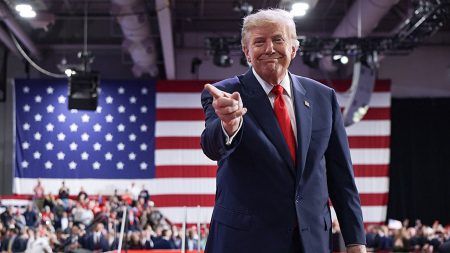



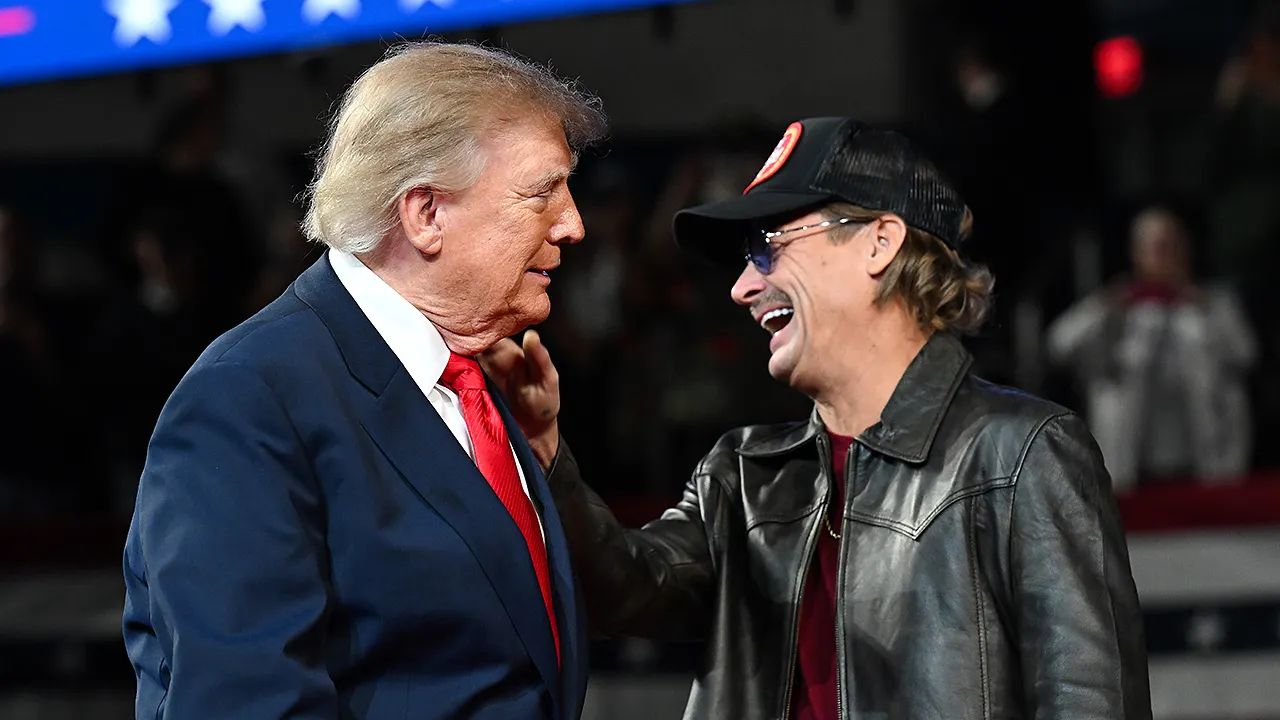
The air in Clarksville crackled with the kind of energy that has become a signature of Donald Trump’s political rallies. This wasn’t a stuffy policy briefing or a carefully scripted press conference; it was part revival, part rock concert, and part family reunion, all set against the rolling hills of Tennessee. President Trump took the stage with the swagger of a man in his element, back in a state that had voted for him in all three of his presidential campaigns. The occasion was the upcoming Nov. 3 midterm elections, and he was there to boost Republican Sen. Bill Hagerty and gubernatorial candidate Marsha Blackburn, but the event quickly became something far more expansive than a typical campaign stop. The evening opened with musician Kid Rock, a longtime friend and supporter, delivering an introduction that felt more like a sermon than a concert opener. He took playful aim at the news media, joking that if Trump literally walked across the Cumberland River, the headlines would accuse him of refusing to swim. Then he struck a more serious chord, condemning Islamist extremism and defending the idea of religious freedom in terms that drew loud cheers. “We are not, and we will never be, one nation under Mohammed, because we are, and we always will be, one nation under God,” Kid Rock declared. The crowd roared, and Trump, visibly appreciative, later thanked his friend by his given name, Bob. It was a moment that captured the essence of the night: a blend of entertainment, raw political passion, and unapologetic cultural commentary that left no room for ambiguity about where the loyalties of the room lay.
Once the president took the microphone, the wide-ranging nature of the evening became even clearer. Trump moved effortlessly from one topic to another, as if he were holding court at a massive dinner table. He turned first to foreign policy and the ongoing tensions with Iran, describing the country’s leaders as “crazy” and recalling past threats that he claimed had softened after American military actions. His descriptions were bold and unverified, but they were delivered with absolute certainty. Trump boasted about the damage dealt to Iran’s military capabilities, claiming that 159 ships had been sunk and that their air force and anti-aircraft defenses had been completely destroyed. “They have no Navy. They have no Air Force, they have no anti-aircraft equipment,” he told the crowd. Then, in a typical shift, he pivoted from the chaos of the Middle East to an unexpected geography lesson. Standing before thousands of supporters, he mused about renaming the Strait of Hormuz to the “Trump Strait,” a remark that drew laughter and applause. But he wasn’t done. He revisited his decision to rename the Gulf of Mexico the Gulf of America and then floated the idea of going even bigger. “We need a river. We need an ocean,” Trump said, suggesting that the Atlantic or Pacific could one day be known as the “Trump Ocean” or the “Ocean of the Americas.” He admitted, with a grin, that he’d like to claim an ocean before leaving office, even as no formal plans were announced. This blend of bravado and whimsy is exactly why his supporters find him so magnetic. He treats the world as a place that can be reshaped by sheer will, and for a night in Tennessee, that vision felt possible.
But for all the far-flung detours and off-script humor, there was a serious message about money, jobs, and the future of American manufacturing woven throughout the rally. Trump took the opportunity to tout major investments coming to Tennessee, positioning them as direct results of his trade and tax policies. The headline was Korea Zinc’s planned investment of more than $6 billion in the state, a project expected to create 740 jobs across Montgomery and Smith counties. Tennessee officials had already announced this $6.6 billion project back in December, hailing it as the largest single private corporate investment in state history. The plans include a new critical-minerals smelter in Clarksville and the reopening of a former mine in Gordonsville. Trump framed it as a historic breakthrough. “And your state will soon be home to the first new mineral smelter in the United States, first one built since 1979,” he said. The project is meant to shore up domestic supplies of minerals essential for semiconductors, defense technology, and advanced manufacturing, a theme that resonates in a region that has seen its industrial base shift over the decades. Trump also highlighted General Motors’ previously announced $275 million investment in its Spring Hill manufacturing facility, which will support production of next-generation turbocharged Cadillac engines. He credited his tariff policies with encouraging companies to expand at home rather than face import duties, a message that speaks directly to working-class voters who remember when American manufacturing was the envy of the world. The White House, in a fact sheet released as the rally began, pushed the narrative even further, claiming that Republican-backed tax policies had preserved $23 billion in economic activity in the state and that the average tax refund for Tennesseans in 2026 was $3,674. These figures were impossible to verify on the spot, but to the crowd, they represented something tangible: a government paying attention to their livelihoods, not just to coastal elites or foreign interests.
Then the president shifted gears, as he so often does, and turned to the issue of public safety. This was not a theoretical discussion of criminal justice reform or policy nuance. Trump delivered a stark and forceful message about crime, law enforcement, and the need for order, particularly in American cities. He praised the work of federal law-enforcement operations in Memphis, claiming that roughly 12,000 dangerous criminals had been removed from the streets. The White House separately asserted that murders and overall crime in Memphis had declined by approximately 36 percent, a statistic credited to the Memphis Safe Task Force. For Trump, these numbers were proof that his approach to public safety was working. He spoke about the importance of backing the police, respecting the men and women in uniform, and taking a hard line against those who threaten communities. In a state that values law-and-order rhetoric, especially in rural and suburban areas, these words landed with real weight. Trump’s voice carried a sense of moral clarity that his supporters find reassuring. He didn’t hedge or offer caveats; he simply promised that under his leadership, the federal government would stand shoulder to shoulder with local authorities to reclaim neighborhoods from violence. He described what he called the removal of dangerous criminals as if it were a personal mission, and the crowd responded with chants of approval. This section of the rally was about more than statistics. It was about the feeling of safety, the desire to walk down a street without fear, and the belief that someone in power was finally taking the side of the ordinary citizen. For many in the audience, that message alone was worth the trip to Clarksville.
For all the tough talk and tough policies, though, there was also something disarmingly personal about the night. At several points, Trump shared details from his life with Melania Trump, offering the kind of glimpses that rarely appear in official transcripts. He recounted her objections to his theatrical impersonations of athletes during discussions about transgender participation in women’s sports. “She said it’s not presidential,” Trump recalled, drawing laughs from the crowd. It was a rare admission that even he has someone who keeps him in check, someone who tells him when to tone it down. Then he went further, joking about her film career and making a quip that was both humble and egotistical at the same time. “There is only room for one star in a family, so I don’t need this movie stuff. I don’t need it.” The line was classic Trump: playful, self-aware, and yet still managing to place himself at the center of the universe. These moments humanize him in a way that policy speeches cannot. They remind supporters that beneath the larger-than-life persona, there is a husband and father navigating the same kinds of family dynamics as anyone else, albeit on a much larger stage. For people who had spent hours in line, endured security checks, and squeezed into a crowded venue, these personal anecdotes were a reward. They made the former president feel like a neighbor rather than a distant figure. They also demonstrated that Trump, despite his often combative public image, is capable of warmth and humor at his own expense. In a political era filled with robotic talking points and carefully managed optics, that unpredictability is part of his appeal. He didn’t have to be on stage in Tennessee, but he was, and he seemed genuinely to enjoy the chance to let down his guard and simply talk.
Underneath all the laughter, the boasts, and the promises, the through-line of the night was the election. Trump repeatedly returned to the November contest, urging supporters to back Republican candidates even though his own name would not appear on the ballot. He asked them to treat the upcoming vote as a referendum on his movement, a way to continue the work he had started. “In this election, I’m asking you to do me a favor. Pretend. Just pretend that I’m running,” Trump said. That line captured the emotional logic of the entire evening. For his supporters, Trump is not just a person; he is an idea, a movement, a banner under which they march. Showing up to vote for Hagerty and Blackburn is, in their minds, the same as showing up to vote for Trump. He framed the visit as an act of gratitude as much as a campaign event. Trump said, “Sometimes it’s nice to go to a place where you don’t have to be, but you’re there to say thank you to the great people that elected you three separate times in record time.” It was a recognition of loyalty returned, a bond between a leader and a state that has embraced him unconditionally. The rally ended the way these events always do, with hands raised, patriotic anthems blaring, and a crowd that left feeling energized, seen, and part of something larger than themselves. In the end, the night in Clarksville wasn’t just about policy or politics. It was about belonging, about belief, and about the simple human desire to be part of a team that is fighting for you. And for the thousands who packed the venue, there was no doubt that they had found that team, and that their quarterback was right there on the field, ready for one more drive.