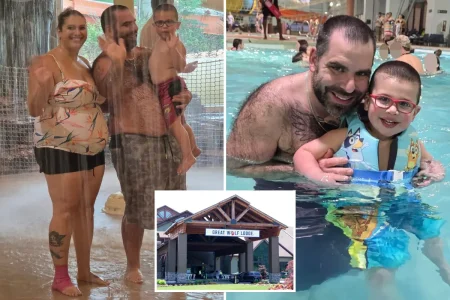



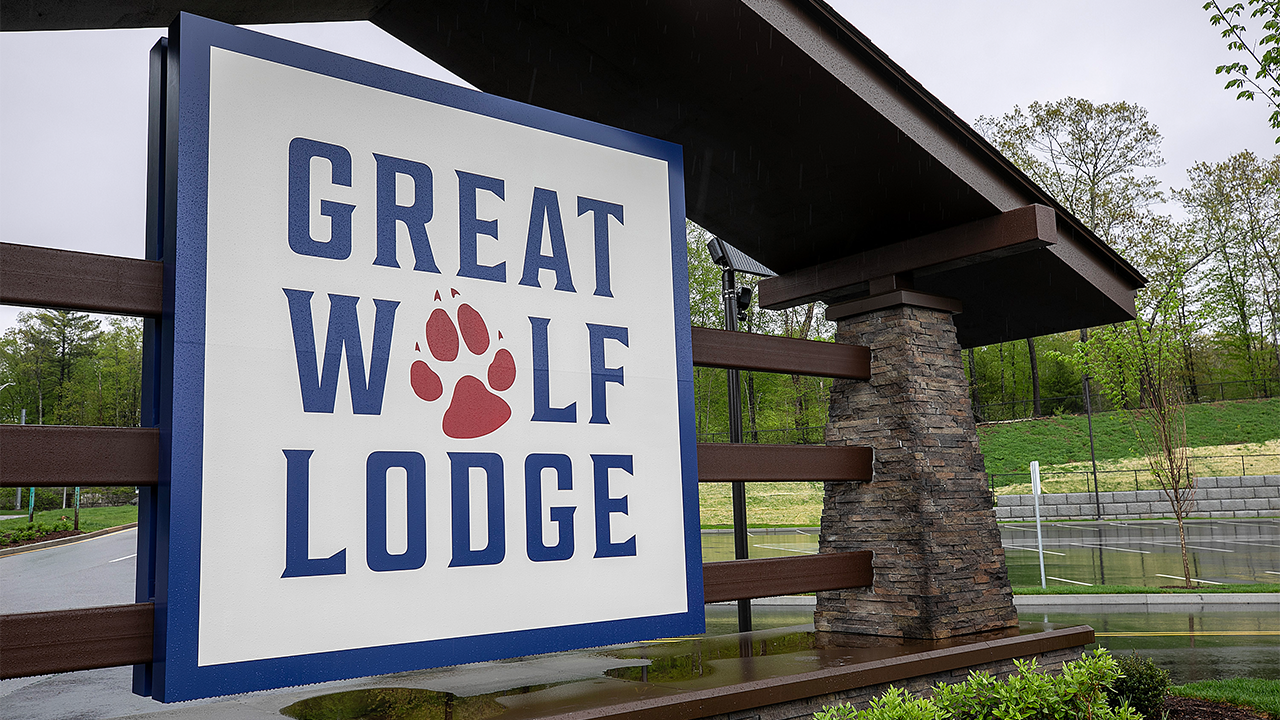
On a Monday afternoon in the Pocono Mountains, the kind of place families usually go to escape the everyday, a call came in that shattered the quiet. The Great Wolf Lodge in Scotrun, Pennsylvania, a sprawling indoor waterpark resort known for its water slides and children’s laughter, became the scene of something no one could have prepared for. Police arrived at room 2030 just after 3:00 p.m. on October 12, responding to a 911 call that reportedly involved a woman asking for help while she was dying. When they reached the door, they found Metallica Rose Harrison, 27, of Towanda, with blood running from cuts on her wrists and puncture wounds around her neck. She spoke of wanting to be with her husband and son. Inside the room, officers discovered the bodies of her husband, Charles Harrison, and their three-year-old son. The child was still so young that authorities identified him only by his initials. In the hours and days that followed, the resort—a destination built around the innocent joy of families—stood mute behind yellow police tape, while investigators began piecing together a story that no one would ever want to tell.
What emerged from the criminal complaint was not just a forensic account of a double homicide, but a portrait of a woman who, by her own alleged words, believed her life was supposed to look very different. As she was being treated and transported to St. Luke’s Hospital’s Monroe Campus in Stroudsburg, Harrison reportedly told emergency responders, “It wasn’t supposed to end like this. I was supposed to have my happy family. That’s what I envisioned since I was a child.” That phrase—“happy family”—trembles with a kind of ache that is hard to read without feeling something heavy in your chest. She went on, according to investigators, to say that she had worked hard every day to be the best person, the best mother, the best wife. These are not the words of someone who appears detached or remorseless; they are words that seem saturated in despair, perhaps from the very person whose dreams had curdled into a nightmare. Of course, the legal system will have to determine exactly what happened, and why, and what her mental state was on that night. But the humanizing detail of her vocalized vision of a happy family reminds us that before this tragedy became a case number, it was a life, a marriage, and a childhood home for a tiny soul who never got the chance to grow up.
The physical evidence inside room 2030 paints a brutal picture. According to the affidavit, police found Charles Harrison with multiple stab wounds to the chest, while the couple’s three-year-old son appeared to have suffered a single stab wound to the chest. A large kitchen knife was discovered on the bathroom floor, and a smaller knife sat on the bathroom sink. Both had teal green handles—a small but poignant detail, because lodge staff confirmed that these knives did not belong to the resort. These were not objects from the waterpark’s kitchen or the room’s standard supplies. They were brought in, or perhaps somehow acquired, adding to the sense that this was not an impulsive act that emerged from a moment of chaos, but something more deliberate and more disturbing. Scattered throughout the room were several medication bottles, a detail that investigators will likely scrutinize, as they may speak to a hidden mental health crisis, a struggle with depression, psychosis, or some other unspoken demon. The family had checked into the resort on September 21, which means they had been living inside this temporary wonderland for weeks, even extending their reservation on October 5, with a planned checkout on October 13. This was not a quick weekend getaway gone wrong; it was a prolonged stay, perhaps an attempt to reset, escape, reconnect, or simply delay returning to an ordinary life that had somehow become unbearable.
Surveillance footage offers a haunting glimpse into the last hours of the family’s time together. At around 6:53 p.m. on Sunday evening, all three family members were seen entering their room. Later that night, Harrison and her husband visited the arcade, playing games among flashing lights and ringing bells, before returning to the room together around 11:22 p.m. That image—a man and woman walking back from an arcade, perhaps tired, perhaps laughing at something, perhaps already silent with tension—is almost unbearably mundane. It reminds us that violence does not always announce itself with shouting or hostility. Sometimes it lives quietly beside the ordinary, waiting for a moment when no one is watching. Monroe County District Attorney Michael Mancuso called the complaint “disturbing reading” and said investigators were continuing to gather evidence that might shed light on the circumstances surrounding what he described as a “horrendous situation.” He also thanked the township officers, Pennsylvania State Police forensic investigators, and the coroner’s office for their work on what he correctly described as a “complex double homicide scene.” In a cautious statement, Mancuso emphasized that Harrison is presumed innocent and that prosecutors must prove guilt beyond a reasonable doubt, a reminder that our legal system insists on fair process even in cases that stir the deepest revulsion and sorrow.
The broader response from officials and the community has been careful and measured, perhaps because the tragedy seems so inexplicable. Police described the deaths as an isolated domestic tragedy and assured the public that there was no ongoing threat to the community. The Great Wolf Lodge, a brand that trades on the innocent happiness of family vacations, issued a statement saying it was “deeply saddened and heartbroken” by the deaths and was cooperating fully with investigators. A resort spokesperson said responding officers quickly determined that there was no ongoing security concern. But even as the official machinery of investigation moves forward, the human weight of this case presses down. Charles Harrison was a husband, presumably a father who loved his son. The three-year-old boy was at an age of wonder—of bedtime stories, stuffed animals, the thrill of an arcade game won, the splash of a waterpark slide. He will never have a first day of school, never learn to ride a bike, never grow up to ask questions about the night his life ended. And Metallica Rose Harrison, now charged with two counts of criminal homicide, sits in the ruins of her own life, too, a woman who told responders she only wanted to be with her husband and son. There are no easy villains here, only broken people and a broken family, scattered like the medication bottles on that hotel room floor.
What can anyone possibly say in the face of a tragedy like this? The phrase “happy family” haunts the entire case. Harrison allegedly said she had envisioned that happiness since childhood—an innocent dream that millions of people carry, one that is supposed to manifest in a spouse, a child, a home, a future. But dreams can become prisons when reality collapses around them. This case forces us to sit with uncomfortable questions about mental health, post-partum depression, parental burnout, domestic strain, and the desperate isolation that can exist even inside a crowded resort. The police found no evidence that the family had been terrorizing anyone; they were, by almost all appearances, just another family on a long stay at Great Wolf Lodge, trying to hold onto something. In the end, all they left behind were redacted initials, a teal-handled knife on a bathroom floor, and a mother’s reported words that she was supposed to have her happy family. No court verdict can bring back the little boy or the man who once shared a late night at an arcade with his wife. No sentence can erase the image of the room. But perhaps the most humane way forward is to remember that the people inside that room were not just statistics, not just headings on a crime report. They were a family—wounded, flawed, maybe even sick—and their story, heartbreaking and irreducibly human, is a call for all of us to pay closer attention to the invisible cracks in the lives around us. Because the happiest families are not those without pain, but those who are seen, heard, and helped before the unspeakable becomes the news.