


Paragraph 1: A Party Leader Stakes His Ground
On Monday, Democratic National Committee Chairman Ken Martin found himself in the hot seat, doing what every party leader eventually has to do: defending the messy, sprawling, and often contradictory coalition that makes up the modern Democratic Party. Appearing on MSNBC, Martin was asked a pointed question that has become something of a political landmine for Democrats: Is the Democratic Socialists of America—the activist organization that has embraced everything from abolishing prisons to eliminating U.S. Immigration and Customs Enforcement—a liability heading into the midterm elections? Martin didn’t blink. Instead, he reached for the oldest playbook in politics, the one that says a winning party is a broad church, not a narrow chapel. He argued that unity comes from addition, not subtraction, and that the key to success in American politics is growing the tent, not shrinking it. It’s a familiar refrain, one he says served him well during his years leading the party in Minnesota, where coalition-building wasn’t just a slogan but a survival strategy. The question, however, hung in the air: in an era of deep political tribalism, can a party truly be all things to all people, or does the embrace of the far left end up handing ammunition to the other side?
Paragraph 2: The Big-Tent Philosophy, Tested
As the interview continued, anchor Peter Alexander pushed back gently but persistently, wondering aloud whether there is a middle ground when Americans look at the Democratic Party and see socialists advocating positions that many voters find extreme. Martin was unapologetic, cutting off the line of questioning with a directness that suggested he had heard it all before. “No, not at all, because that’s where the vast majority of Americans are at,” he replied. He painted a picture of an American electorate that sits somewhere in the middle—maybe slightly center-left, maybe slightly center-right—but that nevertheless benefits from hearing new voices, including those from the socialist wing. His argument was simple: you don’t win elections by purging people; you win them by welcoming them. It’s a classic big-tent philosophy, the kind that has defined successful Democratic coalition-building for decades. But it also raises an uncomfortable question: at what point does a tent become so big that the poles start to bend? Martin seems to believe that the center can hold, and that bringing progressives into the fold doesn’t necessarily alienate moderates—it might even energize them. He repeated his core mantra with the kind of calm resolve that suggests he’s used to fielding criticisms from both sides, insisting that the party must “keep expanding this tent” even if that means occasionally making folks uncomfortable.
Paragraph 3: The Republican Counterpunch
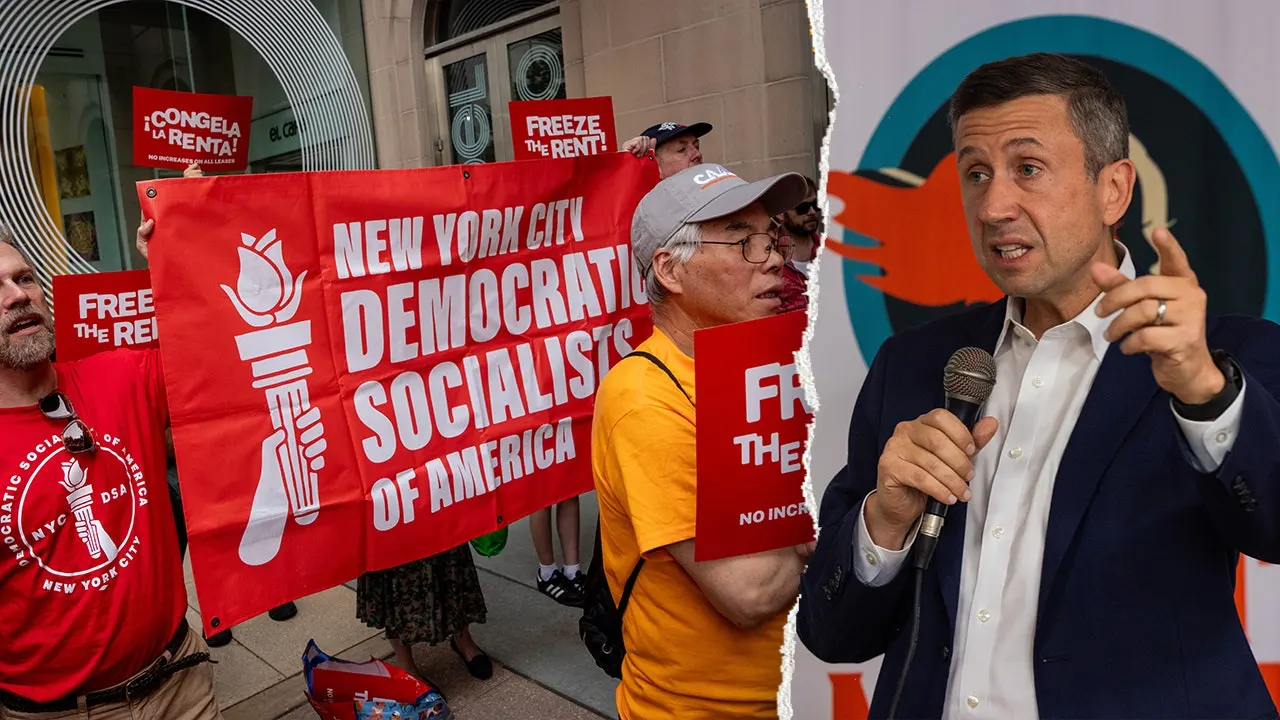
The Democratic National Committee’s stance did not go unnoticed across the aisle. No sooner had Martin made his case on national television than the Republican National Committee fired back with its own sharp retort, posting on X: “Democratic Party Chair Ken Martin embraces far-Left radicals who want to abolish the police, prisons, and borders.” The attack wasn’t new, but it landed with the force of a party that sees the Democratic relationship with the Democratic Socialists of America as a golden opportunity to rally its own base. The DSA, after all, has been vocal about its desire to overhaul American institutions. Its policy wishlist includes abolishing police departments, shutting down prisons, dismantling ICE, doing away with immigration restrictions, and pushing for sweeping public ownership of key industries. For Republicans, this is not just a fringe curiosity—it’s a weapon. President Donald Trump and his allies have zeroed in on the DSA ahead of the November elections, painting the Democrats as unwilling or unable to distance themselves from a movement that many Americans view as radical. The attack is simple: every time a Democratic leader like Martin says “big tent,” Republicans hear a welcome mat for ideas that are far outside the American mainstream.
Paragraph 4: The Price Tag of Radicalism
The fight over the DSA is not just about ideology; it’s also about arithmetic. Earlier this month, Trump’s Council of Economic Advisers released a report designed to put a terrifying number on the socialist agenda. According to the report, if the federal government were to adopt seven major DSA-backed policies, the cost over ten years would reach a staggering $49 trillion in additional deficits—roughly $350,000 per American household. The White House accompanied the report with a dire warning: “Make no mistake, these are the Democrats’ policies. They want to destroy our great, hard-fought nation, and plummet our economy and the very fabric of our nation into the ground.” The language is hyperbolic, but it is also deliberate. By linking the Democratic Party to the DSA’s most ambitious and expensive proposals, Republicans hope to force Democratic candidates into a defensive crouch. For voters who care about fiscal responsibility, the $49 trillion figure is meant to be a wake-up call. For the White House, it is proof that the big tent has a high ceiling tax. Whether the numbers are entirely fair is almost beside the point; in the world of political messaging, a big, scary number attached to your opponent is worth its weight in gold, and the administration is spending it freely.
Paragraph 5: Democrats Try to Draw Their Own Lines
Despite the Republican attacks, many mainstream Democrats are trying to put some distance between themselves and the DSA label. They point out that they support capitalism, that they believe in regulated markets, and that their vision of social democracy is fundamentally different from the more radical positions espoused by socialist organizers. They argue that being a Democrat doesn’t mean endorsing every policy that appears on a DSA flyer, just as being a Republican doesn’t mean agreeing with every opinion on cable news. There is, in other words, an ongoing internal negotiation within the Democratic Party about where the center of gravity actually lies. Some candidates have embraced progressive positions on healthcare and climate change while drawing a hard line at the more revolutionary rhetoric coming from the far left. Others, particularly those in swing districts, prefer to avoid the subject altogether, hoping voters will focus on more immediate concerns like the economy, inflation, or local infrastructure. But the tension remains. Every time a Democratic leader publicly defends the big tent, it gives Republicans another sound bite. Every time a Democratic leader tries to distance the party from the DSA, it risks alienating the grassroots activists who knock on doors and make phone calls. It is a delicate dance, and not everyone is dancing in step.
Paragraph 6: The Uncomfortable Future of the Big Tent
At the heart of this controversy is a fundamental question about what it means to be a political party in the modern era. Ken Martin’s big-tent approach is rooted in the pragmatic belief that elections are won by broad coalitions, not by purity tests. He has seen firsthand how factions can tear a party apart, and he is determined to avoid that fate. But the political environment has changed. Parties are no longer just organizations that nominate candidates; they are brands, and brands are judged by their most visible advocates. When a socialist with a large following declares that borders and prisons should not exist, the entire party gets associated with that vision, no matter how often moderates object. Martin’s defense of the big tent is an attempt to preserve a certain kind of politics—the kind where you can disagree with someone on one thing and still stand with them on another. It’s a noble idea, but it is being tested as never before. With the midterms approaching, with the White House eager to frame the election as a choice between normalcy and radicalism, and with voters more polarized than they have been in generations, the answer to whether addition is better than subtraction will become clear soon enough. The only certainty is that the debate isn’t going anywhere. The Democratic Party will continue to wrestle with its own contradictions, and Republicans will continue to exploit them. In the end, perhaps the big tent is less a strategy than a struggle—an ongoing, messy, human effort to hold together a coalition of people who do not always agree with each other, but who, at least for now, share a party. And that, as Martin might say, is exactly the point.