




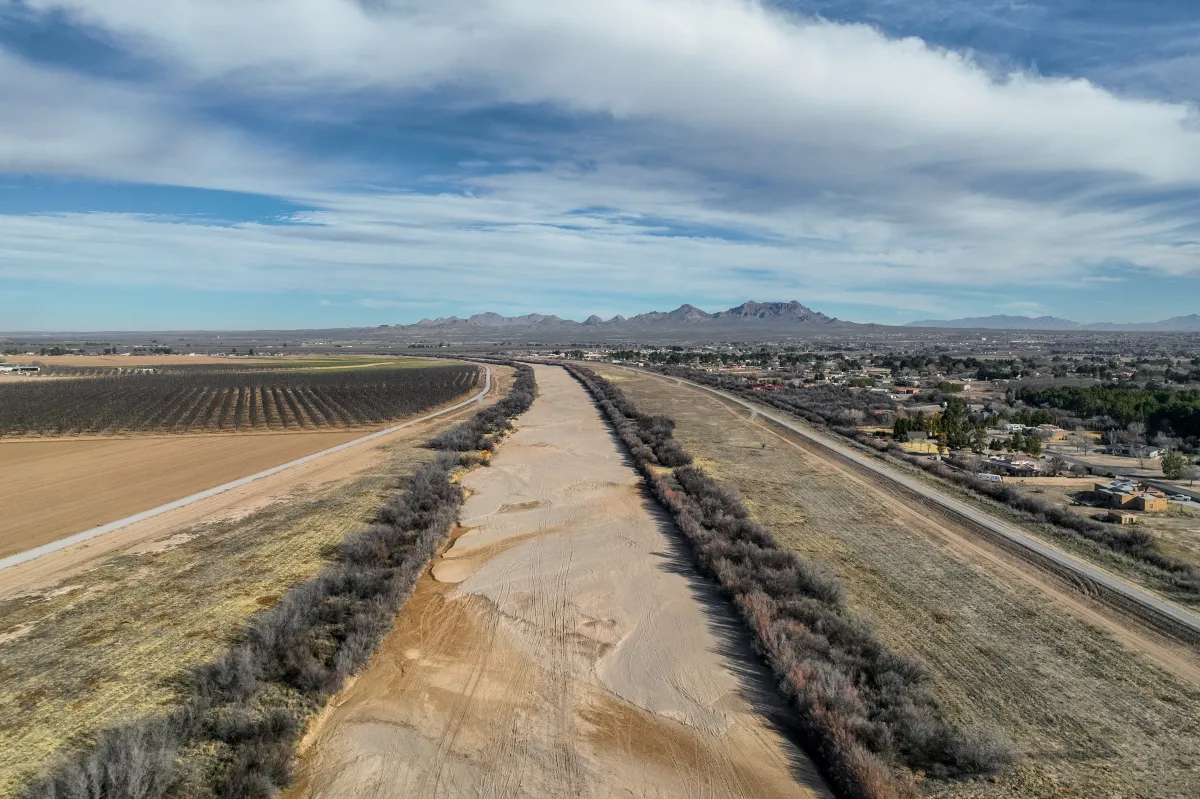
The Colorado River has been grabbing headlines for years, but a quieter, slower-moving emergency has been unfolding along the Rio Grande, a river that many Americans rarely think about until it makes the evening news. The Rio Grande is one of the longest rivers in the United States, stretching roughly 1,900 miles from the snowy peaks of Colorado down through New Mexico and Texas before spilling into the Gulf of Mexico. It is also a lifeline for Mexico and for millions of people who live in one of the driest and fastest-growing regions of the country. According to the World Wildlife Fund, the river has lost about 85 percent of its historic flows because of overuse and years of severe drought, and around 15 million people depend on it for drinking water. That is not a statistic to brush past. It means schools, hospitals, farms, wildlife refuges, and entire communities are living with a river that is increasingly running on fumes. While the Colorado River crisis has received more attention, the Rio Grande has been quietly battling what officials describe as a severe water crisis demanding urgent attention. The situation is not hypothetical or far-off. It is happening now, in the form of dusty riverbeds, shrinking reservoirs, and hard choices about who gets water and who goes without. The river that once supported ancient pueblos, Spanish colonizers, railroad builders, and generations of farmers is now asking a simple question: can we learn to live within its limits before it runs dry?
The numbers coming out of New Mexico are sobering. A spokesperson for the New Mexico Office of the State Engineer, or OSE, told Newsweek that despite recent rains, officials remain very concerned about the water outlook for the Rio Grande over the next few years and decades. This past summer, more than 112 miles of the river dried up entirely. During the current water year, flows in New Mexico were only about 31 percent of median levels, and in August they dropped to roughly 14 percent of what is considered normal. Elephant Butte Reservoir, one of the state’s most important water storage facilities, was less than 1.5 percent full on August 31, the lowest level ever recorded for that date. That is not just a low number; it is a warning sign that the system is running out of buffer. In Texas, the outlook is similarly grim. According to the Texas Water Development Board’s 2027 State Water Plan, existing water supplies that can be relied on during a drought are projected to decline by about 10 percent between 2030 and 2080. Without new supplies or management strategies, Texas water users could face shortages of approximately 3.6 million acre-feet per year by 2030, growing to 5.8 million acre-feet per year by 2080 if a severe drought comparable to the drought of record recurs. To put that in perspective, Texas’s largest reservoir, Toledo Bend, can hold about 4.5 million acre-feet. That means projected annual shortages could exceed the entire capacity of the state’s largest reservoir. These are not abstract figures. They represent the difference between a working farm and a fallow field, between a full glass and an empty one, between a river that supports life and a river that is just a scar in the landscape.
What is causing this crisis? There is no single villain, but rather a collision of climate change, decades of overuse, and a river system that is being asked to do too much with too little. The OSE spokesperson said the Rio Grande’s significantly reduced and declining flows over the past decade, especially over the last five or six years, are occurring in the context of a changing climate and prolonged drought. A study published this month in Agricultural Water Management noted that climate change has intensified the propagation of drought and the frequency and intensity of extreme weather events, posing severe challenges to global agricultural production and water resource management. Timothy Parker, a groundwater expert who has led several Rio Grande and New Mexico aquifer mapping and survey projects, called the water shortage “real and very alarming.” He pointed out that temperatures have gone up over the past two decades, accompanied by drier years. But climate change is only half the story. Parker also noted that New Mexico’s agricultural water use has increased over the last 40 to 50 years as farmers switched from temporary crops to crops that require year-round water. That shift means water is being consumed more constantly, whether the year is wet or dry. According to a November 2025 study in Discover Water led by Brian Richter, irrigated agriculture accounts for 87 percent of direct water consumption in the Rio Grande basin. The same study warned that without a substantial reduction in water consumption, a repeat of the four-year rate of reservoir depletion seen from 2010 to 2013 would completely wipe out all remaining surface water stored in the basin. All remaining water stored in New Mexico reservoirs could be gone in just one or two low runoff years. Rich “Raz” Razgaitis, a national clean water and sustainability expert, put it bluntly: climate change is shrinking the supply, but overuse is why there’s no cushion left. Since 2000, snowmelt runoff, the river’s primary source of water, has averaged about 17 percent below 20th-century levels. “But the bigger structural problem is simple: we consume more water than nature replaces,” Razgaitis said.
Behind every statistic is a human story. The Rio Grande supports farmers who have worked the same land for generations, families in growing cities like Albuquerque and El Paso, Indigenous communities with deep cultural ties to the river, and a vast ecosystem of birds, fish, and plants that depend on its flow. When the river dries up, it is not just a policy problem; it is a personal one. Farmers face the impossible choice of watering their crops or watching them wither. City residents face the prospect of stricter watering restrictions, higher water bills, and the uncomfortable realization that the water coming out of their tap is not guaranteed forever. Brian E. Macmanus, general manager at the East Rio Hondo Water Supply Corporation in Texas, told Newsweek that the next few years should be fine from a municipal supply perspective, but as the region grows and the population doubles in 20 to 25 years, the region will be running out of water via the Rio Grande in a worst-case drought scenario. That kind of statement should not be ignored. It means that the children and grandchildren of today’s residents may inherit a future where the river is no longer a reliable source of water. It also means that the burden of the crisis is not shared equally. Those with the fewest resources, the smallest farms, the least political power, often feel the pain first. But the experts also push back against the idea that farmers are the problem. Razgaitis is clear: “Farmers aren’t the problem—they’re essential to the solution.” The challenge is not to blame people but to create systems that allow everyone to use less water without destroying livelihoods. That is a difficult, emotional, and deeply human task. It requires acknowledging that water is not just an economic resource but a shared inheritance, one that connects the past to the future and one that cannot be taken for granted.
There is no shortage of ideas for how to combat the crisis, but there is a shortage of time. The New Mexico Office of the State Engineer says the state is actively working to address these challenges and is committed to working with other states and stakeholders to protect New Mexico’s water resources. Governor Michelle Lujan Grisham’s 50-Year Water Action Plan includes 11 action items, such as water conservation, developing new supplies, and protecting water and watersheds. Professor Chinonso Anozie from the University of Houston Law Center, who works with the university’s Environment, Energy, and Natural Resources Center, told Newsweek that the most obvious action is implementing the May 2026 Supreme Court Decree in Texas v. New Mexico, which requires a drastic reduction in New Mexico groundwater use over the next decade. He also stressed that because climate change plays a major role in the Rio Grande water crisis, water policymakers must pair short-term solutions with longer-term solutions that directly address climate change impacts on the river. Parker said the New Mexico government is considering developing brackish water for supply augmentation after treatment and management, and he pointed to state and local water agencies working to develop more comprehensive water demand management. That should be accompanied, he said, by land-use planning strategies to optimize the use of available water. Macmanus believes brackish desalination and seawater desalination are the true long-term solutions, but because of higher costs, most utilities treat them as a last resort. “The problem is the drought is here in a year or two, and it takes 5 to 10 years to build alternative water supply systems,” he said. Razgaitis offered a series of practical steps: limit pumping in overdrafted aquifers, require major new industrial users—especially data centers—to bring their own water rather than using drinking water supplies, and give farmers the economic tools to use less. That could mean lower-water crops, shorter irrigation seasons where practical, paid fallowing, and fair compensation for voluntarily retired water rights. These are not easy solutions. They require political will, public understanding, and a willingness to make choices that may be unpopular in the short term but necessary in the long run.
Is there hope? Yes, but it is conditional. Bill Kirk, CEO and co-founder of Weather Trends International and WeatherTrends360, told Newsweek that there are clear signs the 2025 La Niña drought pattern has rapidly intensified to the strongest El Niño in 149 years. This is dramatically changing the weather pattern in the United States and the Rio Grande River Valley between Texas and Mexico. The valley is already seeing a wetter pattern, and it is forecast to continue well into spring 2027, bringing dramatic relief to the river basin, with floods very likely later this winter into spring. But Kirk also warned that a moderate, possibly strong La Niña could return in late fall 2027, meaning the relief may be temporary. The OSE spokesperson said officials expect to see approximately 25 percent less water in the Rio Grande by 2070, even with the possibility of good snowpack in the near term. So the wet winter is not a solution; it is a reprieve. The real work lies in preparing for a future with less water, a future where conservation is not just a slogan but a way of life. The Rio Grande is not the first river to face this kind of crisis, and it will not be the last. But it is a test of whether we can act before it is too late. The river has carried water for millions of people for centuries, and it has carried the weight of our demands, our droughts, and our disagreements. Now it is asking us to carry the responsibility of protecting it. That means listening to the farmers, the scientists, the Indigenous communities, and the local leaders who know the river best. It means investing in new technology, but also in old wisdom about living within limits. It means treating water as a shared treasure, not a commodity to be fought over. The next few years may be fine, but the next few decades will be defined by the choices we make now. We can choose to ignore the warning signs until the river runs dry, or we can choose to write a different story for the Rio Grande, one where the water still flows, the fields still grow, and the communities along its banks still thrive. The river is waiting. The question is whether we are ready to act.