



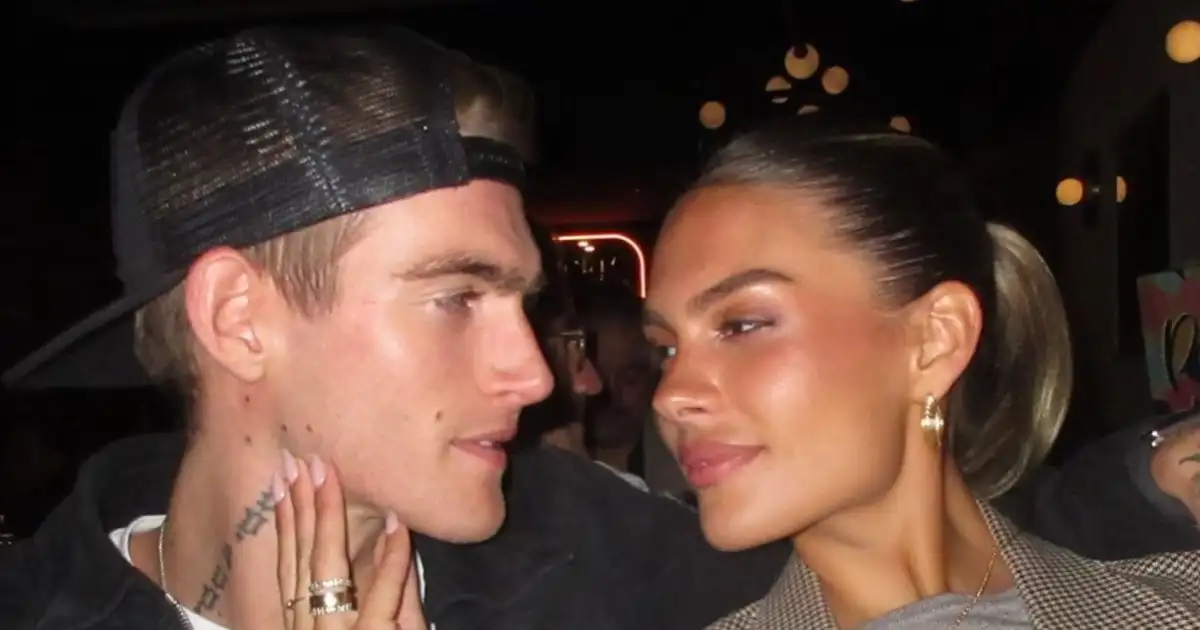
There are certain losses that seem to happen in the public eye and still feel unbearably private. When Presley Gerber died unexpectedly, the shock rippled far beyond the celebrity circles who watched him grow up and beyond the headlines that carried the news. For Isabella Jones, the 27-year-old influencer who spent years close to Presley, the loss is not a story but a deep and ongoing ache. On October 9, Jones turned to Instagram to honor him, sharing a carousel of throwback photographs and a caption that cut straight to the heart: “My sweet Presley, I will miss you for the rest of my life.” The carousel offered a rare glimpse into a relationship that had mostly stayed out of the spotlight. These were images that only the two of them could fully explain—fragments of time that now carry an unbearable weight. For Jones, those photographs are now artifacts of a friendship and love that no longer has a future. Her post was not a detailed eulogy, and it did not try to explain who Presley was to the wider world. It was enough to say that he mattered, that he was loved, and that she will carry him with her. In that way, Jones became one of many voices shaping the collective memory of a young man whose life was marked by beauty, family, fame, and struggle. She reminded everyone that before Presley Gerber was a headline, he was someone’s sweetheart, someone’s friend, someone whose absence leaves a permanent silence. Her words were simple, but in grief, simplicity often says everything. She promised to miss him for the rest of her life, and those who have loved anyone will understand exactly what that means. It is the kind of promise that is made not when the world is watching, but when the heart has no other option. Grief is often described as love with nowhere to go, and Jones’s tribute was proof of that. She gave the world a glimpse of her own heartbreak while also honoring the person she knew—the one who existed beyond the modeling campaigns and the famous family name.
Despite the depth of feeling in Jones’s tribute, much about her relationship with Presley remained private. The two did not often make red-carpet appearances together, and when they were photographed, the images tended to feel candid rather than staged. The last time they were seen in public together was in October 2024, at the Cloud23 launch party in Los Angeles. It was an ordinary kind of event—friends, lights, drinks, laughter—one of those industry nights that happen dozens of times in a city like LA. No one at that party could have guessed that less than a year later, Presley would be gone. On September 20, his death was confirmed. He was 27 years old. The announcement landed like a thunderclap. For many who grew up seeing his face in magazines, it was difficult to accept that someone so young, so visibly part of a family that seemed to have everything, could vanish so suddenly. The days that followed were filled with condolences, memories, and a shared sense of disbelief. But for Jones, the timeline was horrifyingly personal. She had gone from being by his side at a party on the edge of autumn to planning how to say goodbye from a distance. There were no new photographs to take, no more parties to attend, no more moments to quietly share. There was only the archive of what had been. The privacy surrounding their relationship means that we will never know the full shape of their story—how they first connected, how they grew close, or what they said to each other the last time they spoke. But the fact that Jones chose to speak now, with such tenderness, tells its own story. She did not have to post anything. She did not have to make private grief public. She did it because the loss demanded to be acknowledged, and because Presley deserved to be remembered as more than a tragedy. In a world where celebrity relationships are often treated as content, Jones’s tribute was strikingly human. It was not designed for engagement or likes. It was a heart breaking in real time, and she let the world see it. That is a form of courage that grief sometimes grants us.
In the wake of the loss, Presley’s family retreated from the public gaze, asking for the one thing no amount of fame can guarantee: privacy. “The family is asking for privacy during this very difficult and painful time,” a spokesperson for his parents, Cindy Crawford and Rande Gerber, said in a statement. It was a brief, restrained request from a family that had spent decades in front of cameras, suddenly finding themselves in the middle of every parent’s worst nightmare. Their son was gone. The world had questions. But the family needed space even to breathe. A cause of death had not been publicly shared, and authorities continued an ongoing investigation amid suspicions of an apparent overdose. That detail, while not conclusive, landed heavily on those who had followed Presley’s journey. He and his family had previously spoken openly about his struggles with substance abuse, and his sister Kaia did not shield herself from the realities of that struggle. In an interview with Vogue, before her brother’s death, Kaia reflected on how addiction had shaped their family dynamic. “When something like that happens in a family, it kind of levels everyone,” she said. “I think that’s also why I started to self-identify as the easy one and never wanted to ask for help. Because it felt like too much to have two children who were needing.” Her words now carry a sorrowful weight. They illuminate the quiet pressure that siblings of struggling loved ones often feel—the instinct to be small, to be strong, to be the one who does not make things harder. Kaia’s honesty was an act of vulnerability, and it gave context to the family’s pain. Addiction is not a story that begins with a final chapter; it is a long, winding, exhausting road filled with hope, relapse, love, fear, and guilt. It leaves scars not only on the person who struggles but on everyone who loves them. The Gerber-Crawford family had never pretended that things were perfect. They had used their platform to talk about the reality of addiction, perhaps hoping that visibility would bring understanding. Now, they must live with the outcome they had likely feared for so long. No amount of fame, money, or access could shield them from the consequences of a disease that does not discriminate.
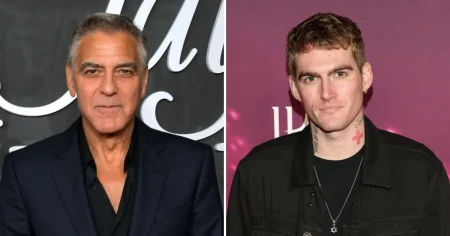
In the difficult weeks that followed, the family found themselves surrounded by their famous circle of friends. Reports that Presley’s remains had been cremated only added a finality that is hard to absorb. For his parents, and for Kaia, the rituals of saying goodbye were private, away from the cameras that had documented so much of their lives. But some friends chose to speak publicly, not because they wanted attention, but because their love for the family was too great to stay silent. George Clooney, Rande Gerber’s close friend and business partner in Casamigos Tequila, broke his silence in an interview with Entertainment Tonight. “I don’t think we’re even in the position of even being able to talk about it,” Clooney said. “Quite honestly, it’s one of the most devastating things that’s happened to our family. And their family is just, as you can imagine, it’s the worst thing that could happen to the family.” There is something deeply human in Clooney’s inability to find the perfect words. He did not try to offer wisdom or comfort. He simply acknowledged the scale of the devastation. He said “our family,” not “their family,” at first—a slip that reveals how close those bonds truly are. Friendships forged through shared business, shared celebrations, and shared decades become something more than friendship. When one family grieves, the other grieves with them. Clooney’s comments were not about Presley specifically, not about his life or his struggles. They were about the people left behind, and how a loss like this shatters everything in its path. It was a reminder that even those with money, influence, and success are not immune to heartbreak. They still drive home from funerals, still stare at empty rooms, still wonder what could have been done differently. They still carry the weight of loving someone who is no longer here. And they still show up for each other. In the world of the famous, grief is often performed for cameras, but Clooney’s hesitation and raw honesty felt genuine. He did not have a polished statement. He had a broken heart. That, perhaps, is the most honest tribute anyone can offer.
Presley’s reach extended beyond family and close family friends to those who had loved him in different ways. Lexi Wood, a Summer House alum who dated Presley, also shared her condolences in the aftermath of his death. Her tribute was longer and more reflective, and it painted a portrait of a man who was far more than the sum of his struggles. “It’s hard to put into words what it means to lose someone who was such a meaningful part of my life for so many years,” Wood wrote. “Through every chapter and every version of our relationship, friendship was always at the core of it. Everyone who loved Presley and was loved by him knows he was one of the kindest, most open, loving and courageous people. He loved so deeply, so purely, was incredibly romantic and thoughtful.” Wood’s words offer a counterweight to the darker narrative that often surrounds a death connected to addiction. She remembered the person, not just the problem. She used words like “kindest,” “courageous,” “romantic,” and “thoughtful”—ordinary words that become extraordinary when applied to someone whose life was cut short. Her tribute also suggests that Presley was a person who held relationships close, even after they changed. She and Presley had gone through more than one chapter, more than one version of their relationship, and yet friendship remained the connective tissue. That says something about Presley: that he was capable of maintaining deep bonds, that he did not discard people when romance ended, and that he left behind a trail of people who genuinely knew him. In grief, there is always the temptation to idealize the dead, but Wood’s account did not feel like idealization. It felt like memory, complicated and tender. She did not mention his addiction or the circumstances of his death. She did not need to. Grief is not the place for judgment; it is the place for love, and Wood’s love was clear. Every relationship with Presley, she seemed to be saying, was part of a larger story. And because of that, losing him means losing something that cannot be replaced. It is a sentiment that connects everyone who grieves him, from Isabella Jones to Lexi Wood to Kaia and his parents. Each of them loved a different version of Presley, and each version was real.
Amid the tributes, the investigation, and the family’s private mourning, there remains a larger, uncomfortable conversation about substance abuse. Presley’s death, while not officially attributed to overdose, has reopened difficult questions about addiction, mental health, and the limits of love. No family can save someone solely by wanting to, and no amount of public sympathy can bring back the moments that were lost. But what the outpouring of grief shows is that Presley was surrounded by love—imperfect, human, sometimes helpless, but real. For anyone reading these words and struggling with their own addiction, or watching someone they love disappear into one, there is help. The Substance Abuse and Mental Health Services Administration (SAMHSA) National Helpline is available around the clock at 1-800-662-HELP (4357). It is a small gesture, a number on a page, but it has the capacity to change a life. Presley Gerber was 27 years old. He was a son, a brother, a friend, a love, a person of beautiful moments and no shortage of them. He was known around the world because of his family, but he was not known fully by anyone except those he let inside. Isabella Jones promised to miss him for the rest of her life. Lexi Wood remembered him as one of the kindest and most courageous people she had ever known. George Clooney called his death the worst thing that could happen to a family. All of these voices are pieces of a mosaic that will never be completed. There is no tidy moral, no message that can make sense of a loss like this. There is only the ongoing work of grieving, remembering, and continuing to live. For his sister, his parents, and everyone who loved him, that work will never truly end. But in every tribute, in every photograph, in every memory that is told and retold, a piece of Presley remains. That is not consolation. It is simply the truth. And for those who loved him, the rest of their lives will be spent holding onto it.