



There is something uniquely terrifying and exhilarating about being declared the future of an entire franchise before you’ve even purchased a proper parking pass. For Fernando Mendoza, the Las Vegas Raiders’ first overall pick in this past April’s NFL Draft, the transition from collegiate deity to professional apprentice has been a brutal, beautiful, and deeply humbling whiplash. He arrives in Las Vegas not merely as a quarterback, but as a mythological figure carrying a Heisman Trophy and a National Championship ring from his spectacular final season with the Indiana Hoosiers. Yet, the stillness of that trophy case offers no protection from the reality of training camp under the stifling desert sun. The roar of sixty thousand neutral fans has been replaced by the surgical whisper of a clipboard-toting assistant coach in his ear, critiquing his footwork on a seven-step drop. Mendoza is learning the monumental difference between being celebrated as the king of the college hill and being tested as the rawest clay on a professional assembly line. Every drill, every repetitive pre-snap read, and every echoing silence after a misdiagnosed defense is a quiet autopsy of his game, a daily reminder that in the NFL, the shine of a stat sheet from Indiana evaporates the moment he steps into the thick, humid air of a professional huddle.
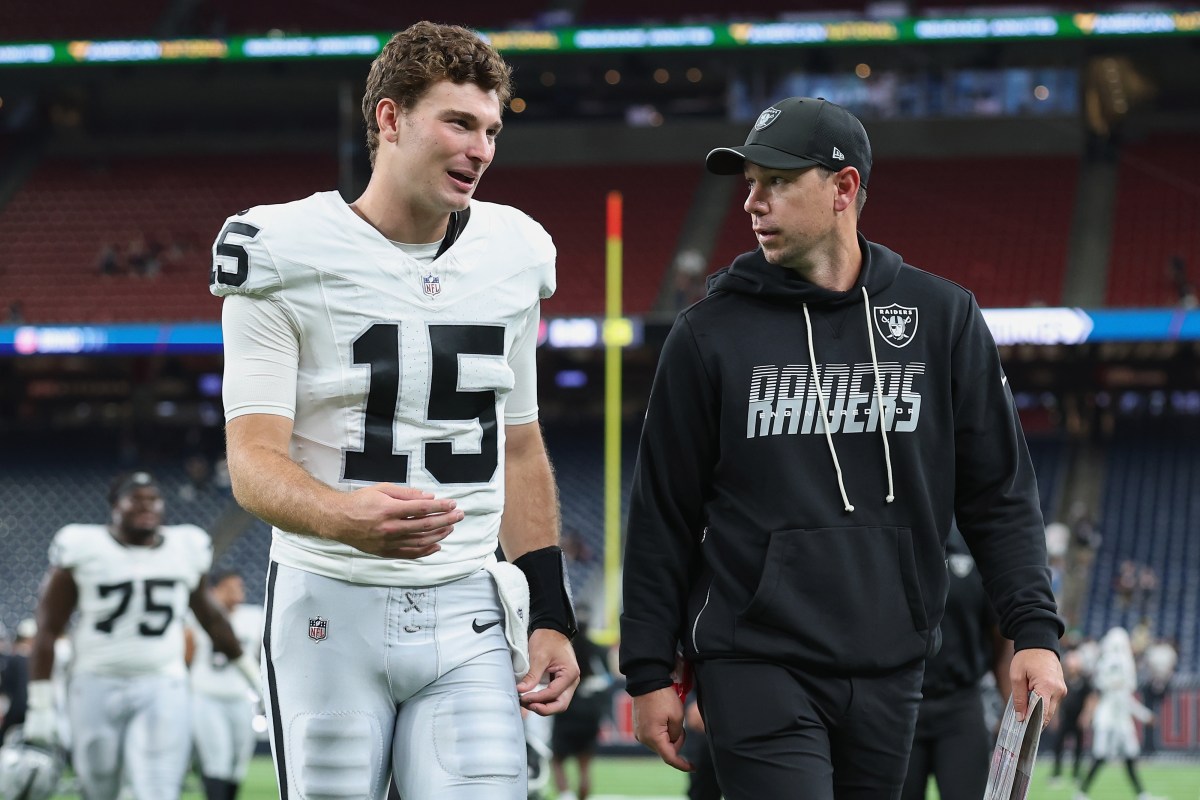
The headstone of this learning process is the demanding presence of head coach Klint Kubiak. He is not there to coddle. During a recent press conference, Kubiak summarized the rookie’s initial weeks in stark realism, a mixture of blunt evaluation and long-view confidence. “I’d say it’s his first one. It’s baptism by fire every day at all positions, especially rookie quarterbacks,” Kubiak said, a flicker of honesty dancing in his eyes. He added, “So I see a rookie player who keeps improving who we just gotta keep being hard on him.” This “baptism by fire” is not just an overused cliché from a media guide; it’s the all-encompassing reality of the human sleep in Las Vegas. Every day, Mendoza walks into the locker room and sees men who’ve played a decade, veterans whose bodies have left forgotten their college snaps. There is no procedural comfort in the routine, only the endless rails of rehabilitation—the silent film, the digital film session with coaches pointing at his flaws, the early-morning looseners before the heat begins. Kubiak’s choice to be “hard” on him is the fine art of a coach chiseling a diamond out of a block of charcoal. It is deliberately uncomfortable. Mendoza, stripped of his Heisman luster, stands in front of a mirror seeing a library of mistakes reflected, but each painted contradiction, each strain in management, is him understanding the momentum of growth does not happen in glory; it happens in the grit of correcting a thrown arc, without the crowd’s applause or a referee’s whistle.
The harsh apprenticeship has been most visibly alarmingly showcased in his two preseason appearances. The first, a narrow-losing 27-14 meeting with the Arizona Cardinals, offered a glimmer of the athlete beneath the expectations. He completed a respectful 10 of 16 passes, accruing 97 yards and a touchdown—statistics that on anyone else’s shoulders might espouse a quiet confidence. Yet for Mendoza, the aftermath was not about the zone of a completed ball. Eyes cut to the floor and voice gravely thickened by humility, he spoke to the media in a tone of raw, self-styled disappointment, confessing that he believed he let his teammates down on certain plays. This is the heart of a professional pride developing. He holds himself to a standard that a “happy-go-lucky” scratch wouldn’t. As the rookie’s second audition rolled along against the Houston Texans, the volcano of craft strikes back at the undeniable peek. The Texans, talented veterans who did week’s worth of film, exposed the neon-veins of the newcomer’s game. They snarled out a terrifying interception, taking it back for a touchdown—a cheetah-like letdown that flashed on the screens. They compounded it by sacking the poor kid like breaking a reed, an 11-yard loss that knocked the wind out of his chest. Numbers will not wash away the fact that Mendoza, in front of millions, looked human rather than supernatural. However, the Raiders eventually won the game, but it was like coasting through a rough storm where the other rookies and backups held the wheel. For him, the result was the sturdy facade of victory, an intangible psychological bruise that taught him the difference between a spot in college where he can rely on one thirty mile comma and the league where the mark of being a successful quarterback means turning gold into mud before the game’s end.
To fully appreciate his situation, you must trace the gap that exists between his gilded honor and the Giants the level of opposition. In college, Mendoza’s arm was a weapon of mass celebration, given to him by the gods. He walked into every coach’s office with the leverage of winning the Heisman and the gratifying, leading a top-tier program under a shouting, yet passionate, Big Ten. Now, within the Raiders organization, he finds a peculiar comfort: the stewardship of Tom Brady, the minority owner and historic golden arm. Having that vote of confidence before the N used to be some kind of golden ticket; now it’s the ghost’s accent on his neck. But Brady isn’t sliding and throwing with him. Mendoza is pitted against the vast physical temple of NFL defenders—men who have developed their craft for half a decade, play with unnatural fast-twist, and wrestle the arm out of him with astronomical physics. His college approach, carefully developed for open spaces, doesn’t survive the compression of professional passing windows which are now as wide as a papercut. The difference is honesty—in college, he can miss a read and win; in the NFL, a missed read turns into a blown ball hitting the turf, and the snap count doesn’t forgive. He is essentially a raw diamond being processed through a high-intensity, meticulous refinery, a process that batters his ego while expanding his constants, proving that talent enthusiasm doesn’t defeat film study and repetition.
Now Mendoza stands at the threshold of the end of the preseason, with undeniable short-term destiny. The Raiders will host the San Francisco 49ers on Thursday night at 8 p.m. ET, a final chance to line up against a diverse defensive scheme and apply the lesson from the Texans. It’s a final script for Kubiak’s staff to glance at the integrity of last week’s load. Yet even he passes that metallic exam, his thumbprint remains on the opening week’s copy. The yawning presence of Kirk Cousins, the steady, grizzled under-taker of the professional pocket, remains the odds-on favorite to open the season at quarterback. They face the fiery Miami Dolphins in Week 1, a game that will test the forte of the franchise entirely. This volume of management sees Mendoza on the sidelines, holding a clipboard, soaking in the scenery—a strange position for a Heisman winner. Most projections understand that his switch at the horizon is a mid-season point; that in late September, the reins will be given to this precise, more-sure version of him. This wait grants him a great blessing; but it also highlights the tense patience involved. He cannot use his body on the turf to apologies; he watches time go by. The expectation of a snap in a real game runs against the actual vacuum of silence, the least humbling to a man who’s only known playing a top rank. This is pressure, but in a completely different arm— one of anticipation.
Yet, ultimately, the Mendoza story that history will remember is precisely the one that is unfolding now, in the shadows and the dark elbow of the process. This is the human element that connects to every spectator living in a fantasy. He is not immortal; he is a young method bruised by cruel workouts, fighting to remain positive while veterans pat him on the shoulder. He is in an improbable story—taking the stumbles of his first passes and turning them into lemonade for his own blueprints. The persistent $14 million weight of draft status is a wearable medal on the chest, but every day, he learns to carry it without being crushed by it. His players could be great with the mentorship of Tom Wilson; his memory belongs to the Golden Age of game-day souls. No matter the victory of this season, he will still experience the collective guilt of reading an interception, and the joy of a completion on a rope. He understands that the “baptism of fire” means entering the scorching unknown not only to gain knowledge, but to discover whether the flame inside him was once potential or true endurance. As the neon lights of Las Vegas flicker outside his hotel, he lies in a quiet, blistered helmet, telling the unbearable heartbeat that the struggling in silence is what forges the sought-after champion. He is achieving direction, one scar, one sack, one rehabilitation at a time. The franchise awaits its Future—but he awaits his own today. For those following the team’s progress, every throw in the coming weeks will reveal not just an athletic report, but the story of a child grown into a warrior, sliding into something that the odds can no longer define.