


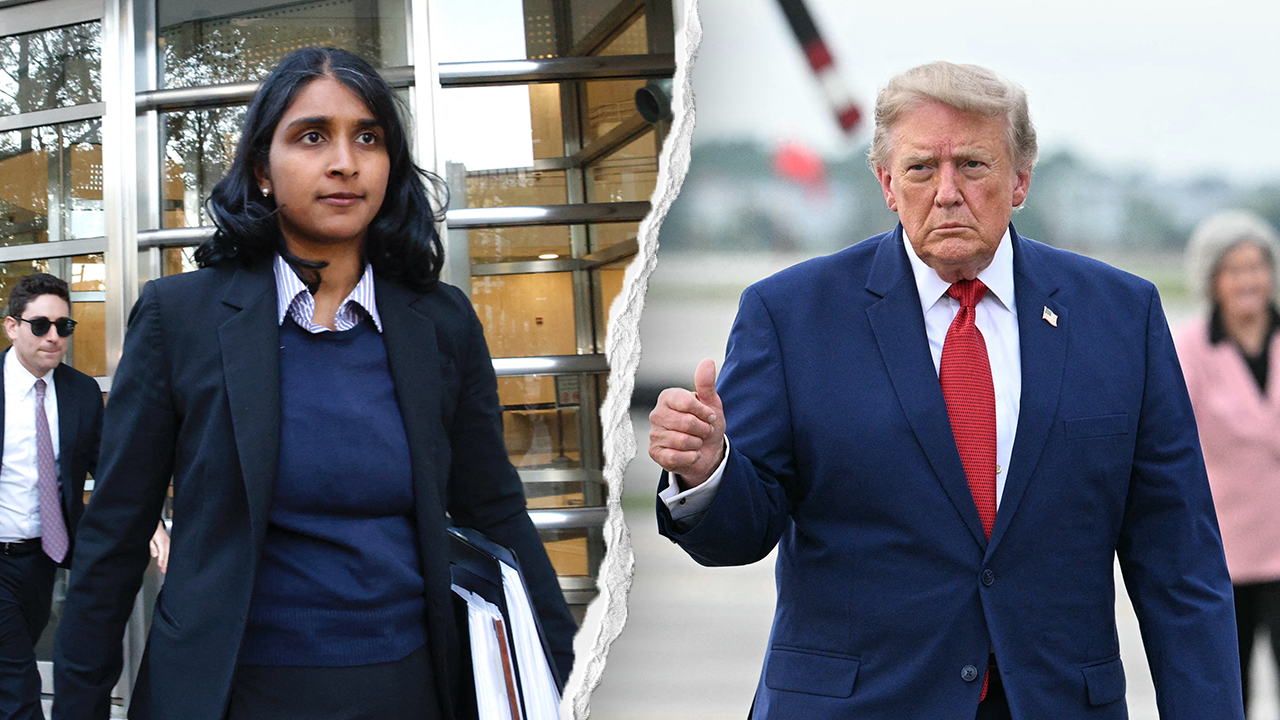
Paragraph 1: The Thunderclap of Endorsement
The political landscape of New York received a seismic shock this week, one that reverberated from the marble corridors of the state capitol in Albany down to the vibrant tenement blocks of the Bronx and the quiet suburbs of Long Island. In a fiery, late-night social media blast that read less like a formal political endorsement and more like a verbal declaration of total war, former President Donald Trump threw his complete and unqualified support behind Republican Saritha Komatireddy in her ambitious bid to unseat the formidable Democratic Attorney General, Letitia James. The post was pure, unadulterated vintage Trump—a dizzying cocktail of hyperbole, derisive nicknames, and an unmistakable undercurrent of vindicated rage simmering just beneath the surface. Calling James the “Most Corrupt Attorney General in the Country,” and gleefully resurrecting the stinging nickname “Peekaboo” to mock her physical stature and supposedly sneaky tactics, Trump painted a bleak, vivid picture of a once-great state spiraling into anarchy under the stewardship of Governor Kathy Hochul and James. He contrasted this purported urban decay and financial ruin with the supposed calm, professional, and law-and-order pedigree of Komatireddy, framing her not just as a candidate, but as a messianic redeemer sent to rescue a “once wonderful state” from a descent into utter chaos. The subtext was unmistakable to anyone paying attention: this is not merely a political contest for a state office; it is the explosive next chapter in a decade-long, deeply personal blood feud that has consumed tens of millions of dollars in legal fees, generated countless tabloid headlines, and now threatens to completely redefine the very scope and power of the top prosecutor’s office in the nation’s most high-profile state. For Trump, this endorsement is the perfect vehicle for exacting a ruinous revenge on the woman who successfully sued him in a massive civil fraud case, who doggedly pursued him through every iteration of his business and political career, and who has become an enduring symbol of the aggressive legal resistance that has plagued his presidency and post-presidency. For New York Republicans, however, it signals a risky political gambit—a potential flashpoint that could either ignite a dormant grassroots coalition eager for change, or expose the deep, irreconcilable polarization that defines the state’s current political reality, particularly in a state where Trump himself remains deeply unpopular at the ballot box.
Paragraph 2: The Scars of a Legal Blood Feud
To truly understand the venomous intensity of Trump’s endorsement, one must travel back through the winding, often surreal history of his legal entanglements with Letitia James. Their animosity is not abstract policy disagreement; it is deeply visceral, forged in the crucible of depositions, courtrooms, and sensationalized press conferences. James, who has built her political career on positioning herself as the ultimate guardian of the consumer and a scourge of corporate and political corruption, filed a sweeping lawsuit against Trump, his business empire, and his adult children in 2022. She alleged a years-long, fraudulent scheme where the Trump Organization systematically inflated the value of assets on financial statements to secure more favorable loan terms and tax benefits. The case was a spectacle of massive proportions, culminating in a judge ruling that Trump had indeed committed persistent fraud, ordering a devastating financial penalty of nearly half a billion dollars, including disgorgement and interest. For Trump, this was not merely a business setback; it was a humiliating, personal attack by a political enemy he believes weaponized the legal system against him. The emotional toll was evident in his angry outbursts during the trial and his consistent claims of a “witch hunt.” However, in a moment of high drama, an appellate court later overturned the massive disgorgement award, ruling that the penalty violated the Constitution’s prohibition on excessive fines—a stunning legal victory for Trump that merely intensified his desire to see James completely destroyed professionally. The appeals court’s decision did not erase the underlying finding of liability, but it effectively nullified the crippling financial blow, leaving James’ office with a symbolic victory but a hollow one. Trump is now seeking to flip the script entirely, pressing the Department of Justice to investigate James over allegations of mortgage fraud related to her own properties—a counterattack that peers directly into the abyss of legal hypocrisy and power dynamics. This ongoing, tit-for-tat legal chess game, played out against the backdrop of intense national politics, provides the necessary context for Trump’s endorsement. He is not simply endorsing a competent lawyer; he is endorsing a champion to dismantle his personal nemesis, to erase the stain of her lawsuit, and to deliver a final, crushing blow to the career of a woman who dared to challenge him on his own turf.
Paragraph 3: Introducing the Challenger – Saritha Komatireddy
Stepping into this minefield is Saritha Komatireddy, a candidate whose resume reads like a textbook blueprint for a traditional, establishment-adjacent Republican, yet whose potential appeal lies in her narrative of public service over political grandstanding. Komatireddy was hand-picked by Trump himself in 2020 to serve as a U.S. District Court judge for the Eastern District of New York, a nomination that was ultimately stalled and never confirmed, leaving her in a state of political limbo that she has now turned into a springboard for elected office. Her professional pedigree is impeccable: she served as the chief of staff at the Drug Enforcement Administration (DEA), where she oversaw complex counter-narcotics operations and policy, and she previously worked as a federal prosecutor, putting away dangerous criminals and handling intricate white-collar cases. She also clerked for Supreme Court Justice Brett Kavanaugh when he was on the D.C. Circuit Court—a detail that adds a sheen of elite judicial credibility. In her political messaging, Komatireddy has been uncharacteristically outspoken for a prospective judge, directly attacking James’ handling of crime and her perceived leniency towards certain violent offenders. She positions herself as a counterweight to the progressive prosecutor movement, arguing that James prioritizes virtue signaling and political ideology over the safety of everyday New Yorkers. Komatireddy’s narrative is one of a competent, disciplined technocrat stepping in to clean up a mess created by a bumbling ideologue. She speaks of returning to basic law and order principles, supporting the police, and draining the bureaucratic swamp that she claims has allowed crime to spiral out of control. Her entry into the race has energized the conservative base, offering them a candidate who is articulate, qualified, and unafraid to step into the ring with James. Yet, she faces an uphill battle in a state where registered Democrats outnumber Republicans by a significant margin, forcing her to rely heavily on crossover appeal and the hope that suburban independents are so fed up with the status quo that they are willing to take a chance on a conservative in a deep blue state.
Paragraph 4: The Battle Cry of Law and Order and Economic Anxiety
Trump’s endorsement meticulously catalogued the grievances that he believes will resonate with a weary New York electorate, turning the race into a referendum on social disorder and economic decay. He lambasted James for being obsessed with targeting him while “Murder and other Violent Crime is RAGING OUT OF CONTROL” in New York, a claim that, while contested by statistics, powerfully taps into the perception of fear among many residents who have witnessed high-profile incidents of subway shoving, retail theft, and street-level violence. This narrative extends beyond mere public safety; it bleeds into the exodus of businesses and families fleeing the state. Trump painted a picture of New York as a crumbling sanctuary state, hemorrhaging its wealthiest taxpayers as a direct result of burdensome regulations and a perceived lack of enforcement that James embodies. He explicitly tied the state’s woes to the broader immigration crisis, referencing the surging costs of accommodating illegal immigrants and the recent Justice Department lawsuit against New York and other blue states over tuition benefits for undocumented residents. In this framing, James is not just an attorney general; she is the architect of a failed social experiment, prioritizing the rights of criminals and illegal border crossers over the safety and financial stability of law-abiding citizens. Komatireddy, in this contrast, is presented as the antidote—the fierce prosecutor who will “Champion our Law Enforcement and First Responders,” “Stop Migrant Crime,” and “Uphold our Constitution.” The emotional appeal is aimed squarely at the stressed-out parent in Queens worried about their commute, the small business owner in Buffalo struggling to pay for theft insurance, and the senior in Westchester concerned about profligate spending. Trump’s language—crude, repetitive, yet powerfully evocative—transforms complex policy issues into a simple, gut-level choice: safety and prosperity under Komatireddy, or chaos and decline under James. It is a simplistic binary rooted in economic anxiety, but it is a message that has proven historically potent among Republican and independent voters in midterm and off-year elections, ignoring the nuances of quantitative crime data in favor of a qualitative, lived experience of unease.
Paragraph 5: The Strategic Calculations and Political Realities
For Komatireddy, receiving Trump’s endorsement is a double-edged sword that she wielded with calculated grace in her immediate public response. She took to X (formerly Twitter) to express her profound gratitude, acknowledging his prior nomination of her to a federal judgeship and framing the endorsement as a validation of her career in law enforcement. She carefully pivoted to her core campaign message, claiming to work hard “to win the support of all New Yorkers and defeat Letitia James this November.” The delicate tightrope she walks is obvious: she must embrace the energy and financial resources that come with Trump’s MAGA base, which is rapturously loyal and willing to pour money into anti-James efforts, while simultaneously attempting to appear moderate and competent enough to attract the moderate suburban women and independents who often decide New York state races. She is essentially trying to litigate the case of “Who can govern best?” rather than “Who is more conservative?” on the campaign trail. The Republican State Committee is watching this race closely, hoping that the raw animosity towards James can transcend party lines. James, however, remains deeply entrenched. She has won statewide office twice, possesses a massive campaign war chest, and enjoys the support of the Democratic establishment, including powerful unions and progressive donors. Yet, the political winds are shifting. Surveys increasingly show that crime and the cost of living top the list of concerns for New York voters, and this pressure is being felt even within the Democratic party, forcing James to moderate her rhetoric on bail reform and prosecution. The upcoming primary could be a pivotal moment—if Komatireddy can secure the Republican nomination decisively, she will become the de facto standard-bearer for a national anti-progressive movement, turning a state-level race into a proxy war for the future of American legal philosophy. However, the historical precedent for Republican statewide victories in New York is sparse, and Komatireddy must navigate the inherent contradiction of campaigning on a platform of “law and order” while aligning herself with a president who was himself convicted on 34 felony counts in Manhattan—an attack James’ campaign is certain to maximize, painting Komatireddy as the candidate of a convicted felon.
Paragraph 6: A Symbolic Confrontation and the Road Ahead
Ultimately, this budding contest between Saritha Komatireddy and Letitia James transcends the individuals involved; it represents a broader, existential struggle over the role of a state Attorney General in modern American democracy. James has redefined the office as a bulwark of progressive activism, using it to challenge federal policies, corporate malfeasance, and threats to civil liberties. Komatireddy offers a constitutionalist vision, arguing that the office should be a neutral arbiter of justice, focused on punishing criminals and defending the letter of the law, not engaging in political vendettas. Trump is betting his entire political capital on the idea that New Yorkers are so exhausted by the social disruption and economic strain they feel under Democratic leadership that they will finally embrace the candidate he has anointed. The stakes are emotional as well as political. For James, a loss would end her political career in humiliating fashion, vindicating her critics who see her as an opportunist. For Komatireddy, a victory would be an astronomical upset, catapulting her into the national spotlight as a rising GOP star. There is also the looming shadow of the ongoing federal investigation into James’s own financial dealings, a potentially radioactive cloud that could explode at any moment on the campaign trail. As November approaches, the campaign will likely descend into a frenzy of personal attacks, courtroom references, and policy debates. The ordinary New Yorker, standing in a crowded subway car or paying exorbitant rent, watches this unfolding drama with a mixture of morbid fascination and cynical fatigue. Will they be swayed by Trump’s thunderous rhetoric or by James’s record of progressive reform? The election hangs in the balance, a single contest in a deeply polarized nation, yet carrying the weight of a symbolic confrontation between the past and the future, between revolutionary legal theory and traditional enforcement. It is a story of two powerful women, two competing visions of justice, and a former president determined to have the last word. The road to the fall election is long and treacherous, but one thing is certain: the eyes of the nation, and the volatile heart of Donald Trump, are fixed squarely on New York.