


Escalating tensions in the Middle East have reached a boiling point following a series of decisive American military actions, prompting fierce and immediate rhetorical retaliation from senior Iranian officials. Following a fresh round of airstrikes conducted by U.S. Central Command (CENTCOM), Iranian leaders took to social media to broadcast stern warnings. Ebrahim Rezaei, a representative in Iran’s Parliament and the spokesperson for the National Security and Foreign Policy Commission, invoked the memory of supreme leadership to declare that the Islamic Republic would deliver a “hard slap” to its adversaries. Simultaneously, Mohammad Bagher Ghalibaf, the influential speaker of Iran’s Parliament, issued a blunt ultimatum directly to Washington, warning that any further American aggression would be met with swift retaliation. Ghalibaf asserted that the era of cost-free Western bullying had officially ended, threatening that the highly strategic Strait of Hormuz would henceforth only operate under strict “Iranian arrangements.”
This intense war of words was ignited by U.S. military operations specifically designed to curb Iran’s ability to disrupt vital global trade routes. According to CENTCOM, American forces executed extensive, targeted airstrikes to degrade Iran’s capacity to threaten free navigation in the region, particularly within the Strait of Hormuz. In official statements, U.S. military officials emphasized that these defensive operations were a direct response to recent, unjustified Iranian aggression against commercial shipping vessels and innocent civilian crews. Washington has vowed to hold Tehran fully accountable for threatening international maritime security, framing the military intervention as a necessary measure to protect global commerce and maintain stability in one of the world’s most critical marine transit choke points.
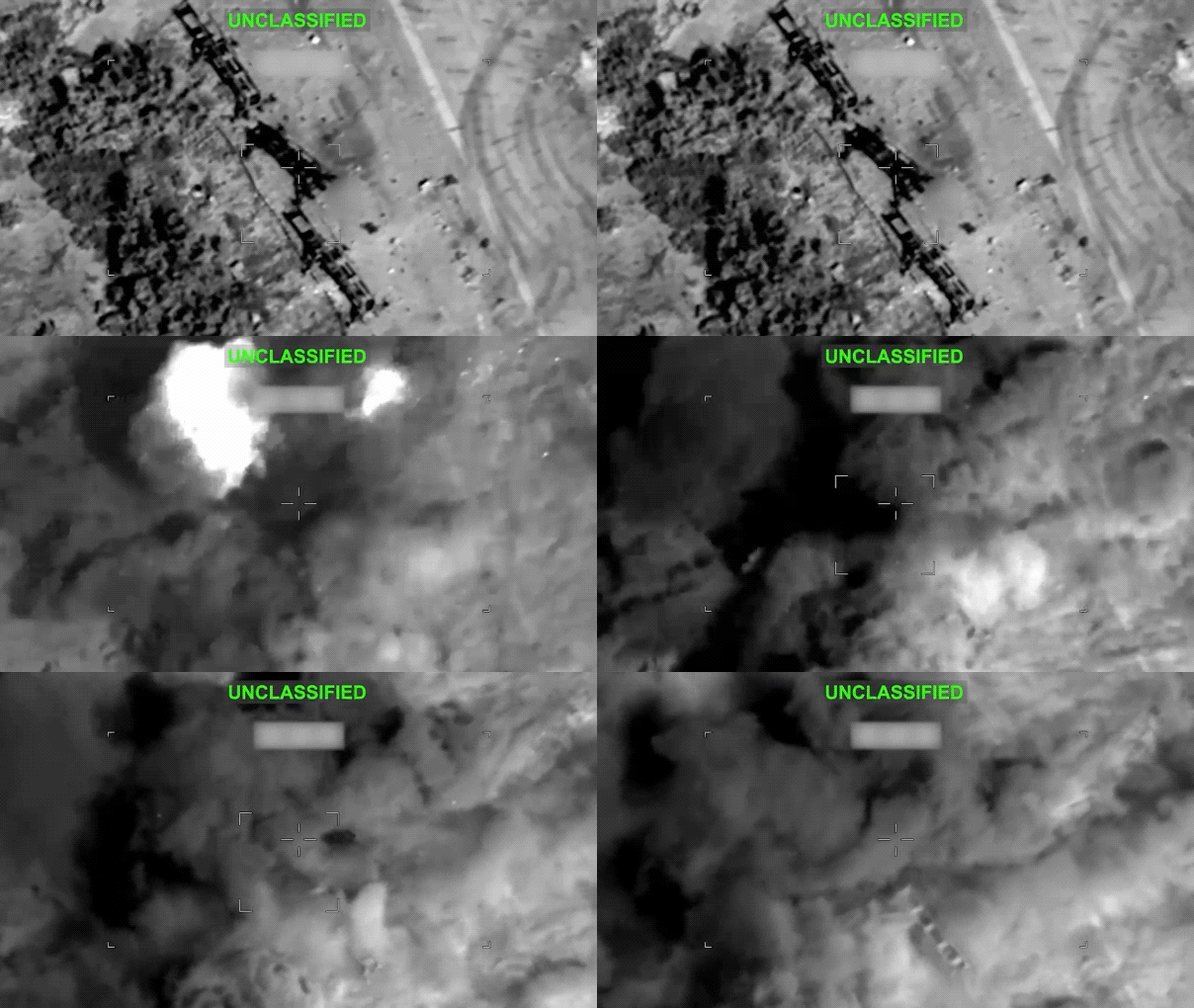
The sheer scale of the American military campaign underscores the severity of the security crisis unfolding along Iran’s coastline. Over a multi-day operation, CENTCOM forces successfully struck approximately 90 high-value Iranian military targets, including air defense systems, coastal surveillance infrastructure, naval assets, and key drone and missile storage facilities. This barrage followed an equally intense offensive the previous night, during which American forces neutralized roughly 80 military targets. Among the assets destroyed were more than 60 small boats belonging to the Islamic Revolutionary Guard Corps (IRGC). The U.S. military clarified that these heavy-handed strikes were executed to impose severe consequences on Iran for violating an active ceasefire agreement by launching hostile attacks against three commercial vessels.
The renewed hostility has shattered fragile diplomatic efforts and effectively dismantled previous peace agreements. President Donald Trump weighed in on the rapidly deteriorating situation, declaring that the U.S.-Iran Memorandum of Understanding ceasefire was officially “over.” The collapse of this diplomatic framework has plunged the region back into active conflict, placing neighboring countries on high alert as the theater of war expands. The sudden end of the ceasefire signals a dramatic shift toward a more confrontational and unpredictable U.S. foreign policy stance, leaving little room for immediate diplomatic de-escalation and raising fears of a broader, sustained military confrontation in the Gulf.
As the conflict intensifies, neighboring Gulf nations have found themselves directly in the line of fire, actively defending their sovereign airspace against incoming Iranian munitions. Both Kuwait and Bahrain reported experiencing direct aerial bombardments shortly after the U.S. strikes. The Kuwaiti Ministry of Defense announced that its armed forces successfully detected and intercepted three ballistic missiles, one cruise missile, and ten hostile drones that had violated Kuwaiti airspace. This coordinated assault highlights the expanding geographical footprint of the conflict, as local defensive systems are increasingly tested by a variety of sophisticated unmanned aerial vehicles and guided missiles.
Similarly, the Bahrain Defense Force confirmed that its native air defense network was thrust into action to confront and neutralize multiple treacherous Iranian aerial attacks. Operating at maximum combat readiness, Bahrain’s military successfully intercepted the incoming threats, preventing potential devastation on the ground. These aggressive maneuvers by Iranian forces against regional neighbors have amplified international anxiety, illustrating that the fallout from the U.S. strikes is no longer contained to a bilateral dispute. With skies over the Gulf turning into active combat zones, the international community watches with mounting concern as the threat of an all-out regional war looms larger than ever.