


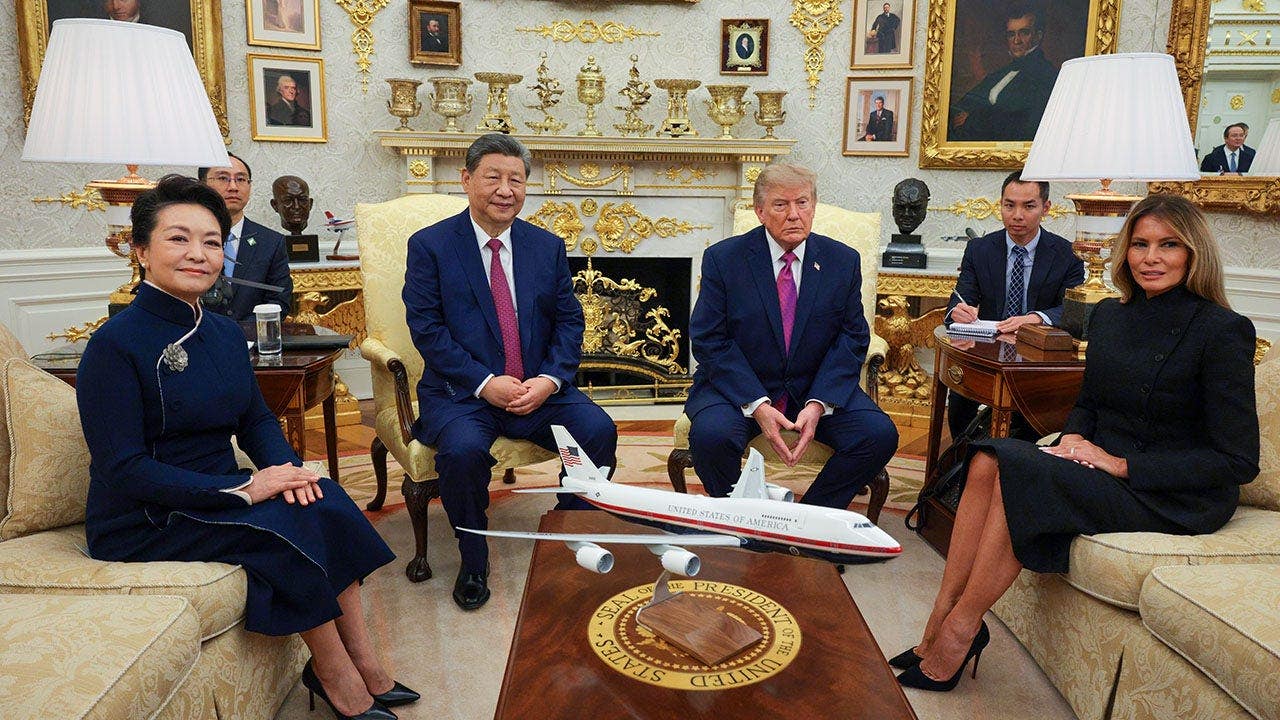
On a drizzly Saturday morning in Taipei, a roomful of scholars, retired military officers, and government officials gathered to do something that has become a familiar ritual in Taiwan: read the tea leaves of a Trump-Xi summit. The two presidents had just finished a state visit in Washington, their third face-to-face meeting since Trump returned to office, and the mood in the room was a mixture of anxiety and cautious hope. Taiwan has been here before. Every time the leaders of the United States and China sit down together, Taiwanese officials hold their breath, wondering whether the island will be treated as a bargaining chip or quietly abandoned in exchange for trade deals and geopolitical favors. At the forum hosted by the Institute for National Policy Research, the consensus was that no dramatic change in U.S. policy toward Taiwan had occurred. “Both of them got what they want and what they need,” said Kuo Yu-jen, INPR’s vice president and a professor at National Sun Yat-sen University’s Institute of China and Asia-Pacific Studies. Trump could point to economic results from his negotiations with Xi, while Xi could return to Beijing with the prestige of a high-profile American reception. Kuo dismissed as excessive speculation the idea that Trump had “sold out” Taiwan. But he and the other panelists knew that the real test would come later, when Washington starts making decisions about arms sales, official visits, and other forms of support. For now, the only certainty was uncertainty. Taiwan’s government has long relied on American support—not just weapons and intelligence, but the political signal that Washington stands with the island. Any softening in that signal, even a single word changed in a joint statement, can send shockwaves through Taipei’s stock market and political establishment. That is why the panelists spent hours parsing the summit’s public statements, looking for hidden meanings and private promises. Kuo’s assessment offered some comfort, but it was not a promise. The meeting was a transaction between two powerful leaders, he said, not a betrayal. Yet transactions have consequences, and Taiwan will have to live with them.
One of the most sensitive moments of the summit came when Xi reportedly pressed Trump to say that the United States “opposes” Taiwan independence. Washington’s long-standing position, carefully maintained by successive administrations, is that the United States does not “support” Taiwan independence. That distinction may sound like diplomatic hair-splitting, but for Taiwan it is vital. “Opposes” would put Washington on China’s side of the argument, suggesting that the United States agrees Taiwan should not be independent. “Does not support” is more neutral, leaving room for Taiwan to manage its own future. To the relief of Taiwan’s government, Trump kept the familiar wording. Speaking exclusively to Fox News Digital after the forum, Taiwan’s Deputy Foreign Minister François Wu said Beijing is after something much bigger than a change in diplomatic language. China wants the entire world to view Taiwan as a domestic Chinese issue, Wu argued. If that framing succeeds, Beijing could claim that other countries have no right to respond to its actions against the island—whether those actions are military exercises, economic pressure, or something more severe. “The so-called independence of Taiwan is just an issue made specifically by the Chinese government,” Wu said. Taiwan, he noted, already has a president and a government elected by its own people, its own territory, and its own currency. “We just don’t need to declare any independence. We are a sovereign country.” Wu had expressed similar fears before Trump’s earlier visit to China in May, telling Bloomberg that what Taiwan feared most was being put “on the menu” of a Trump-Xi conversation. The summit in Washington, he said, reinforced that anxiety. For Wu, the summit was a reminder that Taiwan cannot take its international position for granted. The United States has been Taiwan’s most important partner for decades, but it also has its own interests, and those interests sometimes conflict with Taiwan’s needs. Wu’s message was simple: Taiwan is already independent in every meaningful way, and it does not need to declare something that already exists. The challenge is convincing the rest of the world to see it that way.
China’s Foreign Ministry, for its part, claimed that Xi had urged Trump to maintain the “correct position” and oppose Taiwan independence. Taiwan’s Foreign Ministry responded quickly, issuing an objection even though the day was a public holiday in Taiwan, and repeating the island’s clear position on its sovereignty. The official White House summary of Xi’s visit, however, announced no change in Taiwan policy. Instead, it emphasized more favorable tariff treatment for roughly $30 billion in goods in each direction, a new communication channel for AI incidents, and U.S. concerns about rare earth and critical-mineral supplies. That focus on trade and technology did little to calm nerves in Taipei. If the two leaders had reached a quiet understanding about Taiwan, analysts said, it would not show up in a public readout. It would only become visible in the months ahead, through decisions on arms sales, senior official visits, and whether Taiwan’s president would be allowed to make a transit stop on U.S. soil—all things China strongly opposes. Trump’s handling of those issues will reveal how he balances his desire for a good relationship with Beijing, his administration’s long-standing support for Taiwan, and his own political priorities. Meanwhile, Taiwan security officials claimed that China had deployed more than 100 vessels near Taiwan in the wake of the summit, a reminder that Beijing’s pressure on the island did not pause for diplomatic pleasantries. The ambiguity of the summit is itself a source of anxiety. Taiwan’s officials know that ambiguity can be useful, allowing Washington to maintain flexibility. But it also means that every new policy decision is watched with suspicion, and every rumor of a back-channel deal is taken seriously. The White House’s emphasis on economics and technology suggested that Trump’s priorities lie elsewhere. He wants to show American voters that he can get a good deal from China, and he wants to avoid a confrontation that could spiral out of control. That is not necessarily bad for Taiwan, but it means Taiwan is not at the center of Trump’s thinking. The island is part of a larger chessboard, and its fate may depend on moves made far away.
To understand why Taiwan reacts so intensely to every Trump-Xi meeting, it helps to remember the long and unresolved history behind the island’s status. The argument over Taiwan is nearly 80 years old. China claims the island as part of its territory, but the People’s Republic of China has never governed Taiwan for even a single day. The Republic of China government, led by the Nationalists, relocated to Taiwan in 1949 after losing the civil war to Mao Zedong’s Communists. Since then, Taiwan has developed its own democratic system, its own economy, and its own sense of national identity. The governing Democratic Progressive Party’s 1999 Resolution on Taiwan’s Future described Taiwan as an independent sovereign state called the Republic of China under its existing constitution. Every democratically elected president of Taiwan has said something similar in interviews with international media: Lee Teng-hui told The Washington Post in 1997, Chen Shui-bian told the BBC in 2010, Ma Ying-jeou told CNN in 2010, and Tsai Ing-wen told the BBC in 2020. Current President William Lai Ching-te said the same thing to Time in 2024, adding his oft-repeated insistence that the Republic of China and the People’s Republic of China are not subordinate to each other. This status quo—Taiwan operating as a de facto independent state with its own government, military, and currency—is what Taiwan intends to defend, according to Deputy Foreign Minister Wu. Xi left Washington having restated China’s demands, but he did not appear to have changed the reality on the ground. The question is whether he managed to nudge U.S. policy in any way, and that will soon be tested in concrete decisions. The historical narrative matters because it shapes how each side views the present. For Beijing, Taiwan is a renegade province that must eventually be reunited with the mainland. For Taiwan, the island has been self-governing for decades, with its own elected leaders and its own international identity. The two sides cannot even agree on the basic facts, which makes any diplomatic solution almost impossible. That is why the status quo has lasted so long, and why it is so fragile.
At the INPR gathering, analysts offered different interpretations of what Xi and Trump were really doing. Dong Li-wen, executive director of the government-funded Foundation on Asia-Pacific Peace Studies, described the two leaders’ shared approach as delaying difficult decisions while waiting for circumstances to change. For Xi, Dong argued, that is a longer-term strategy. China can afford to wait, gradually shifting the international consensus and building its military strength. For Trump, it is a temporary tactic. He can claim progress on trade and avoid getting bogged down in a conflict over Taiwan that might derail his agenda. The two sides can keep talking and set aside issues they cannot settle, but their underlying competition remains. Dong’s framing suggests that the summit’s warmth may be deceptive. Behind the smiles and handshakes, China and the United States are still locked in a struggle over the future of the Indo-Pacific, and Taiwan is at the center of that struggle. The panel also discussed the possibility that weapons packages for Taiwan could be scaled down or “unbundled”—split into smaller pieces to avoid provoking Beijing or to make them easier to approve. A retired U.S. military officer on the panel reportedly cautioned that the strategic picture is more complicated than simply selling more weapons. Taiwan’s own defense budget, its ability to absorb new equipment, and the willingness of its soldiers to fight are all factors that Washington weighs when deciding how much support to provide. The consensus was that Taiwan should not expect a blank check. Dong’s point also applies to Taiwan’s own leaders. They, too, are waiting and watching, trying to read the shifting winds in Washington and Beijing. They know that the status quo is not guaranteed to last, but they also know that any move to change it—whether by declaring independence or by seeking formal U.S. recognition—could trigger a crisis. So they continue to do what Taiwan has done for decades: maintain a de facto independent state, seek friends abroad, and hope that the great powers do not decide to settle their differences at Taiwan’s expense.
Ross Darrell Feingold, a political analyst and assistant professor at Tamkang University’s Department of Diplomacy and International Relations, added another layer of complexity: Taiwan’s domestic politics. With a local election scheduled for November, followed by presidential and legislative elections in January 2028, Taiwan’s own political calendar will shape how Washington handles sensitive decisions. “Although the U.S. is likely to back President Lai’s re-election; agreeing to arms sales, visits by Trump administration officials or Lai’s desired transit stop in the U.S. will need to be balanced against coming across as too blatantly interfering in Taiwan’s election, as well as the inevitable anger from China,” Feingold said. In other words, the United States may want to support Lai, but it also does not want to hand Beijing a propaganda victory by appearing to dictate Taiwan’s political future. Every arms sale, every official visit, every symbolic gesture will be calculated with an eye toward both Beijing’s reaction and the voters in Taiwan. Feingold’s warning is particularly relevant because Taiwan’s elections are always a delicate moment in cross-strait relations. Beijing tends to increase its pressure during campaign seasons, hoping to influence voters or to punish candidates it dislikes. Washington, meanwhile, must decide how visible its support should be without making Taiwan a partisan issue. The result is a complex dance in which every gesture is scrutinized by multiple audiences. For ordinary Taiwanese, the summit’s aftermath is a reminder of how fragile their position can be. They live on an island that has built a thriving democracy in the shadow of a powerful neighbor that refuses to recognize its existence. They have learned to read between the lines of diplomatic statements, to watch for subtle changes in wording, and to hope that the United States will remain a reliable partner. The Trump-Xi meeting may not have changed anything immediately, but it also did not resolve anything. The same tensions remain, the same threats persist, and the same questions hang over Taiwan’s future. As one participant in the forum put it, Taiwan can only continue to defend its status quo while preparing for the possibility that the status quo may not last forever.